
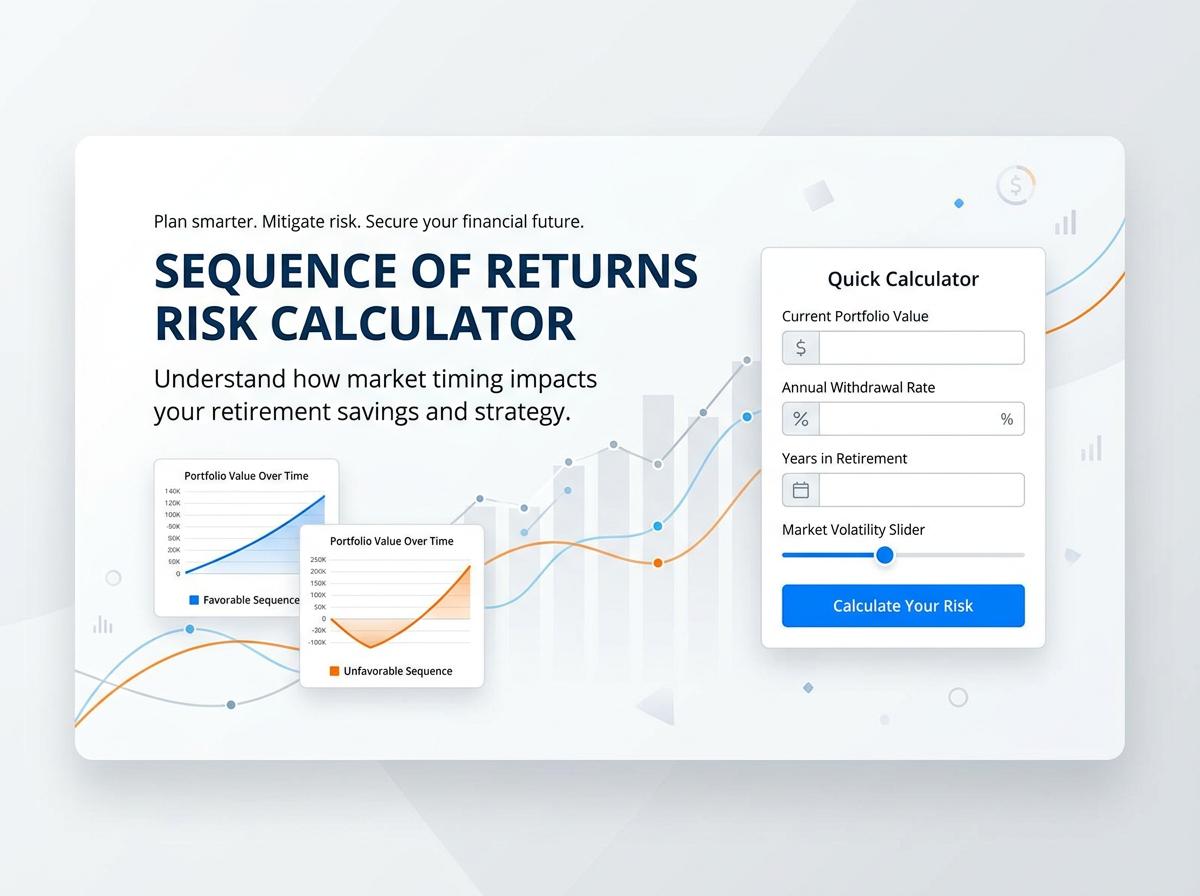

Protect your retirement savings with our Sequence of Returns Risk Calculator. Simulate various market scenarios and withdrawal rates to analyze how the order of investment returns impacts your portfolio's longevity. Stress-test your financial strategy today to ensure your money lasts.
Sequence of Returns Risk Calculator
What is sequence of returns risk
Sequence of returns risk, or sequence risk, is the danger that negative market returns combined with ongoing portfolio withdrawals will deplete your retirement savings faster than anticipated. When the stock market experiences a downturn, the overall value of your portfolio drops. If you withdraw funds during this period, you are forced to sell a larger number of shares to meet your income needs.
Because these shares are sold at lower prices, fewer shares remain in your account to benefit from eventual market recoveries. This compounding effect drastically shortens the lifespan of your portfolio, even if the long-term average returns of the market remain positive. Ultimately, the timing of market downturns matters just as much as the actual returns.
Why are poor market returns most dangerous early in retirement
Poor market returns are most dangerous early in retirement because of the compounded impact of drawing down a shrinking portfolio base. If a steep market decline happens in your first few years of retirement, a rapid chain reaction occurs:
- Your portfolio balance drops due to market losses.
- You must sell shares at depressed prices to generate required income.
- Significantly fewer shares remain in your account.
- When the market inevitably rebounds, your smaller asset base generates much less growth.
If poor returns happen late in retirement, they are far less dangerous because your portfolio has already benefited from decades of compounding growth, and your remaining investment time horizon is substantially shorter.
How does sequence risk differ from average annual returns
While average annual returns measure the overall performance of an investment over time, sequence risk evaluates the specific order in which those returns occur. If you aren't withdrawing money, the sequence doesn't matter—only the average return dictates your final balance. However, once you start taking withdrawals, the timing becomes critical.
| Concept | Primary Focus | Impact on Retirees |
|---|---|---|
| Average Returns | Overall long-term growth rate | Ignores the timing of cash flows and withdrawals. |
| Sequence Risk | Chronological order of returns | Early losses permanently shrink the invested asset base. |
Two retirees can experience the exact same 7% average annual return over 20 years, but if Retiree A experiences negative returns first while taking withdrawals, they may run out of money.
What is the retirement danger zone for sequence risk
The "retirement danger zone," frequently referred to as the "fragile decade," is the specific period when an investor's portfolio is most vulnerable to sequence risk. Generally, this critical window includes:
- 5 to 10 years before retirement: A severe market crash right before retiring heavily reduces the total capital available to generate future income.
- 5 to 10 years after retirement: Taking required withdrawals during early retirement market declines permanently removes shares that could have participated in future market rallies.
During this 10-to-20-year window, your portfolio is usually at its absolute peak value, making percentage-based losses devastating in absolute dollar terms. Once you survive this danger zone, the threat of sequence risk diminishes.
How do regular portfolio withdrawals amplify market losses
Regular portfolio withdrawals amplify market losses by forcing retirees to sell a disproportionately high number of shares to generate a fixed dollar amount. This phenomenon is highly destructive to long-term wealth.
Imagine you need $5,000 a month to live. If your investment shares are priced at $100, you only need to sell 50 shares. However, if a market crash drops the share price to $50, you must now sell 100 shares to get the same $5,000. By liquidating twice as many shares during a downturn, you permanently lock in those losses. Because those shares are gone forever, your portfolio has a much smaller asset base to generate future growth when the market eventually recovers.
Does sequence risk matter during the wealth accumulation phase
During the wealth accumulation phase—when you are consistently contributing money to your portfolio and not taking withdrawals—sequence risk generally does not matter. In fact, experiencing negative returns early in your savings journey is highly beneficial.
When the stock market drops while you are actively accumulating wealth, your ongoing payroll contributions buy more shares at much lower prices. Because your investment time horizon is long and you are not liquidating assets for income, your portfolio has ample time to recover. The order of returns only starts to pose a significant threat as you approach retirement and prepare to transition into the distribution phase.
What is reverse dollar-cost averaging
Reverse dollar-cost averaging is the mathematical effect of taking fixed dollar withdrawals from a fluctuating investment portfolio. While traditional dollar-cost averaging helps investors build wealth by buying more shares when prices are low, reverse dollar-cost averaging does the exact opposite.
- During a Bull Market: When share prices are high, you sell fewer shares to meet your fixed income needs.
- During a Bear Market: When share prices fall, you are forced to liquidate a significantly larger number of shares to generate the exact same amount of cash.
This dynamic rapidly accelerates the depletion of your investment base. By continually siphoning off more shares at depressed prices, you cripple your portfolio’s ability to compound and recover.
How can a cash bucket strategy mitigate sequence risk
A cash bucket strategy mitigates sequence risk by segmenting retirement assets into different "buckets" based on time horizons, allowing retirees to avoid selling volatile investments during market crashes.
- Bucket 1 (Short-term): Holds 1 to 3 years of living expenses in ultra-safe, liquid assets like cash, high-yield savings, or short-term certificates of deposit (CDs).
- Bucket 2 (Medium-term): Holds stable, fixed-income investments like bonds to cover years 4 through 10 of retirement.
- Bucket 3 (Long-term): Holds growth-oriented assets like equities to outpace inflation.
If the stock market crashes early in retirement, you can draw income exclusively from the cash bucket. This gives the equity portion (Bucket 3) the necessary time to recover.
Why do flexible withdrawal rates help protect a portfolio
Flexible withdrawal rates protect a portfolio by dynamically adapting to current market conditions rather than relying on a rigid, fixed withdrawal amount. By reducing the amount of money you take out during a market downturn, you instantly decrease the number of shares you are forced to sell at depressed prices.
Planners implement this flexibility in several ways, such as skipping annual inflation adjustments following a negative market year, using "guardrails" that adjust your withdrawal percentage up or down based on portfolio performance, or relying strictly on generated dividends during bear markets. This flexibility preserves your underlying asset base, ensuring more capital remains invested to capture the eventual market recovery.
Can adjusting asset allocation reduce sequence of returns risk
Yes, dynamically adjusting your asset allocation is a primary defense against sequence of returns risk. Because the risk is highest right around your retirement date, planners use allocation strategies to lower volatility during this danger zone.
- Equity Glide Paths: Gradually reducing stock exposure and increasing bonds as retirement approaches strictly limits the impact of a sudden pre-retirement market crash.
- The Bond Tent: This strategy builds up a large "tent" of safe, fixed-income assets right at the point of retirement. Once retired, you spend down the bonds first. This naturally allows your equity allocation to drift back up over time, protecting against early sequence risk while maintaining long-term growth.
Reducing portfolio volatility when you first start taking withdrawals drastically shrinks sequence risk.
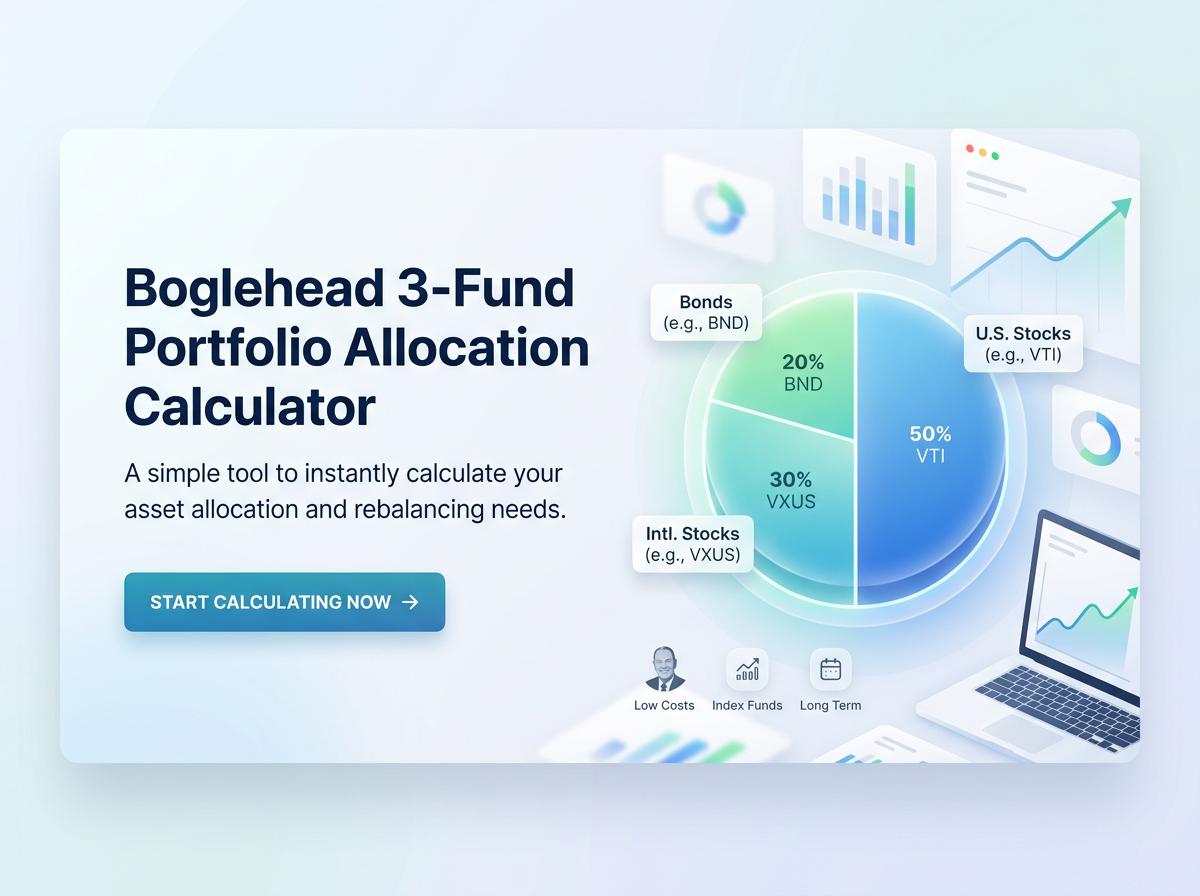 Boglehead 3-Fund Portfolio Allocation Calculator