
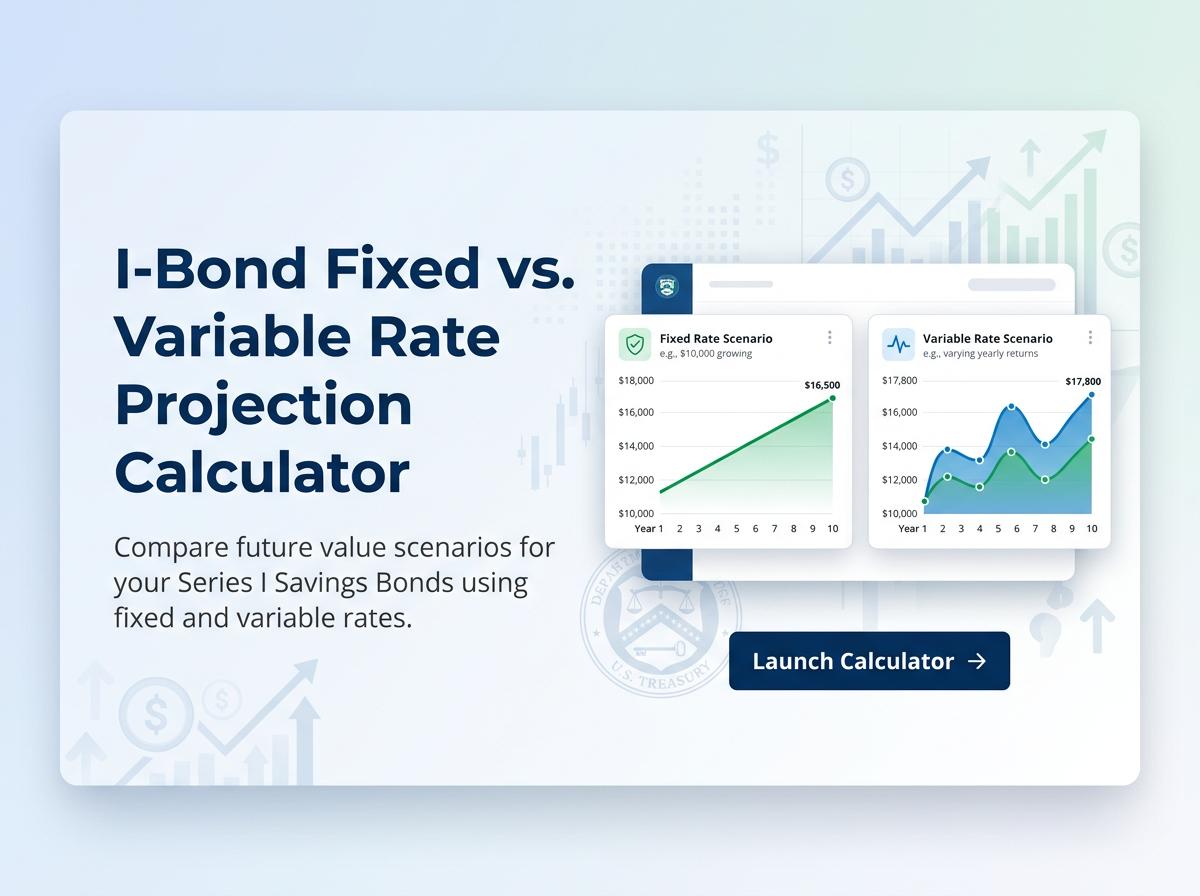

Maximize your Series I Bond returns with our Fixed vs. Variable Rate Projection Calculator. Easily forecast future earnings, compare fixed base rates against inflation-adjusted variable rates, and make informed investment decisions today.
I-Bond Projection Calculator
How is the I-Bond fixed rate determined?
The fixed rate of a Series I Savings Bond is determined by the Secretary of the Treasury. It is set based on prevailing market conditions, particularly tied to the real yields of Treasury Inflation-Protected Securities (TIPS) and other macroeconomic factors. The Treasury Department evaluates these conditions and announces a newly determined fixed rate twice a year.
How long does the fixed rate remain active on a bond?
The fixed rate remains active and completely unchanged for the entire life of the I-Bond. Once you purchase an I-Bond, the specific fixed rate assigned to it at the time of issuance is permanently locked in for up to 30 years (the 20-year original maturity period plus a 10-year extended maturity period), or until you decide to cash the bond.
How often does the variable inflation rate change?
The variable inflation rate changes every six months from the bond's issue date. While the Treasury announces new rates twice a year, the exact timing of when your specific bond's rate updates depends on the month you bought it. For example, if you buy a bond in January, its inflation rate will update in July and then again the following January.
What economic index determines the variable rate?
The variable inflation rate is determined by the Consumer Price Index for All Urban Consumers (CPI-U). This index is calculated and published monthly by the Bureau of Labor Statistics (BLS). It measures the average change over time in the prices paid by urban consumers for a market basket of consumer goods and services, including:
- Food and beverages
- Housing
- Apparel
- Transportation
- Medical care
How do the fixed and variable rates combine into the composite rate?
The Treasury uses a specific formula to combine the fixed rate and the semiannual inflation rate into a single, annualized composite yield. The formula is:
Composite Rate = Fixed Rate + (2 × Semiannual Inflation Rate) + (Fixed Rate × Semiannual Inflation Rate)
Because the inflation rate is mathematically applied to the fixed rate in the final part of the equation, the final composite yield is slightly higher than simply adding the two primary rates together.
In which two months are new I-Bond rates officially announced?
New I-Bond rates are officially announced by the U.S. Department of the Treasury twice a year. The rate announcements occur on the first day of the following two months:
| Announcement Date | Applicable Purchase/Issue Dates |
|---|---|
| May 1 | May 1 through October 31 |
| November 1 | November 1 through April 30 |
How can investors project upcoming variable rate changes?
Investors can accurately project upcoming variable rate changes by tracking the monthly CPI-U data released by the Bureau of Labor Statistics before the official Treasury announcements. The Treasury calculates the semiannual inflation rate by comparing the CPI-U from two specific periods:
- For the May 1 rate: Compare the September CPI-U from the previous year to the March CPI-U of the current year.
- For the November 1 rate: Compare the March CPI-U to the September CPI-U of the current year.
By calculating the exact percentage change between these index numbers, investors can predict the new variable rate weeks before the official announcement.
Why is a higher fixed rate generally better for long-term holding?
A higher fixed rate is highly advantageous for long-term holding because it dictates the guaranteed "real yield" of the bond above inflation. Since the fixed rate never changes for the 30-year life of the I-Bond, locking in a high fixed rate ensures your purchasing power actively grows over time, regardless of varying economic conditions.
If you buy an I-Bond with a 0% fixed rate, your return will strictly match inflation. A higher fixed rate continuously compounds your wealth beyond simple capital preservation.
Can the variable inflation rate drop below zero during deflation?
Yes, the variable inflation rate can drop below zero. If the economy experiences a period of deflation—meaning the Consumer Price Index (CPI-U) decreases during the six-month measurement period—the semiannual inflation rate calculated by the Treasury will be a negative percentage.
Will a negative variable rate ever reduce the underlying fixed rate?
No, a negative variable rate will never reduce the underlying fixed rate, nor will it ever reduce the principal value of your savings bond. The fixed base rate remains permanent and untouched.
During periods of deflation, a negative variable inflation rate can mathematically drag down the composite rate, potentially offsetting your fixed rate returns. However, the Treasury enforces a strict floor: the combined composite rate can never drop below 0.00%. Your I-Bond will never lose its accumulated monetary value due to negative inflation.
 Mutual Fund Front-End Load Impact Calculator