
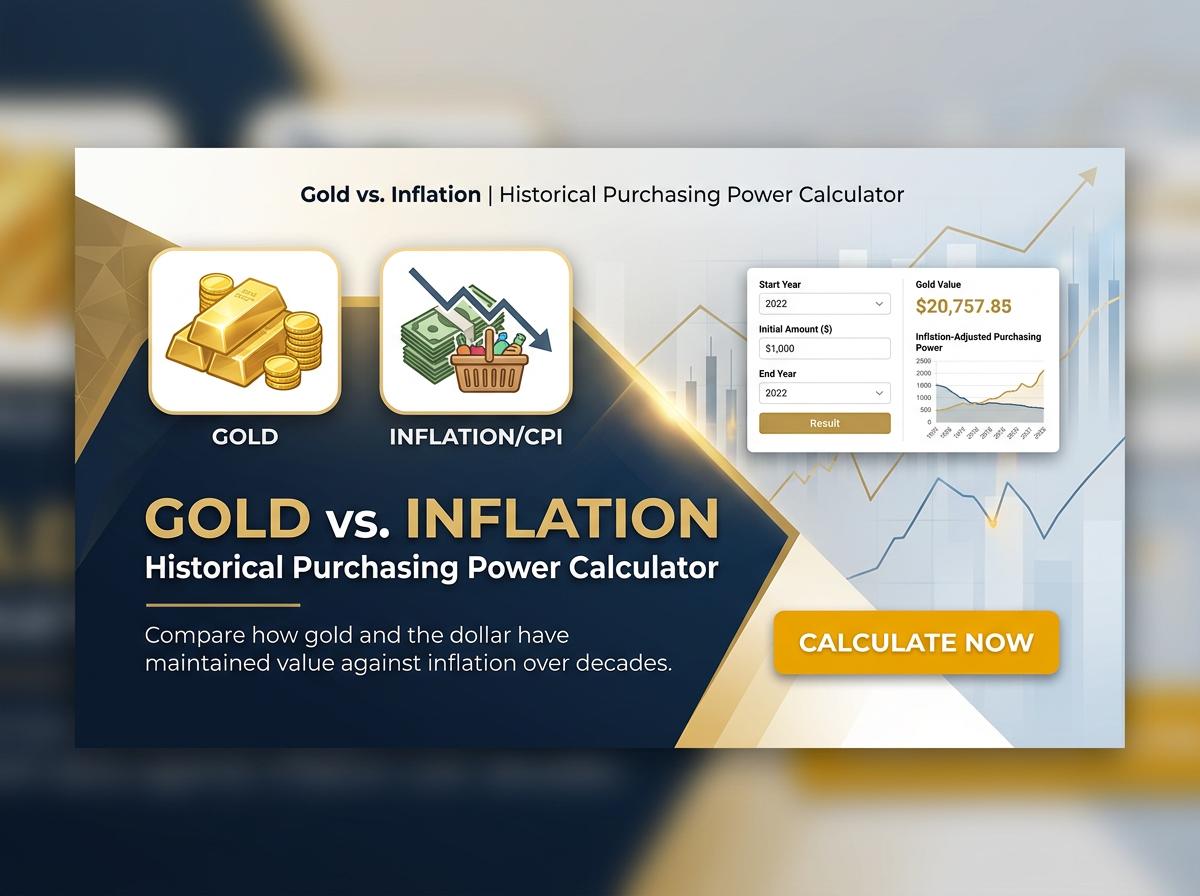

Track gold's true value over time with our Gold vs. Inflation Historical Purchasing Power Calculator. Compare historical gold prices against inflation rates to analyze real returns, currency depreciation, and long-term wealth preservation. Enter your dates and amounts to see how effectively gold protects your buying power. Try the free calculator today!
Gold vs. Inflation Calculator
Results ()
Initial Amount:
Value if held in Gold:
Purchasing Power of Cash:
How exactly does gold preserve purchasing power over long historical periods?
Gold preserves purchasing power primarily through its extreme scarcity and tangible nature. Unlike fiat currencies, which central banks can print in unlimited quantities, gold has a finite physical supply constrained by the cost and difficulty of mining. This intrinsic limitation prevents the rapid dilution of its supply over time.
Historically, gold has held a universally recognized value, acting as a reliable store of wealth across different centuries and civilizations. When inflation continuously erodes the purchasing power of paper money, the nominal price of gold typically rises to reflect this monetary devaluation. Because it cannot be artificially created or destroyed, it maintains its real purchasing power for buying goods and services across generations.
What happened to gold prices during the high inflation of the 1970s?
During the 1970s, gold experienced a massive bull market, serving as an exceptional inflation hedge amidst double-digit inflation, oil crises, and economic stagnation (stagflation).
| Year | Event / Inflation Context | Approx. Gold Price |
|---|---|---|
| 1971 | Nixon ends the gold standard | $35/oz |
| 1974 | Post-first oil crisis | $195/oz |
| 1980 | Peak inflation (~14.8%) | $850/oz |
This represents a roughly 2,300% nominal return over the decade. Gold vastly outperformed the high inflation rates of the era, cementing its modern reputation as a safe haven during periods of extreme price instability.
Has gold ever failed to act as a reliable hedge against inflation?
Yes, gold has periodically failed as a short-to-medium-term inflation hedge. The most notable failure occurred between 1980 and 2000. After peaking in 1980, gold entered a grueling two-decade bear market.
- Inflation continued to rise cumulatively (though at a slower, more controlled rate than the 1970s).
- The nominal price of gold dropped from $850 in 1980 to around $250 by 1999.
Consequently, the real (inflation-adjusted) purchasing power of gold fell dramatically during this era. Gold severely underperformed as an inflation hedge because robust stock market returns (the dot-com boom) and high real interest rates drew capital away from precious metals.
How does the historical purchasing power of gold compare to fiat currencies?
Over the long term, gold has significantly outperformed all fiat currencies in maintaining purchasing power. Since the creation of the Federal Reserve in 1913, the US Dollar has lost over 96% of its purchasing power due to cumulative inflation. Conversely, gold's nominal value has increased to offset this devaluation.
- Fiat Currencies: Designed to have mild, continuous inflation (typically targeting 2%), which guarantees a mathematical loss of purchasing power over time.
- Gold: Maintains a highly stable purchasing power over centuries, automatically adapting to the inflation of the fiat currency it is priced against.
While fiat currencies inevitably trend toward zero intrinsic value historically, physical gold has successfully retained its economic energy.
What is the historical correlation between gold prices and the Consumer Price Index?
The historical correlation between gold prices and the Consumer Price Index (CPI) is complex and depends entirely on the timeframe.
Over a timeline of a century or more, the correlation is strongly positive; as the CPI rises, gold prices eventually rise commensurately to catch up. However, in the short to medium term (1 to 10 years), the correlation is surprisingly weak. Factors like geopolitical tensions, speculative trading, stock market performance, and central bank policies can drive gold prices completely independently of the CPI. Therefore, while gold reliably tracks the CPI over multiple decades, it is an inconsistent tracker of annual CPI fluctuations.
How did the abandonment of the gold standard affect gold's inflation-adjusted value?
The abandonment of the gold standard in 1971 (the "Nixon Shock") drastically changed gold's behavior. Under the standard, gold was pegged at a fixed price ($35 per ounce), meaning its nominal value couldn't rise to offset inflation, effectively suppressing its real purchasing power.
Once unpegged, gold became a free-floating commodity. Its inflation-adjusted value experienced a paradigm shift:
- Immediate Aftermath: Prices surged violently in the 1970s, rapidly overcompensating for decades of suppressed, fixed-price value.
- Long-Term Effect: It allowed gold to trade based on free-market demand, monetary expansion, and inflation fears, transforming it into a volatile but accurate long-term barometer for fiat depreciation.
Does the classic analogy that an ounce of gold buys a fine men's suit hold up historically?
Yes, the "gold-to-decent-suit" analogy is a famous historical benchmark that generally holds true. The concept illustrates gold's long-term purchasing power stability across wildly different eras:
- Ancient Rome: One ounce of gold bought a high-quality, customized toga and accessories.
- 1920s: At roughly $20 per ounce, it bought a premium tailored men's suit.
- Today: At over $2,000 per ounce, it still easily purchases a bespoke, high-end men's suit.
While the precise equivalent fluctuates depending on fashion manufacturing costs and brief periods of gold volatility, the core premise remains remarkably accurate over thousands of years.
How do real interest rates influence gold's ability to maintain purchasing power?
Real interest rates—calculated as the nominal interest rate minus the inflation rate—are a primary driver of gold prices. Because physical gold yields no dividends or interest, it carries an "opportunity cost" for investors.
- Negative Real Rates: When inflation is higher than interest rates, cash in the bank loses purchasing power. The opportunity cost of holding gold disappears. Investors flock to gold, driving its price and purchasing power up.
- Positive Real Rates: When interest rates outpace inflation, risk-free cash yields a real return. Investors sell gold to buy yielding assets like bonds, causing gold prices to stagnate or fall, temporarily hurting its purchasing power.
How does gold perform during periods of hyperinflation versus moderate inflation?
Gold performs exceptionally well during hyperinflation but yields highly mixed results during moderate inflation.
- Hyperinflation: When a currency collapses (e.g., Weimar Germany, modern Zimbabwe, or Venezuela), fiat money becomes worthless rapidly. Gold acts as a financial lifeboat, maintaining near-perfect purchasing power because it holds universally recognized, intrinsic value outside the failing government system.
- Moderate Inflation: In environments with 2% to 4% inflation, gold's performance is erratic. Central banks can often manage these economies with interest rate adjustments. During these periods, gold frequently underperforms stocks or real estate, as investors prefer assets that generate compounding cash flow.
Is gold better at hedging against short-term inflation spikes or long-term currency devaluation?
Gold is vastly superior at hedging against long-term currency devaluation than it is at hedging against short-term inflation spikes.
In the short term (months to a few years), gold prices are highly volatile. They are driven by immediate market psychology, interest rate expectations, and the strength of the US dollar. During sudden inflation spikes, gold has frequently dropped if central banks aggressively hike interest rates in response.
However, over decades or centuries, short-term volatility cancels out. Gold's track record of tracking the relentless, long-term expansion of the money supply and the subsequent devaluation of fiat currency is practically unmatched.
Sources:
 Margin Call Trigger Price Calculator