
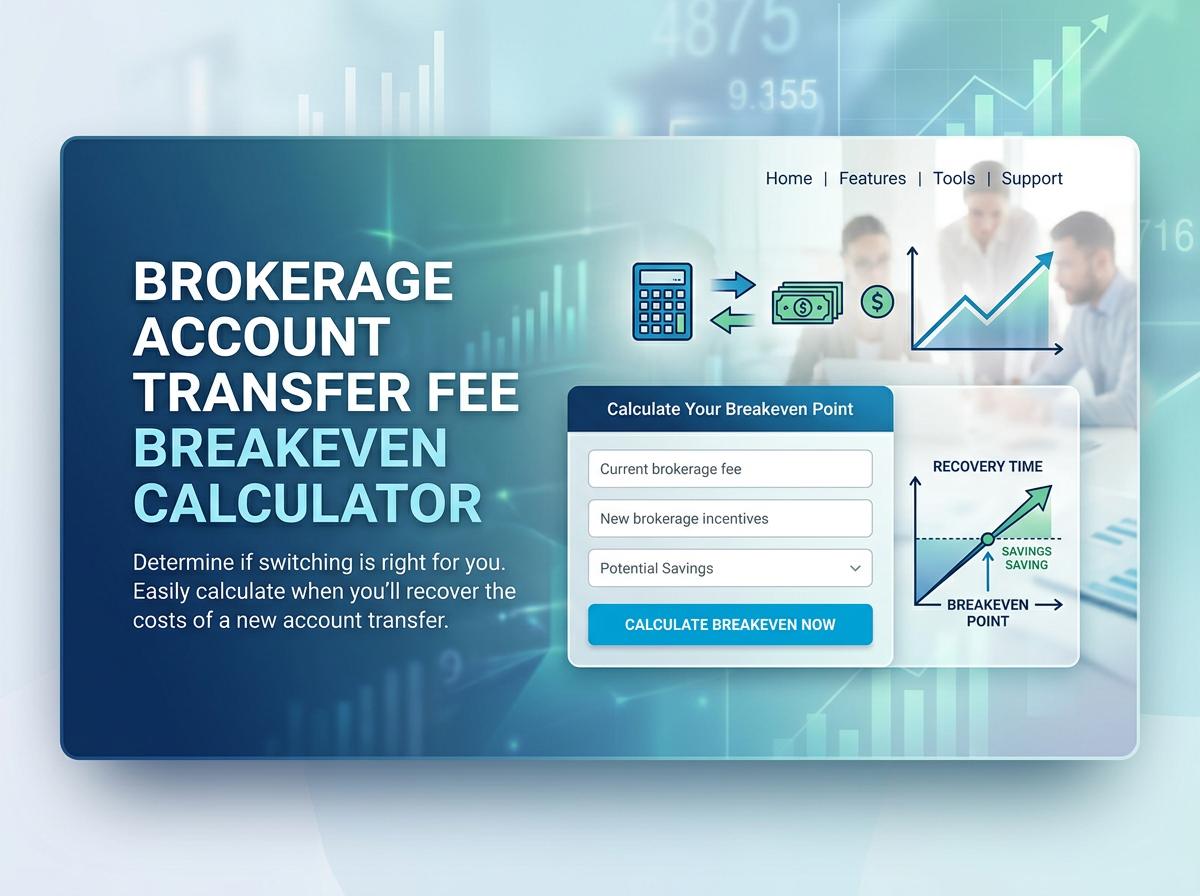

Thinking of switching brokers? Use our free Brokerage Account Transfer Fee Breakeven Calculator to discover if moving your investments makes financial sense. Instantly compare ACAT exit fees against sign-up bonuses, lower commission rates, and potential portfolio yields to find your exact breakeven point. Make smarter, data-driven investing decisions and maximize your returns today.
Account Transfer Breakeven
What is the exact outgoing transfer fee charged by your current brokerage?
The outgoing transfer fee, commonly known as an ACATS (Automated Customer Account Transfer Service) fee, varies widely depending on your current brokerage. Typically, you can expect to pay between $50 and $100 for a full account transfer.
| Brokerage Example | Typical Full Transfer Fee |
|---|---|
| Robinhood / SoFi | $100 |
| Webull | $75 |
| Charles Schwab / Fidelity | $50 |
You must check your specific broker's official fee schedule, usually located in their legal disclosures or pricing pages, to find the exact outgoing fee charged to your account.
Will the receiving brokerage reimburse this outbound transfer fee?
Yes, in many cases, the receiving brokerage will reimburse the outbound transfer fee, as it serves as a strong incentive to attract new customers. However, this is not a universal policy and usually comes with specific procedures.
- Automatic Reimbursement: Some modern brokers automatically credit your account when their system detects an ACATS fee.
- Manual Request: Others require you to submit proof of the fee, such as a recent PDF statement from your old broker highlighting the transfer charge.
- Confirmation: Always contact the receiving broker's customer support prior to initiating the transfer to confirm their current reimbursement policies and required documentation.
What is the minimum account balance required to qualify for fee reimbursement?
Receiving brokerages typically require a minimum transfer value to qualify for ACATS fee reimbursement. This policy ensures the broker acquires enough new assets to justify absorbing your transfer cost.
- Low-Tier Minimums: App-based and aggressive growth brokers may require as little as $500 to $2,000 to cover the fee.
- Mid-Tier Minimums: Standard discount brokerages frequently set the minimum reimbursement requirement at $2,500 or $3,000.
- High-Tier Minimums: Certain premium brokerages or exclusive promotional offers might require account balances of $10,000 or more to be eligible for full fee reimbursement.
Always verify the exact minimum balance threshold with your new brokerage before transferring.
Does the new brokerage offer a promotional cash bonus that offsets the transfer cost?
Many brokerages offer promotional cash bonuses for new customers funding their accounts, which can effectively offset or completely eclipse your outbound transfer costs. These promotions generally operate on a tiered structure—the more assets you transfer, the larger the cash bonus you receive.
For example, transferring $10,000 might yield a $100 bonus, while $100,000 could earn you $500 or more. Some platforms even offer a percentage match (e.g., 1%) on transferred assets. Even if your new broker doesn't officially reimburse the ACATS fee, a lucrative sign-up bonus can make the transfer highly profitable. Be sure to read the fine print, as these bonuses typically require you to maintain the transferred funds in the account for a specific holding period, often 90 days to a year.
How much money will you save on trading commissions or maintenance fees at the new broker?
Calculating your potential savings depends heavily on your specific trading habits and the fee structures of both brokerages. To estimate your savings, review your past 12 months of statements and calculate your expenditures on:
- Trading Commissions: Options contracts (e.g., saving $0.65 per contract), OTC stocks, or mutual fund transaction fees.
- Maintenance Fees: Monthly or annual account fees, inactivity penalties, or paper statement charges.
- Margin Interest: The difference in lending rates if you trade on margin.
For example, if you execute 50 options contracts a month and switch to a broker with zero-commission options, you save $32.50 monthly. Combine this with the elimination of annual maintenance fees to project your total yearly savings.
How many months of these fee savings will it take to reach the breakeven point?
To determine your breakeven point, you simply divide your total un-reimbursed transfer cost by your projected monthly fee savings.
Breakeven Formula:
Months to Breakeven = Total Transfer Fee ÷ Monthly Savings
For instance, if your current broker charges a $75 transfer fee, the new broker does not reimburse it, and you save $15 a month in options commissions and account fees at the new broker:
- Calculation: $75 ÷ $15 = 5 Months
In this scenario, it will take exactly 5 months to break even. After the fifth month, the switch becomes purely profitable. If your fee is fully reimbursed or covered by a sign-up bonus, your breakeven point is immediate.
Does the new broker offer higher yields on uninvested cash to help speed up the breakeven?
Yes, the yield on uninvested cash is a crucial factor that can significantly accelerate your breakeven point. Many modern brokerages automatically sweep idle cash into high-yield partner banks or money market funds, offering APYs of 4% to 5% or more. In stark contrast, some legacy brokerages pay a negligible 0.01% to 0.45% on uninvested cash.
If you regularly hold $10,000 in cash waiting for investment opportunities, moving from a 0.01% yield to a 4.5% yield generates an additional $449 in interest annually (about $37.41 per month). This extra passive income can easily cover a typical $75 transfer fee in just two months, making cash sweep features incredibly powerful for offsetting costs.
Is the fee lower if you do a partial account transfer instead of a full transfer?
Yes, executing a partial account transfer is frequently cheaper than a full account transfer, and depending on the brokerage, it may even be completely free.
While most brokers charge a flat fee (usually $50 to $100) to transfer out and close your entire account, a partial transfer—where you move specific stocks or a set cash amount while leaving the original account open—often incurs a reduced fee, such as $25 to $50. Some major brokerages waive partial transfer fees entirely to encourage asset movement without triggering an account closure. If your goal is to switch brokers without a hefty full-transfer fee, leaving a small amount of cash behind to initiate a partial transfer can be an excellent workaround.
Will liquidating assets instead of transferring in-kind trigger taxes that alter the breakeven math?
Absolutely. If you choose to liquidate (sell) your assets and transfer cash instead of performing an "in-kind" transfer (moving the actual shares), you will trigger taxable events in a standard, taxable brokerage account.
Selling assets at a profit incurs capital gains taxes. Depending on your income tax bracket and how long you held the assets, short-term or long-term capital gains taxes can cost hundreds or thousands of dollars, completely obliterating any mathematical advantage of switching brokers to save on minor fees.
To avoid this, you should almost always use the ACATS system to transfer assets in-kind. Note that liquidating assets within a tax-advantaged account like an IRA does not trigger capital gains taxes, provided the funds remain within the IRA wrapper.
Are there additional account closure fees on top of the standard automated transfer fee?
While the ACATS fee typically covers the cost of transferring assets, you may encounter additional hidden fees when completely closing out your old account. Potential extra charges include:
- IRA Termination Fees: If you are transferring a retirement account, many brokers charge a separate IRA closure or termination fee (often $25 to $50) for specialized tax reporting.
- Paper Check Fees: If residual dividends arrive after the transfer and are paid out as a physical check rather than swept electronically, you might face a processing fee.
- Proprietary Fund Liquidation: Mutual funds proprietary to your old broker cannot transfer in-kind. You may face transaction fees to liquidate them prior to the transfer.
 Direct Indexing Tax Alpha Calculator