
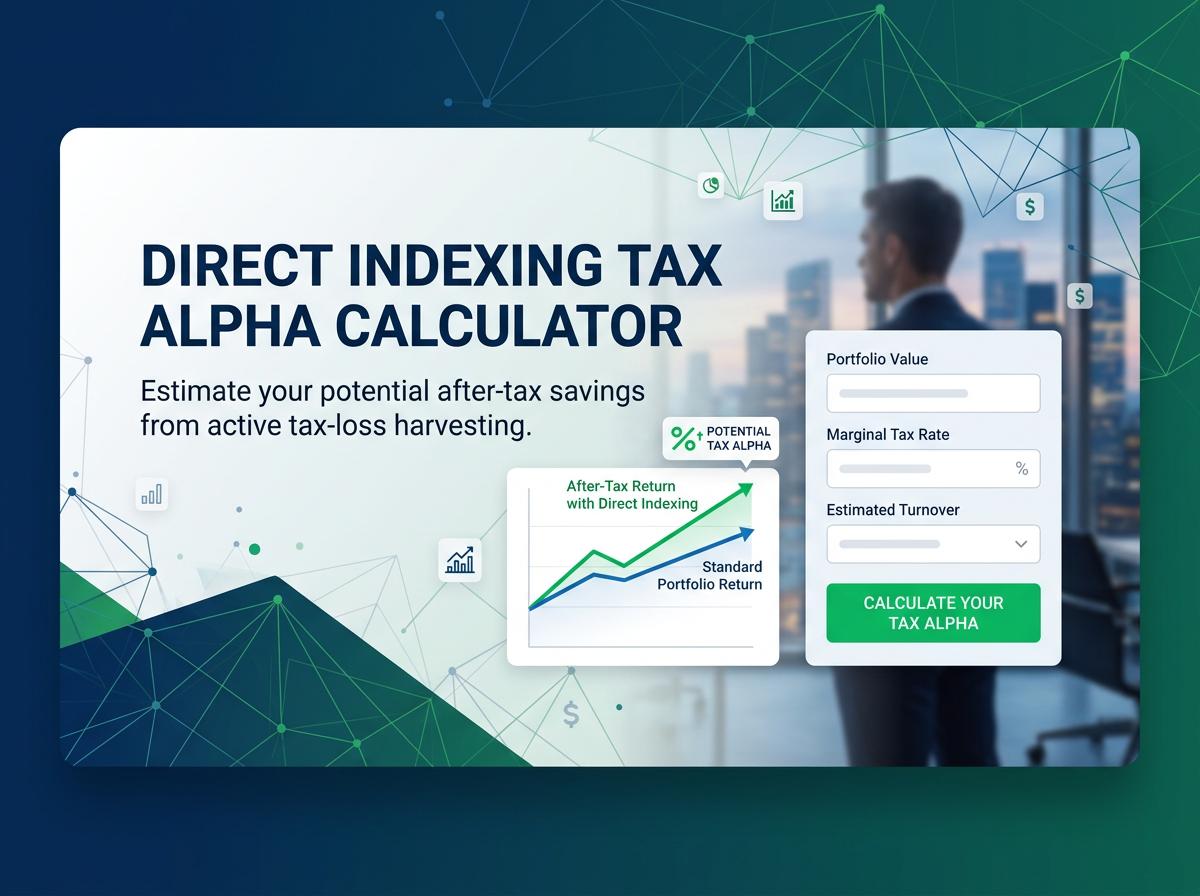

Maximize your after-tax returns with our Direct Indexing Tax Alpha Calculator. Estimate potential tax savings and excess returns generated through automated tax-loss harvesting today.
Direct Indexing Tax Alpha Calculator
What exactly is direct indexing tax alpha?
Direct indexing tax alpha is the additional after-tax return an investor earns by holding the individual stocks of an index rather than a pooled vehicle like an ETF or mutual fund. By owning the underlying securities directly, investors can selectively sell individual stocks that have declined in value to harvest tax losses, even if the overall index is up.
This process generates "alpha" (excess return) not through better stock selection, but through superior tax efficiency. These harvested losses can be used to offset capital gains elsewhere, thereby lowering the investor's tax bill and increasing their total net wealth over time.
How does continuous tax-loss harvesting generate this alpha?
Continuous tax-loss harvesting generates alpha through a systematic, automated process of realizing capital losses:
- Scanning: Algorithms continuously monitor the portfolio (often daily) for individual stocks that have dropped below their purchase price.
- Selling: These losing stocks are sold to "realize" the tax loss.
- Replacing: The sold stock is immediately replaced with a highly correlated substitute to maintain the portfolio's target allocation and market exposure.
- Offsetting: The realized losses are used to offset capital gains and up to $3,000 of ordinary income annually.
By harvesting continuously rather than just at year-end, the strategy captures intra-year dips and heightened volatility, maximizing the amount of usable losses.
Which tax brackets and investor types benefit the most?
Direct indexing tax alpha is most beneficial for specific investor profiles:
- High-Net-Worth Individuals: Investors in the highest federal and state marginal tax brackets (e.g., residents of California or New York) see the largest mathematical benefit from tax deductions.
- Investors with Outside Gains: Those who regularly generate large capital gains from other sources, such as selling real estate, private business equity, or highly appreciated company stock, benefit immensely from having losses to offset those gains.
- New Cash Investors: Tax-loss harvesting works best with newly funded cash accounts, as a higher cost basis provides more immediate harvesting opportunities compared to legacy assets.
Do the generated tax savings consistently outweigh the management fees?
Generally, yes, but it is highly dependent on market conditions and the investor's tax situation. Historically, direct indexing can generate an estimated 1.00% to 2.00% in annual tax alpha. Given that typical direct indexing management fees range from 0.15% to 0.40%, the tax savings usually outweigh the costs for high-bracket investors.
However, the net benefit can fluctuate:
- In highly volatile or down markets, tax alpha surges and easily covers fees.
- In long bull markets, portfolios may accumulate deep embedded gains with fewer losing stocks to harvest, shrinking the tax alpha over time.
If an investor has no outside capital gains to offset, the realized losses hold less immediate value, potentially making the fees harder to justify.
How do wash sale rules impact the tax harvesting process?
The IRS wash sale rule strictly dictates that an investor cannot claim a tax loss if they sell a security at a loss and buy a "substantially identical" security within 30 days before or after the sale.
In direct indexing, this significantly impacts the harvesting process. When an algorithm sells a losing stock (e.g., Coca-Cola), it cannot simply buy it back to maintain index exposure. Instead, the software must automatically purchase a proxy stock—a highly correlated alternative with similar risk and return characteristics (e.g., PepsiCo)—for at least 31 days.
This proxy replacement ensures the portfolio stays aligned with the target index without triggering a wash sale violation.
What is the trade-off between maximizing tax alpha and minimizing tracking error?
There is an inherent tug-of-war between tax optimization and index fidelity. Selling losing stocks and replacing them with proxy securities causes the portfolio to deviate from the exact holdings and weightings of the benchmark index.
| Strategy Focus | Tax Alpha | Tracking Error |
|---|---|---|
| Aggressive Harvesting | Higher | Higher (Portfolio drifts from benchmark) |
| Strict Index Matching | Lower | Lower (Fewer harvesting opportunities taken) |
Algorithms must constantly balance this trade-off using risk models. If the software sells too many stocks for tax benefits, the tracking error could result in pre-tax returns that severely underperform the index.
How does market volatility increase tax-loss harvesting opportunities?
Market volatility is the primary fuel for direct indexing tax alpha. In a perfectly smooth bull market, stocks only go up, leaving no losses to harvest. However, in a volatile market, individual stock prices fluctuate wildly, frequently dipping below the investor's original purchase price.
Because direct indexing analyzes hundreds of individual stocks rather than a single ETF price, elevated volatility means there are almost always some companies experiencing short-term downturns, even on days when the broader market is positive. Continuous scanning algorithms capitalize on these micro-dips, capturing losses during turbulent periods before the stocks inevitably rebound.
Can these harvested losses offset capital gains from outside the portfolio?
Yes. This is perhaps the most powerful advantage of direct indexing. The capital losses generated within a direct indexing account are not confined to that specific portfolio.
Investors can use these harvested losses to offset capital gains generated from entirely external sources, such as:
- The sale of a primary or secondary residence.
- The sale of a privately held business.
- Liquidating highly appreciated concentrated stock (e.g., executive compensation).
- Selling mutual funds in other brokerage accounts.
Furthermore, if harvested losses exceed total capital gains for the year, investors can use up to $3,000 to offset ordinary income, carrying the remainder forward indefinitely.
How are existing capital gains managed when transitioning assets into a direct index?
Transitioning existing, highly appreciated assets into a direct index requires careful transition management to avoid triggering a massive initial tax bill. Instead of liquidating the legacy portfolio all at once, platforms use sophisticated algorithms to transition the assets gradually.
- In-Kind Transfers: Existing stocks are transferred "in-kind" without being sold.
- Tax Budgeting: The investor sets a maximum annual "tax budget" limiting the capital gains they are willing to realize.
- Strategic Selling: The algorithm immediately sells stocks with losses or high cost bases.
- Gradual Alignment: Highly appreciated stocks are held and only sold slowly over time, offset by losses harvested elsewhere in the new portfolio.
This creates a smooth, tax-efficient glide path toward the target index.
Does customizing the index with ESG screens reduce your potential tax alpha?
Yes, applying Environmental, Social, and Governance (ESG) screens or other custom exclusions generally reduces potential tax alpha.
When you exclude certain sectors (like fossil fuels) or specific companies from your investable universe, you shrink the pool of individual stocks available for the algorithm to harvest losses from. A smaller universe means fewer opportunities to capture micro-dips.
Additionally, restricting available proxy stocks makes it harder for the algorithm to navigate wash sale rules while keeping tracking error low. If the software cannot buy a highly correlated replacement because it violates an ESG screen, it must choose a less ideal proxy or forgo the tax-loss harvesting opportunity altogether.
 Unit Investment Trust (UIT) Creation Fee Calculator