
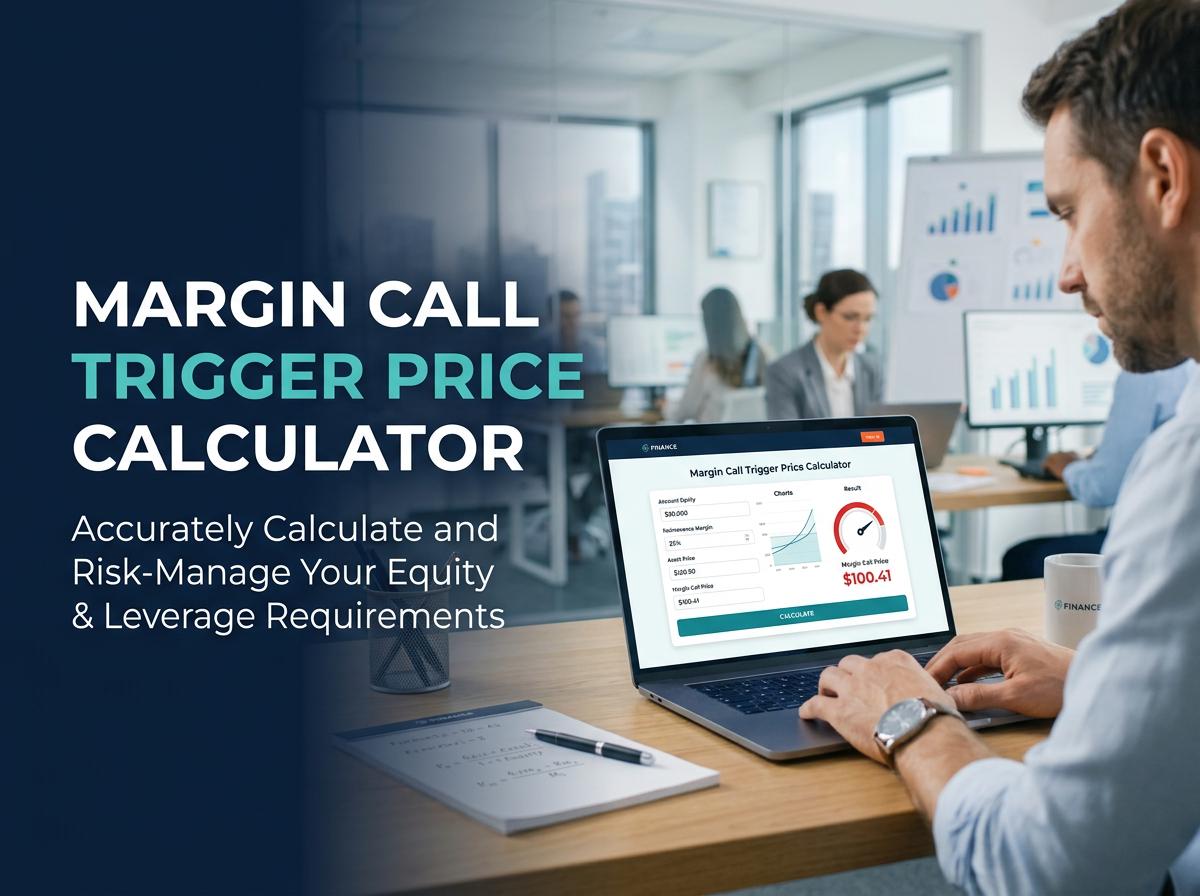

Use our free Margin Call Trigger Price Calculator to instantly determine the exact asset price that will trigger a margin call. Simply input your purchase price, initial margin, and maintenance margin to accurately manage your portfolio risk, avoid forced liquidations, and trade with confidence. Essential for all leveraged traders.
Margin Call Calculator
What exactly is a margin call trigger price
A margin call trigger price is the specific market price of an asset at which an investor's equity in a margin account drops below the broker's required maintenance margin. When the asset's price reaches this exact threshold, it triggers a "margin call." At this point, the broker demands that the investor deposit additional funds or marginable securities into the account to bring the equity back up to the minimum requirement. If the investor fails to meet this demand promptly, the broker reserves the right to forcefully liquidate the investor's positions to cover the shortfall. Essentially, the trigger price acts as a critical, automated safety mechanism for brokers to protect themselves from absorbing excessive losses caused by an investor's leveraged trades.
How is the margin call trigger price mathematically calculated
The mathematical calculation for a margin call trigger price depends primarily on the entry price, initial margin, and maintenance margin. For a standard long position, the formula is:
Trigger Price = Purchase Price × (1 - Initial Margin) / (1 - Maintenance Margin)
For example, if you buy a stock at $100 with a 50% initial margin and a 25% maintenance margin requirement:
- Purchase Price: $100
- Initial Margin: 0.50
- Maintenance Margin: 0.25
Calculation: $100 × (1 - 0.50) / (1 - 0.25) = $100 × 0.50 / 0.75 = $66.67. If the stock drops to $66.67, a margin call is immediately triggered.
What role does the maintenance margin play in setting this price
The maintenance margin is the absolute minimum percentage of equity an investor must maintain in their margin account after initiating a leveraged trade. It is the core regulatory variable that determines the trigger price. In the trigger price formula, the maintenance margin acts as the limiting denominator. A higher maintenance margin requirement means the trigger price will be much closer to the original purchase price. Consequently, the investor has less "breathing room" for the asset's price to decline before receiving a margin call. Conversely, a lower maintenance margin allows the asset's price to drop further before the broker demands additional funds. It acts as the broker's ultimate risk threshold.
How does the amount of leverage used affect the trigger level
The amount of leverage utilized is inversely proportional to your initial margin; higher leverage means you are putting down less of your own capital. Because you have less initial equity buffering your position, higher leverage mathematically pushes the margin call trigger price much closer to your entry price.
For example, if you use 2:1 leverage (50% initial equity), a stock might need to drop 33% to hit the trigger. However, if you use 4:1 leverage (25% initial equity), even a minor drop of a few percentage points could instantly trigger a margin call. Therefore, aggressive leverage drastically shrinks your margin for error, significantly increasing the probability of hitting the trigger price during normal market volatility.
What happens immediately when an asset hits the trigger price
When an asset hits the trigger price, a sequence of protective actions is initiated by the brokerage:
- Account Flagging: The system automatically flags the margin account for having deficient equity.
- Margin Call Issuance: The broker issues a formal margin call to the investor via email, platform notification, or phone, demanding an immediate deposit of cash or securities.
- Trading Restrictions: The account is usually restricted from opening any new positions until the equity deficiency is fully resolved.
- Potential Liquidation: Depending on the broker's terms and current market volatility, the broker may immediately liquidate the asset (common in crypto) or grant the investor a short grace period (often 2 to 5 days in equities) to meet the call.
Can a broker change the margin requirements and trigger price without notice
Yes, brokers absolutely have the legal right to change margin requirements and, consequently, the trigger price without prior notice. When you open a margin account, you sign a margin agreement that grants the broker this authority. These sudden changes are often referred to as "house maintenance requirements." Brokers typically increase margin requirements during periods of extreme market volatility, broad economic uncertainty, or when a specific stock becomes highly speculative (such as "meme stocks"). If a broker abruptly raises the maintenance margin from 25% to 40%, your trigger price instantly changes, moving much closer to the current market price. This sudden shift can instantly trigger a margin call on an otherwise healthy account.
How can traders actively avoid letting their positions reach the trigger price
Traders can employ several active risk management strategies to prevent their positions from hitting the margin call trigger price:
- Use Stop-Loss Orders: Set strict stop-loss orders well above the calculated trigger price to automatically close the position before a margin call becomes possible.
- Maintain Cash Buffers: Keep excess cash or uninvested equity in the portfolio to ensure the account equity stays well above the minimum maintenance requirement.
- Utilize Lower Leverage: Borrow less money. Using conservative leverage vastly increases the distance between the entry price and the trigger price.
- Monitor and Scale Out: Regularly monitor portfolio health and proactively sell off portions of a losing position to restore equity levels before broker intervention.
Does the trigger price formula differ between long and short positions
Yes, the formulas differ significantly because long positions lose value when prices fall, while short positions lose value when prices rise.
| Position Type | Risk Direction | Trigger Price Formula |
|---|---|---|
| Long (Buying) | Price drops | Purchase Price × (1 - Initial Margin) / (1 - Maintenance Margin) |
| Short (Selling) | Price rises | Short Sale Price × (1 + Initial Margin) / (1 + Maintenance Margin) |
For a short sale, if you short a stock at $100 with a 50% initial margin and 30% maintenance margin, the trigger price is $100 × 1.50 / 1.30 = $115.38. A margin call occurs if the asset's price rises to this level.
How do sudden market gaps and high volatility impact the trigger price
Sudden market gaps and high volatility pose severe risks to margin accounts because they completely bypass normal price action. If a stock closes at $100 and poor earnings cause it to gap down and open at $60 the next day, it may instantly blow past a trader's $75 trigger price. In these scenarios, the broker's automated liquidation systems cannot sell the position exactly at the trigger price. Instead, the asset is forcefully sold at the next available market price (e.g., $60). This extreme slippage can result in the trader losing significantly more money than their initial investment, potentially leaving the margin account with a negative cash balance that the trader legally owes to the broker.
Do different asset classes have significantly different trigger price thresholds
Yes, different asset classes feature vastly different margin requirements, which dictate their trigger price thresholds, based on inherent historical volatility and regulatory frameworks.
- Equities (Stocks): Heavily regulated (e.g., Regulation T in the US). The initial margin is typically 50%, and maintenance is 25%, making trigger prices relatively predictable and standardized.
- Forex: Due to low daily percentage moves in currency pairs, brokers offer extreme leverage (up to 50:1 in the US). Maintenance margins are tiny, meaning the trigger price is extremely close to the entry price.
- Cryptocurrency: Highly volatile and largely unregulated. Exchanges may offer 100x leverage but enforce strict, dynamic maintenance margins. Liquidations happen instantly via automated algorithms the precise moment a trigger price is hit.
 CD Early Withdrawal Penalty Calculator