
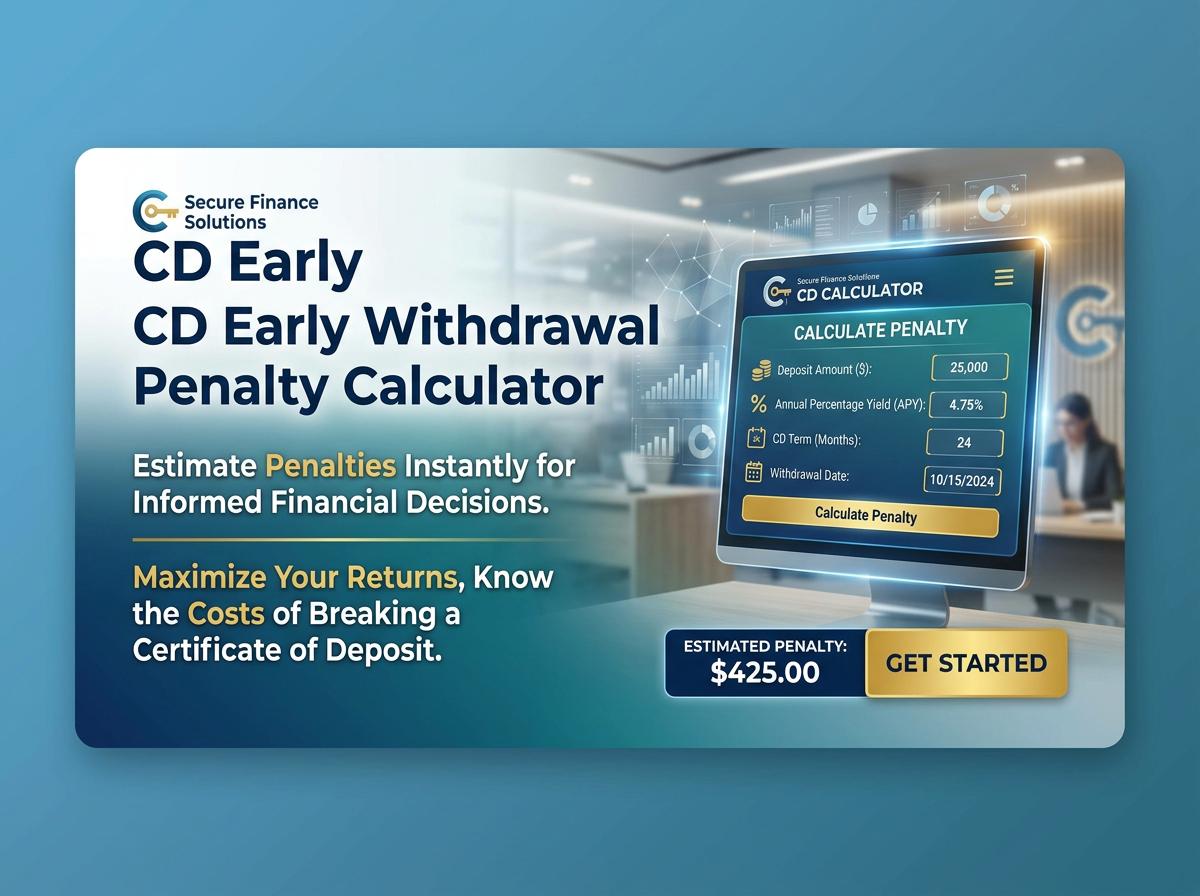

Calculate the exact cost of cashing out your Certificate of Deposit early. Use our free CD Early Withdrawal Penalty Calculator to easily estimate bank fees, lost interest, and your actual net payout before making a move. Make informed financial decisions today!
CD Early Withdrawal Penalty
What is a CD early withdrawal penalty?
A Certificate of Deposit (CD) early withdrawal penalty is a fee charged by a bank or credit union if you withdraw funds from your account before its maturity date.
When you open a CD, you agree to lock your money away for a specific term in exchange for a fixed, generally higher interest rate. Breaking this agreement triggers a penalty. This fee serves two main purposes:
- To compensate the financial institution for the disruption to their projected cash flow.
- To discourage depositors from using CDs as highly liquid, everyday transaction accounts.
How do banks calculate the penalty amount?
Banks generally calculate the penalty amount using a formula based on the interest earned over a specific number of days or months. The calculation is typically tied to the amount being withdrawn.
Common penalty structures include:
- Short-term CDs (under 1 year): 60 to 90 days of interest.
- Mid-term CDs (1 to 3 years): 180 to 270 days of interest.
- Long-term CDs (over 3 years): 365 to 540 days of interest.
While an interest-based method is the industry standard, some institutions might charge a flat fee plus a percentage of the interest, or even a percentage of the overall principal balance.
Can the penalty reduce my original principal investment?
Yes, an early withdrawal penalty can absolutely reduce your original principal investment.
This typically happens if you withdraw funds shortly after opening the CD, before sufficient interest has accrued to cover the cost of the penalty. Because the bank enforces the fee based on a set formula (e.g., 90 days of interest), the fee must be paid regardless of your actual earnings.
For example, if your penalty is 90 days of interest but you withdraw your funds after only 30 days, the bank will take your 30 days of earned interest and deduct the remaining 60 days' worth of interest directly from your initial deposit.
Does the penalty size depend on the CD term length?
Yes, the size of the penalty is almost always directly correlated with the length of the CD term. Financial institutions require a firmer commitment for longer lock-up periods, so they impose steeper penalties to deter early access.
| CD Term Length | Typical Penalty Size |
|---|---|
| Less than 1 Year | 60 to 90 days of interest |
| 1 to 3 Years | 180 to 270 days of interest |
| 4 to 5+ Years | 365 to 540 days of interest |
Always review your deposit agreement, as some banks have unusually harsh penalties for long-term CDs, while others offer more forgiving terms.
Are there any life events or exceptions that waive the penalty?
Yes, many financial institutions waive early withdrawal penalties under specific, severe life circumstances. These exceptions are legally permitted and governed by your deposit agreement.
Common exceptions include:
- Death of the account holder: If the primary or joint CD owner passes away, beneficiaries or the estate can usually withdraw the funds without a penalty.
- Incompetence: If a court legally declares the account holder incompetent to manage their finances.
- Severe Hardship: Rarely, some credit unions or banks may waive penalties for severe medical emergencies or job loss, but this is discretionary and not federally required.
Can I withdraw earned interest without triggering a penalty?
In many cases, yes. Numerous banks allow you to withdraw the interest your CD has already earned without triggering an early withdrawal penalty, provided you leave the original principal untouched.
Banks often offer the following options for accessing your interest:
- Transferring it periodically to a linked checking or savings account.
- Mailing you a paper check monthly, quarterly, or annually.
However, if you choose to let the interest compound inside the CD, some banks consider it part of the principal once it posts. Withdrawing it later might then trigger a fee. Always verify your specific bank's rules.
How do no-penalty CDs differ from traditional CDs?
No-penalty CDs (or liquid CDs) offer a hybrid experience between a traditional CD and a high-yield savings account. The key differences include:
| Feature | Traditional CD | No-Penalty CD |
|---|---|---|
| Withdrawal Fee | Charges a penalty for early access. | Allows withdrawal without a penalty fee. |
| Interest Rates | Generally offers the highest fixed rates. | Offers slightly lower fixed rates in exchange for liquidity. |
| Withdrawal Rules | Partial withdrawals are usually allowed (with a fee). | Often requires you to withdraw the entire balance; partial withdrawals are usually restricted. |
No-penalty CDs usually require a waiting period (typically 6 to 7 days after funding) before you can withdraw cash penalty-free.
Are CD early withdrawal penalties tax-deductible?
Yes, CD early withdrawal penalties are generally tax-deductible. The IRS considers this penalty an adjustment to income, meaning it is an "above-the-line" deduction.
Here is how the process works:
- You do not need to itemize your deductions to claim this benefit; it can be taken even if you claim the standard deduction.
- At tax time, your bank provides a Form 1099-INT.
- Box 2 of this form will explicitly list your "Early withdrawal penalty" amount.
- You report this amount on Schedule 1 of your Form 1040, which directly reduces your adjusted gross income (AGI) and lowers your overall tax burden.
Does a partial withdrawal trigger a penalty on the entire balance?
Generally, no. If your bank permits partial early withdrawals, the penalty is usually calculated only on the specific amount you are withdrawing, not on the entire remaining CD balance.
For example, if you have a $10,000 CD and withdraw $2,000 early, the bank will typically calculate the interest penalty based strictly on that $2,000.
However, keep two limitations in mind:
- Some institutions do not permit partial withdrawals at all. They require you to break the entire CD, triggering a penalty on the full balance.
- Banks enforce a minimum balance. If your partial withdrawal drops the CD below that minimum, you must close the entire account.
Is the penalty automatically deducted from my payout?
Yes, the early withdrawal penalty is automatically deducted from your CD balance at the exact moment you execute the withdrawal.
You do not receive a separate bill, nor do you have to write a check to the bank to cover the fee. When you request the early withdrawal, the bank's automated system calculates the penalty based on your agreement, subtracts that fee directly from your principal and accrued interest, and distributes the remaining net funds to you.
Because this happens instantaneously, the cash payout you receive will simply be smaller than your stated account balance.
 Brokerage Account Transfer Fee Breakeven Calculator