
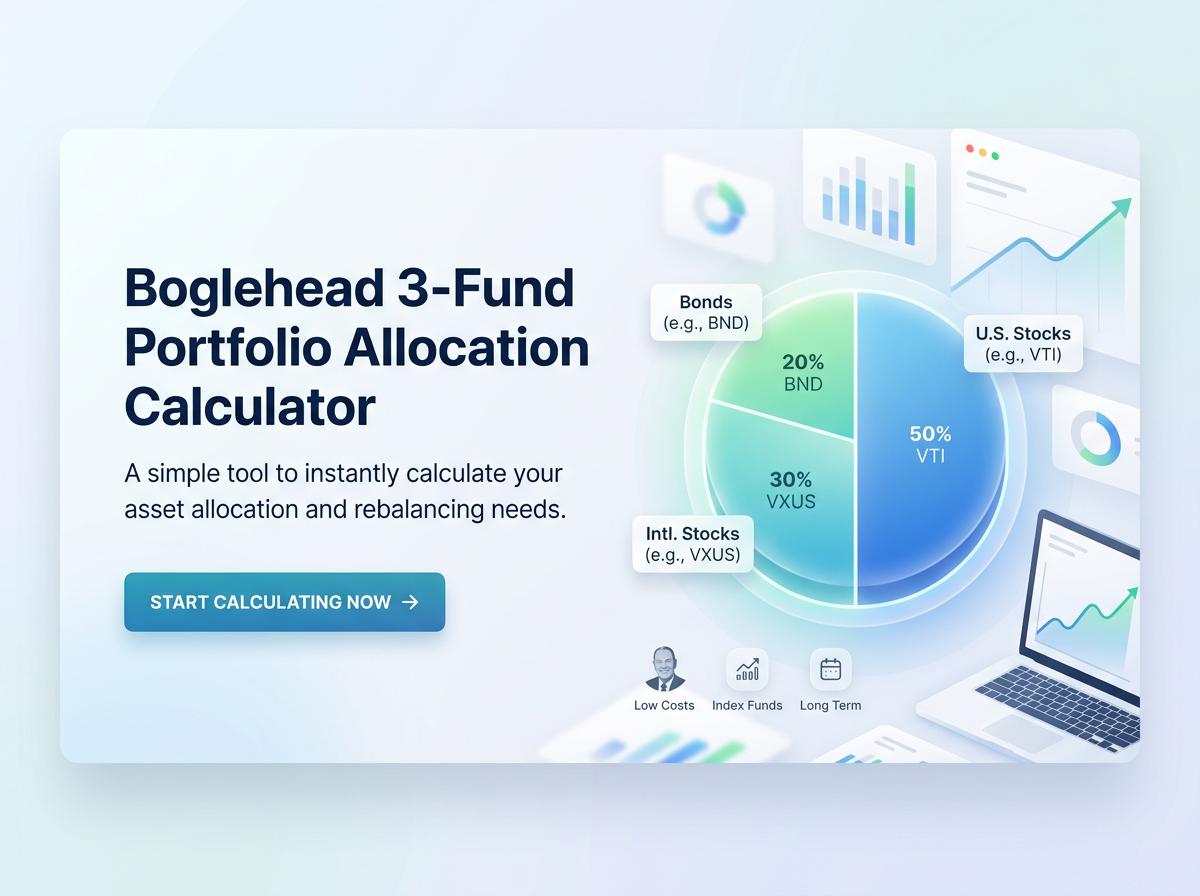

Optimize your investments with our Boglehead 3-Fund Portfolio Allocation Calculator. Easily determine the perfect balance of US stocks, international stocks, and bonds based on your risk tolerance and financial goals. Build a simple, low-cost, and diversified portfolio today to secure your financial future.
3-Fund Portfolio Calculator
What three specific asset classes make up the Boglehead portfolio?
The Boglehead "Three-Fund Portfolio" is built on simplicity, utilizing broadly diversified index funds to capture the entire global market. The three specific asset classes are:
- Total US Stock Market: Represents all publicly traded companies in the United States, providing aggressive domestic growth.
- Total International Stock Market: Captures publicly traded companies outside the US (including both developed and emerging markets), providing global diversification.
- Total US Bond Market: Consists of US government, corporate, and municipal bonds. This asset class provides steady income and acts as a stabilizing force against stock market volatility.
How do I choose the right stock-to-bond ratio for my age and risk tolerance?
Your stock-to-bond ratio depends primarily on your investment timeline and your emotional ability to handle market crashes. You can start with these common rules of thumb:
- Age in Bonds: A traditional, conservative rule where your bond percentage equals your age (e.g., at age 30, hold 30% bonds and 70% stocks).
- 120 Minus Age: A modern, more aggressive approach (e.g., 120 - 30 = 90% stocks and 10% bonds).
Adjust these baselines based on your personal risk tolerance. If a 30% drop in your portfolio value would cause you to panic-sell, you should hold more bonds. If you have a secure pension or are investing for a very long horizon, you can comfortably hold more stocks.
Which specific mutual funds or ETFs represent these three asset classes?
While many brokerages offer excellent low-cost index funds, Vanguard's funds are the traditional Boglehead standard. You can build this portfolio using either Mutual Funds or Exchange-Traded Funds (ETFs). Here is a breakdown:
| Asset Class | Mutual Fund Ticker | ETF Ticker |
|---|---|---|
| Total US Stock Market | VTSAX | VTI |
| Total International Stock | VTIAX | VXUS |
| Total US Bond Market | VBTLX | BND |
Why are extremely low expense ratios critical to this investment strategy?
Low expense ratios are the bedrock of the Boglehead philosophy because high fees severely erode long-term compounding. An expense ratio is the annual fee a fund charges to manage your money.
For example, if you invest $100,000 over 30 years at a 7% annual return, a fund with a 0.04% expense ratio will cost you just a few thousand dollars in total fees. Conversely, a managed fund with a 1.00% expense ratio will drain over $100,000 in fees and lost compound interest over that same period. Since investors cannot control market returns, minimizing costs is the single most reliable way to keep a larger share of your money.
How often should I rebalance the portfolio to maintain my target allocation?
Rebalancing is the process of buying and selling assets to return your portfolio to its original target allocation (e.g., 80% stocks / 20% bonds). You can manage this using two main strategies:
- Time-based Rebalancing: Pick one specific day a year (like your birthday or New Year's Day) to review and adjust your portfolio. This prevents emotional, reactionary tinkering.
- Threshold-based Rebalancing: Adjust only when an asset class drifts by a certain percentage (e.g., a 5% deviation). If stocks surge to 85%, sell the excess 5% and buy bonds to return to your 80% target.
Alternatively, you can passively rebalance by directing new cash deposits entirely into the underperforming asset class.
What role do bonds play in protecting my money during market downturns?
Bonds act as the primary shock absorber in a Boglehead portfolio. While stocks offer high long-term growth, they are incredibly volatile. Bonds serve three critical protective roles:
- Volatility Reduction: Bonds experience much smaller price swings than stocks, smoothing out your overall portfolio trajectory and preventing emotional panic.
- Non-correlation: Historically, when stock markets crash, high-quality government bonds often hold their value or even rise, as investors flock to safety.
- Dry Powder: During a stock market downturn, your bond allocation acts as a reserve. You can sell bonds that have held their value to buy stocks while they are "on sale" during your rebalancing process.
Why is international stock exposure recommended alongside domestic stocks?
International exposure protects investors from geographic concentration risk. While the US stock market has performed exceptionally well over the last decade, US and international markets historically take turns outperforming one another.
By holding both, you capture the growth of global economic powerhouses and emerging markets, ensuring you own the winners regardless of where they are located. Furthermore, a globally diversified portfolio reduces volatility. If the US economy suffers a specific localized downturn, stagflation, or regulatory shock, your international holdings can help stabilize your returns and reduce overall portfolio risk.
How should I distribute these funds between taxable and tax-advantaged accounts?
Distributing funds based on tax efficiency is known as "asset location." Since different assets are taxed differently, placing them in the correct accounts maximizes your after-tax returns:
- Tax-Advantaged Accounts (e.g., Traditional IRA, 401k):
- Hold your Total US Bond Market funds here.
- Bonds generate regular interest taxed as ordinary income; shielding them prevents an annual tax drag.
- Taxable Brokerage Accounts:
- Hold your Total US and International Stock funds here.
- Stocks benefit from lower, favorable long-term capital gains tax rates. International funds also offer a Foreign Tax Credit when held in taxable accounts.
Why does this passive index strategy typically beat actively managed portfolios?
Passive indexing beats active management primarily due to cost efficiency and the Efficient Market Hypothesis. Actively managed funds employ highly-paid analysts to pick stocks, resulting in high expense ratios, trading commissions, and capital gains taxes.
Statistically, it is incredibly difficult for a manager to consistently pick winning stocks that outperform the broader market enough to cover these high fees over a 10- or 20-year period. According to standardized industry scorecards, over 90% of actively managed funds underperform their benchmark indexes over 15-year horizons. Passive indexing guarantees you the market average return with near-zero costs, mathematically placing you ahead of most active investors.
How do I actually automate and manage this portfolio on a regular basis?
The beauty of the Boglehead strategy is its "set it and forget it" nature. To automate your portfolio, follow these steps:
- Select a low-cost brokerage: Open accounts with a provider like Vanguard, Fidelity, or Schwab.
- Set up auto-deposits: Schedule automatic cash transfers from your checking account to your brokerage immediately after every payday.
- Enable auto-investing: Configure your account to automatically buy mutual funds at your set target allocation (e.g., 60% VTSAX, 20% VTIAX, 20% VBTLX).
- Reinvest dividends: Turn on automatic Dividend Reinvestment Programs (DRIP) to continuously compound your growth.
- Stay the course: Ignore daily financial news and market volatility. Only log in annually to rebalance.
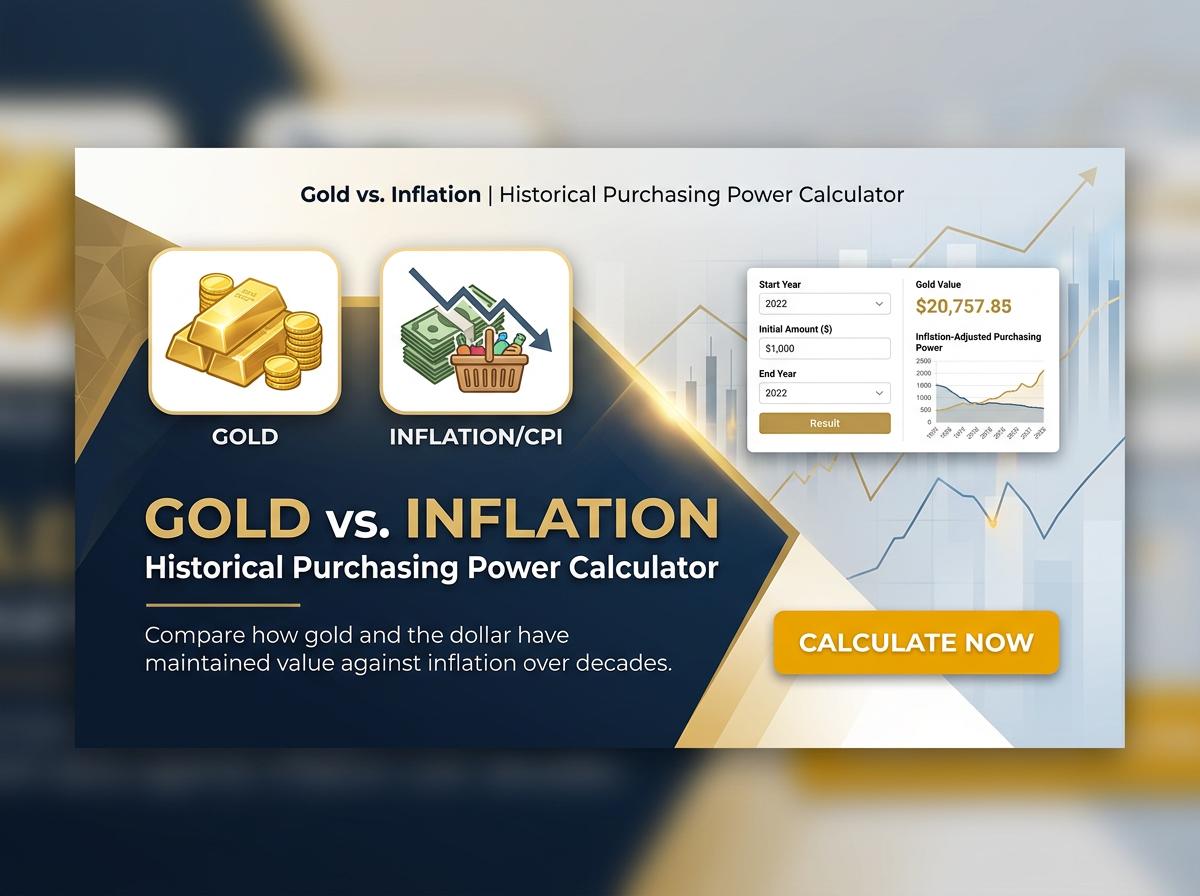 Gold vs. Inflation Historical Purchasing Power Calculator