
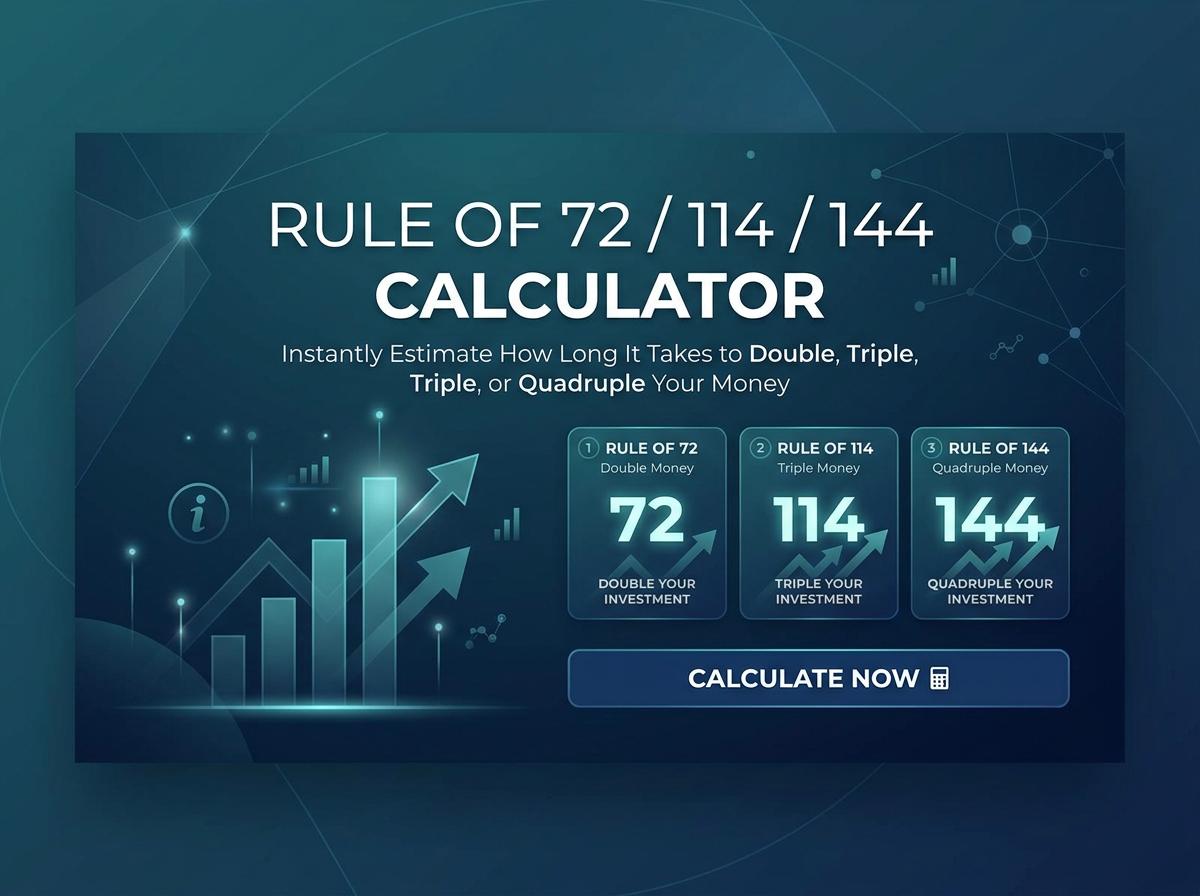

Quickly calculate how long it takes to double, triple, or quadruple your money. Use our free Rule of 72, 114, and 144 calculator to forecast compound interest and project your investment growth instantly.
Rule of 72 / 114 / 144
What is the primary financial purpose of these three mathematical shortcuts?
The primary financial purpose of the Rule of 72, 114, and 144 is to provide investors with quick, simple mental math shortcuts to estimate the exponential growth of an investment over time. Specifically, they calculate how long it takes for a lump sum to multiply:
- Rule of 72: Double (2x) in value.
- Rule of 114: Triple (3x) in value.
- Rule of 144: Quadruple (4x) in value.
These formulas eliminate the need to memorize or calculate complex logarithmic equations. They allow individuals to quickly evaluate investment opportunities, compare potential compounding returns, and set realistic long-term wealth accumulation goals.
How exactly does the Rule of 72 calculate the time to double an investment?
To calculate the time it takes for an investment to double, you simply divide the number 72 by the fixed annual interest rate (expressed as a whole number, not a decimal).
Formula: Years to Double = 72 ÷ Interest Rate
Example Application: If you invest $1,000 at a 6% annual return:
- 72 ÷ 6 = 12 years to double your money to $2,000.
You can also reverse the equation to find the required interest rate for a specific timeframe. For instance, if you want to double your money in exactly 8 years, you divide 72 by 8, meaning you would need to secure a 9% annual return.
When should an investor use the Rule of 114 to project portfolio growth?
An investor should use the Rule of 114 when they want to estimate how many years it will take for their portfolio to triple in value. Like the Rule of 72, it is highly useful when dealing with fixed-rate investments or projecting long-term average returns for retirement.
Common Use Cases:
- Setting aggressive long-term wealth accumulation targets.
- Comparing high-yield savings or mutual fund accounts.
- Assessing if a current balance will meet a future milestone (e.g., needing $300k from a $100k starting balance).
You simply divide 114 by the expected annual rate of return. For example, at an 8% return, an investment will triple in about 14.25 years (114 ÷ 8).
How is the Rule of 144 applied to estimate when your money will quadruple?
The Rule of 144 is applied to determine the timeline for an investment to quadruple (grow to four times its original value). You simply divide the constant 144 by your fixed annual interest rate.
Step-by-Step Application:
- Identify your expected annual rate of return (e.g., 12%).
- Divide 144 by that whole number (144 ÷ 12).
- The result is the number of years required to quadruple (12 years).
This rule is particularly useful for younger investors analyzing long-term horizons, such as a 30-year retirement plan. It helps them visualize the massive power of compounding over decades without needing a financial calculator.
Do these formulas require compound interest or do they work with simple interest?
These shortcuts strictly require compound interest to work correctly. They do not apply to simple interest.
Compound interest means you earn returns on both your initial principal and the accumulated interest from previous periods, resulting in an exponential growth curve. The Rules of 72, 114, and 144 are actually simplified logarithmic derivations of the complex compound interest formula.
If an investment uses simple interest (earning returns only on the original principal), the growth is purely linear, and it will take much longer to multiply. For simple interest, you would simply divide 100 by the interest rate to find the doubling time.
How can you use these exact same rules to calculate the negative impact of inflation?
These rules can be inversely applied to measure the destructive power of inflation on your purchasing power. Instead of calculating portfolio growth, you calculate currency depreciation by dividing the rule number by the annual inflation rate.
| Rule | Inflation Metric (Value Loss) |
|---|---|
| Rule of 72 | Years for purchasing power to be cut in half (1/2). |
| Rule of 114 | Years for purchasing power to drop to one-third (1/3). |
| Rule of 144 | Years for purchasing power to drop to one-quarter (1/4). |
For example, with a sustained inflation rate of 6%, your money will lose half its buying power in just 12 years (72 ÷ 6 = 12). This helps investors visualize the critical need to outpace inflation.
What are the accuracy limitations of these rules compared to exact mathematical formulas?
While highly convenient, these rules are mathematical approximations, not precise calculations. Their accuracy limitations include:
- Divergence at extremes: They are most accurate at moderate interest rates but lose precision at extremely low (under 4%) or exceptionally high (over 15%) rates.
- Ignoring ongoing contributions: These formulas assume a single, static lump-sum investment with no additional periodic deposits or withdrawals.
- Tax and fee exclusion: They calculate gross returns, completely failing to account for the drag of capital gains taxes, management fees, or trading costs.
For exact figures, investors must bypass these heuristics and use full logarithmic equations or digital financial calculators.
Which specific ranges of interest rates yield the most accurate results for these shortcuts?
These shortcuts are derived from natural logarithms and are calibrated to be most accurate within a specific, moderate band of interest rates.
The Rule of 72 is highly accurate for interest rates between 6% and 10%. The actual mathematical constant for doubling is roughly 69.3, but 72 is used because it has many convenient divisors (2, 3, 4, 6, 8, 9, 12).
| Interest Rate | Actual Doubling Time | Rule of 72 Estimate |
|---|---|---|
| 6% | 11.90 years | 12.00 years |
| 8% | 9.01 years | 9.00 years |
| 10% | 7.27 years | 7.20 years |
Outside of the 5% to 12% range, the approximation drifts. For rates outside this band, adding or subtracting 1 from 72 for every 3-point deviation improves accuracy.
How does changing the compounding frequency affect the reliability of these calculations?
The standard Rules of 72, 114, and 144 assume annual compounding. If the compounding frequency changes to semi-annual, monthly, or daily, the reliability of the baseline calculation decreases because more frequent compounding accelerates growth.
If an investment compounds monthly, the effective annual yield is higher than the stated nominal rate. Consequently, the money will double, triple, or quadruple slightly faster than the rule predicts.
To adjust for different frequencies, you must divide the rule number by the periodic rate (e.g., the specific monthly interest rate) rather than the annual rate. This will give you the answer in total periods (months) instead of years.
Why might relying solely on these fixed-rate rules be risky for real-world financial planning?
Relying exclusively on these shortcuts can be dangerous for comprehensive financial planning due to the unpredictable nature of real-world markets:
- Market Volatility: The rules assume a continuous, fixed rate of return. In reality, asset classes like equities fluctuate wildly. A 10% average return includes severe negative years, which alters the compounding path (sequence of returns risk).
- Variable Inflation: Just as market returns fluctuate, inflation isn't static. A static projection might drastically overestimate your future real purchasing power.
- False Confidence: Simplified math might lead an investor to under-save, falsely believing their current lump sum will magically hit target goals without needing ongoing, disciplined contributions.
These rules should only be used for baseline estimations.
Sources:
 Sequence of Returns Risk Calculator