
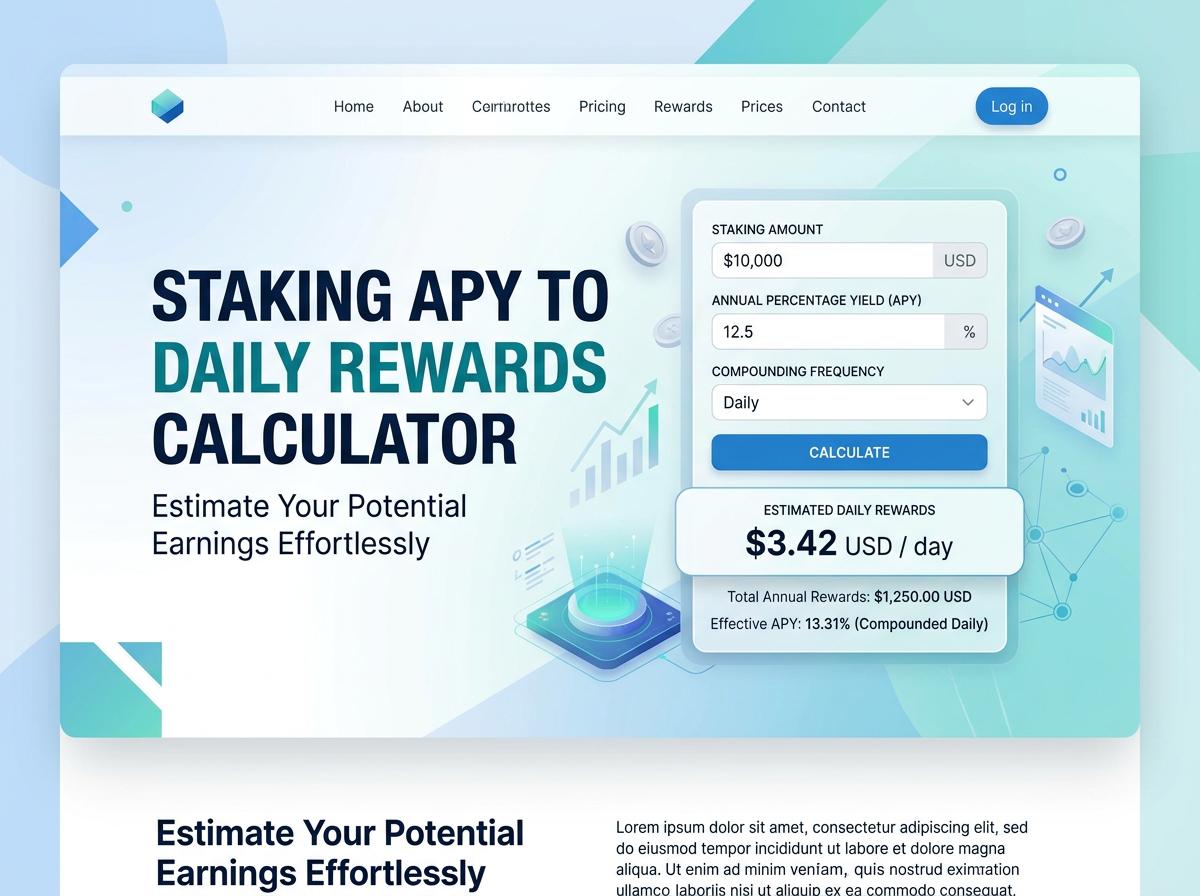

Calculate your crypto staking earnings instantly. Use our free Staking APY to Daily Rewards Calculator to accurately project your daily, weekly, and monthly passive income. Maximize your crypto ROI today!
Staking APY Calculator
What formula is used to convert an annual APY into a daily percentage yield?
To convert an Annual Percentage Yield (APY) into a daily percentage yield, you must account for compounding interest. You cannot simply divide the APY by 365. Instead, you use the following formula:
Daily Yield = (1 + APY)(1/365) - 1
In this formula, the APY is expressed as a decimal (for example, a 5% APY is 0.05). By adding 1, taking it to the power of 1 divided by 365, and then subtracting 1, you find the exact daily growth rate that, when compounded daily over a year, results in the stated APY.
Does the advertised APY assume automatic compounding of your daily rewards?
Yes, by definition, the advertised APY (Annual Percentage Yield) intrinsically assumes that your daily rewards are continuously or periodically compounded. It calculates your return based on the premise that earned rewards are added back to your principal balance to generate further interest.
If a platform advertises an APY but does not offer an auto-compounding feature, the platform is assuming you will manually claim and restake your rewards on a regular schedule to achieve that exact percentage.
How does APR differ from APY when calculating daily staking payouts?
When calculating daily payouts, the primary difference lies in how interest accumulates over time.
| Metric | Interest Type | Daily Payout Calculation |
|---|---|---|
| APR (Annual Percentage Rate) | Simple Interest | Calculated purely on the original principal. Daily rate is simply APR ÷ 365. Payouts remain flat. |
| APY (Annual Percentage Yield) | Compound Interest | Calculated on the principal plus previously earned rewards. Daily payouts grow slightly larger each day. |
Do you need to manually claim and restake daily rewards to actually achieve the stated APY?
This depends entirely on the specific blockchain protocol or decentralized finance (DeFi) platform you are using.
- Auto-compounding platforms: Smart contracts automatically harvest and reinvest your daily rewards back into your staking pool. You do not need to do anything to achieve the APY.
- Manual platforms: Rewards accumulate in a separate balance. To achieve the advertised APY, you must manually claim and restake them.
When restaking manually, you must also factor in blockchain network gas fees. If the gas fee to claim and restake costs more than the daily reward itself, doing so frequently will result in a net loss rather than reaching the stated APY.
Is the staking APY a fixed rate or does it fluctuate daily based on network participation?
In the vast majority of Proof-of-Stake (PoS) blockchains, the staking APY is highly dynamic and fluctuates daily. It is rarely a fixed rate.
Blockchains generally allocate a fixed amount of inflation or block rewards over a given period. This fixed reward pool is divided among all active stakers. Therefore:
- Higher Participation: If more users stake their tokens, the reward pool is spread thinner, lowering the APY.
- Lower Participation: If users un-stake, the remaining stakers receive a larger slice of the rewards, increasing the APY.
Are validator commissions and network fees deducted before calculating your daily rewards?
Yes, validator commissions and network fees are almost always deducted before your final daily rewards are calculated and distributed.
When you delegate your crypto to a validator node, that validator performs the computational work to secure the network. As compensation, they charge a commission rate (typically ranging from 1% to 10%). The protocol automatically deducts this percentage from the gross block rewards generated by your staked tokens. The advertised APY on staking interfaces is usually the net APY, meaning it already accounts for the validator's commission.
Are your daily earned rewards immediately liquid or subject to a lock-up period?
The liquidity of your daily rewards varies widely depending on the blockchain's specific tokenomics.
- Immediately Liquid: On networks like Cardano (ADA) or Algorand (ALGO), staking rewards are completely liquid and can be spent or transferred the moment they are distributed.
- Locked with Principal: On networks like Polkadot (DOT) or Cosmos (ATOM), auto-compounded rewards are bound to the principal. To access them, you must initiate an "unbonding" period, which can lock your funds for up to 21-28 days before they become liquid.
- Liquid Staking Derivatives: Using protocols like Lido (stETH) provides liquid tokens representing your staked assets and rewards, allowing you to bypass standard network lock-up periods.
Are the daily rewards paid out in the same native token that you initially staked?
In traditional Layer-1 Proof-of-Stake consensus staking, yes. If you stake Solana (SOL), your daily rewards are paid out in SOL. The network incentivizes you with its native asset.
However, if you are staking in Decentralized Finance (DeFi) protocols or liquidity pools, the answer often changes. You might stake a stablecoin or a native token but receive your daily payouts in the protocol's secondary "governance" or "farm" token. These secondary tokens often have vastly different economic models and inflation rates than the asset you initially deposited.
How does token price volatility impact the actual fiat value of your daily rewards?
Token price volatility fundamentally disconnects your staking yield from your real-world fiat returns. Because staking APY is paid in the native cryptocurrency, not fiat currencies like USD or EUR, your actual purchasing power fluctuates wildly.
For example, if you earn 10 tokens daily and the token is worth $1.00, your fiat reward is $10/day. If the token price crashes by 50% to $0.50, you still earn 10 tokens daily, but your fiat value drops to $5/day. A high APY cannot protect you from a severe drop in the underlying token's market price, which can easily wipe out your fiat gains.
Can network slashing penalties reduce or wipe out your accumulated daily payouts?
Yes, network slashing can severely impact both your earned rewards and your initial principal.
Slashing is a punitive mechanism used by PoS blockchains to punish malicious behavior (like double-signing blocks) or prolonged validator downtime. If the validator you delegate your tokens to is penalized, the network will permanently confiscate a percentage of their staked funds—which includes your delegated tokens.
A severe slashing event can instantly destroy months of accumulated daily payouts and even result in you holding fewer tokens than you originally staked.
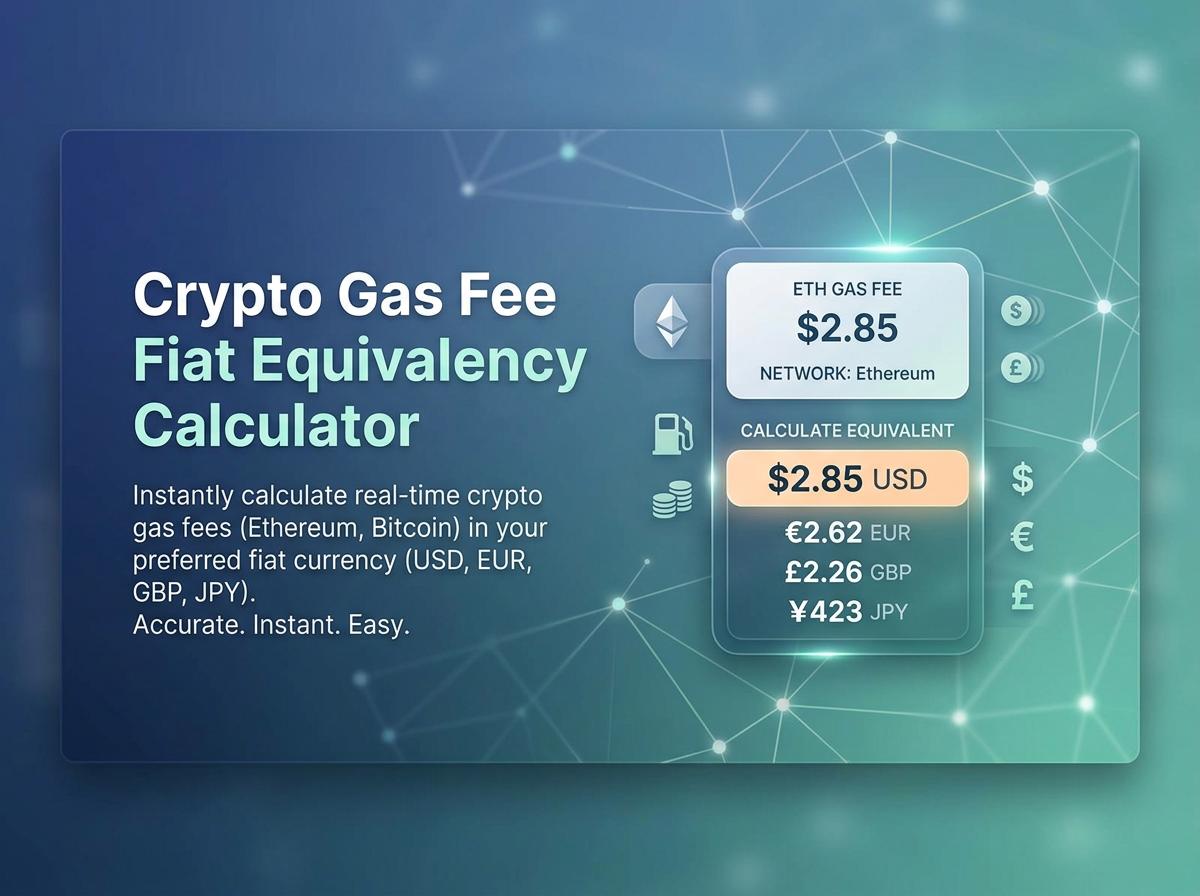 Crypto Gas Fee Fiat Equivalency Calculator