
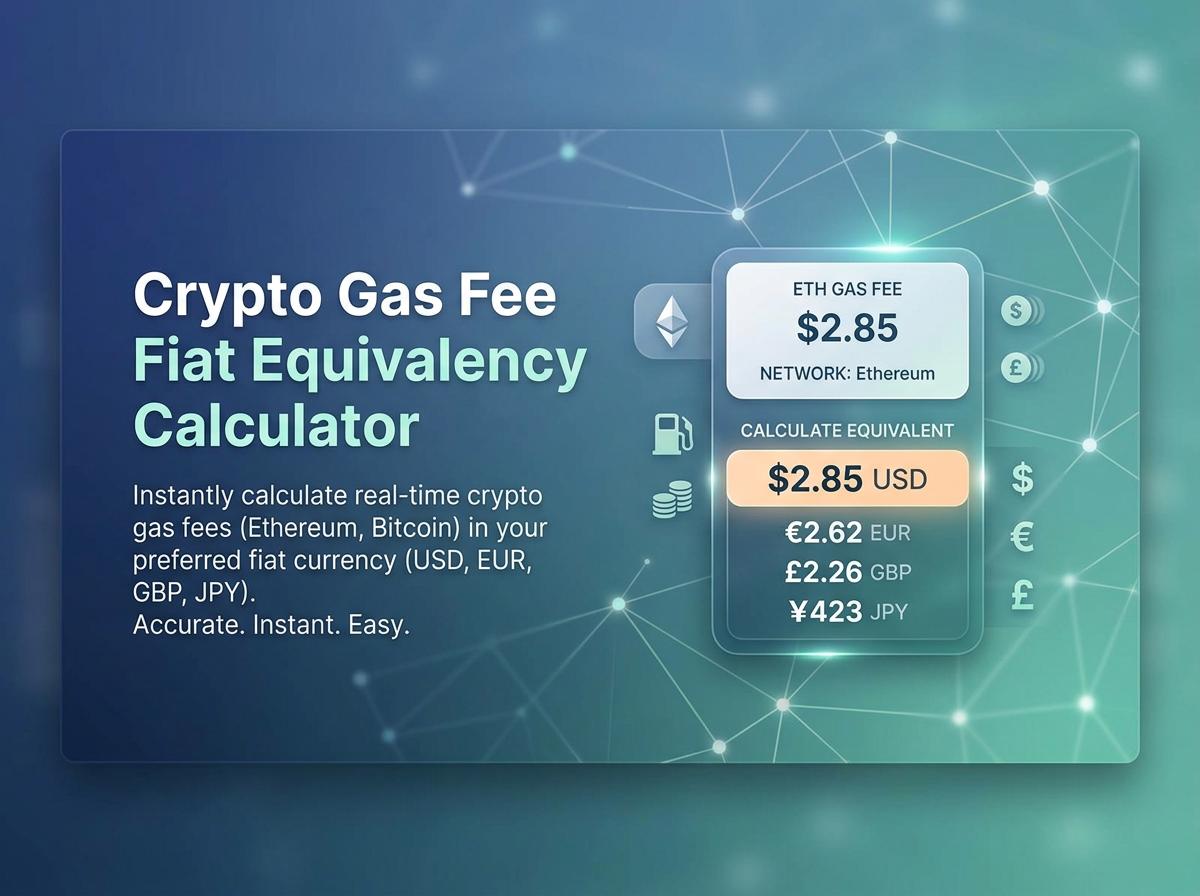

Easily convert crypto gas fees into real-world fiat values with our Crypto Gas Fee Fiat Equivalency Calculator. Check live transaction costs for Ethereum, Bitcoin, Solana, and more in USD, EUR, and other major currencies. Avoid hidden costs, plan your crypto transfers, and optimize your trades with real-time, accurate gas-to-fiat conversions.
Gas Fee Calculator
How do you calculate the exact fiat value of a crypto gas fee?
To calculate the exact fiat value of a crypto gas fee, you need three variables: the required gas limit, the gas price, and the current fiat exchange rate of the network's native token.
- Determine Gas Units: Identify the amount of computational effort required (e.g., a standard Ethereum transfer costs 21,000 gas units).
- Multiply by Gas Price: Multiply those units by the current network gas price, which is usually measured in micro-denominations like Gwei.
- Convert to Native Token: Convert that total into the main token unit. For example, divide Gwei by 1,000,000,000 to find the total Ethereum cost.
- Multiply by Fiat Price: Multiply the resulting token amount by the live market price of the asset in USD, EUR, or your preferred fiat currency.
Why does the fiat cost of gas fluctuate so rapidly?
The fiat cost of gas fluctuates rapidly due to the constant shifting of two distinct, independent markets acting simultaneously:
- Network Congestion: Blockchains have limited space per block. When demand is high, users bid higher gas prices to get their transactions processed quickly. This drives up the required amount of native crypto needed for the transaction.
- Native Token Volatility: Because gas fees are paid in the blockchain's native cryptocurrency (like ETH or SOL), any change in the token's fiat market value directly impacts the fiat equivalent of the fee.
Consequently, even if network demand remains perfectly stable, a sudden 15% spike in Ethereum's USD price will immediately cause a 15% increase in the USD cost of your gas fee.
Which tools track real-time fiat equivalents for transaction fees?
Several specialized tools and blockchain explorers provide real-time gas tracking in both native crypto and fiat equivalents. Here are some of the most reliable options:
| Tool | Best Feature |
|---|---|
| Etherscan Gas Tracker | Provides live Ethereum gas prices, estimating exact fiat costs for standard transfers, token swaps, and smart contracts. |
| Blocknative | Browser extension offering highly accurate, mempool-based fee estimates in USD for traders. |
| CoinGecko | Great for checking network-specific average transaction fees converted into dozens of localized fiat currencies. |
| Web3 Wallets | Apps like MetaMask provide live, transaction-specific fiat estimates on the confirmation screen before you sign. |
How does native token volatility impact your fiat gas costs?
Native token volatility directly and proportionally impacts your fiat gas costs. Blockchain networks do not recognize fiat currencies; they strictly price computational effort in their native tokens.
If a smart contract execution requires exactly 0.01 ETH to process, the network will charge exactly 0.01 ETH regardless of traditional financial market conditions. However, the fiat impact on your real-world wallet changes based on the live exchange rate:
- If ETH is priced at $2,000, the transaction costs $20.00 in fiat.
- If ETH suddenly surges to $4,000, the exact same transaction immediately costs $40.00 in fiat.
Therefore, users frequently experience "expensive gas" during crypto bull markets primarily because the underlying asset has appreciated significantly against fiat currencies.
Is it possible to pay blockchain gas fees directly with fiat?
Traditionally, no. Blockchains strictly require their native cryptocurrency (e.g., ETH, MATIC, SOL) to compensate validators for processing transactions and securing the network.
However, modern Web3 innovations are making indirect fiat payments possible for everyday users:
- Account Abstraction (ERC-4337): This technology allows "Paymasters" to sponsor gas fees. A centralized provider can accept your fiat payment (via credit card) and simultaneously pay the underlying crypto gas fee on your behalf.
- Integrated Fiat On-Ramps: Some modern smart wallets integrate with payment processors like Stripe. They buy the exact fraction of crypto needed for gas seamlessly in the background.
- Centralized Exchanges: When withdrawing assets, platforms deduct a fiat or stablecoin equivalent from your account balance to cover the blockchain's underlying crypto gas fee.
How does network congestion drive up the fiat price of gas?
Network congestion drives up gas prices through a basic supply-and-demand auction mechanism. Blockchains can only process a limited number of transactions in each block due to their underlying architecture.
When user demand exceeds this limited capacity (such as during a highly anticipated NFT mint or intense market volatility), the network becomes congested. To ensure their transactions are processed quickly, users must incentivize network validators by including a larger "tip" or bidding a higher gas price. Validators naturally prioritize the transactions offering the highest fees.
As users continually outbid one another, the baseline amount of crypto required to push a transaction through surges. When this elevated crypto fee is multiplied by the token's market price, the overall fiat cost skyrockets.
Are fiat-equivalent gas fees tax-deductible for crypto trading?
Yes, in most major tax jurisdictions (like the US, UK, and Australia), the fiat equivalent of gas fees is considered a deductible trading expense. However, it is usually factored directly into your capital gains calculations rather than treated as a separate, standalone deduction.
Here is how it typically works:
- Buying Assets: Gas fees paid to acquire cryptocurrency are added to the asset's cost basis. For example, buying $100 of tokens with a $10 gas fee makes your cost basis $110.
- Selling Assets: Gas fees paid to sell an asset are deducted from your gross sales proceeds.
By increasing your cost basis and reducing your final proceeds, gas fees effectively lower your total taxable capital gains. Note: Always consult a certified tax professional.
Why do wallets sometimes show inaccurate fiat gas estimates?
Crypto wallets often display inaccurate fiat gas estimates due to the unpredictable nature of both blockchain block times and real-world market prices.
- Historical Estimation: Wallets predict your fee based on data from the most recently completed blocks. If network demand unexpectedly spikes in the seconds between viewing the estimate and the block finalizing, the actual fee will be higher.
- Variable Contract Logic: Complex transactions (like routing a trade through decentralized exchanges) require varying computational effort depending on live liquidity pools. The wallet estimates the maximum potential path, but the actual gas used is often lower.
- Lagging Price Oracles: Wallets rely on third-party APIs to convert the crypto fee into fiat. If there is a slight delay in updating the live fiat price, the wallet's USD estimate will be misaligned.
How much do Layer 2 networks lower the fiat cost of transactions?
Layer 2 (L2) networks drastically reduce fiat transaction costs, typically lowering them by 95% to 99% compared to traditional Layer 1 blockchains like Ethereum.
L2s achieve this using Rollup technology. They bundle thousands of individual user transactions together, process them quickly off-chain, and then post a single, compressed cryptographic proof back to the main blockchain. This distributes the expensive Layer 1 security fee among thousands of people.
| Network Type | Average Fiat Transfer Cost |
|---|---|
| Ethereum (Layer 1) | $1.00 - $15.00+ |
| Arbitrum / Optimism (L2) | $0.01 - $0.05 |
| Base / zkSync (L2) | $0.001 - $0.02 |
Following Ethereum's Dencun upgrade (EIP-4844), many Layer 2 fiat fees dropped to fractions of a single cent.
What formula converts gwei and gas limits into a fiat currency?
To mathematically calculate the exact fiat cost of a transaction, you must combine the transaction's gas limit, the live gas price in gwei, and the current market price of the native token.
The standard conversion formula is:
Fiat Cost = (Gas Limit × Gas Price in Gwei) × 10-9 × Token Fiat Price
Step-by-step breakdown:
- Calculate Base Fee: Multiply the Gas Limit (the maximum units of work) by the Gas Price (the cost per unit, measured in gwei).
- Convert to Whole Tokens: Multiply that result by 10-9 (or divide by 1,000,000,000) to convert the gwei back into whole tokens (e.g., ETH).
- Convert to Fiat: Multiply the resulting token amount by the current USD exchange rate.
Sources:
 Futures Contango / Backwardation Yield Calculator