
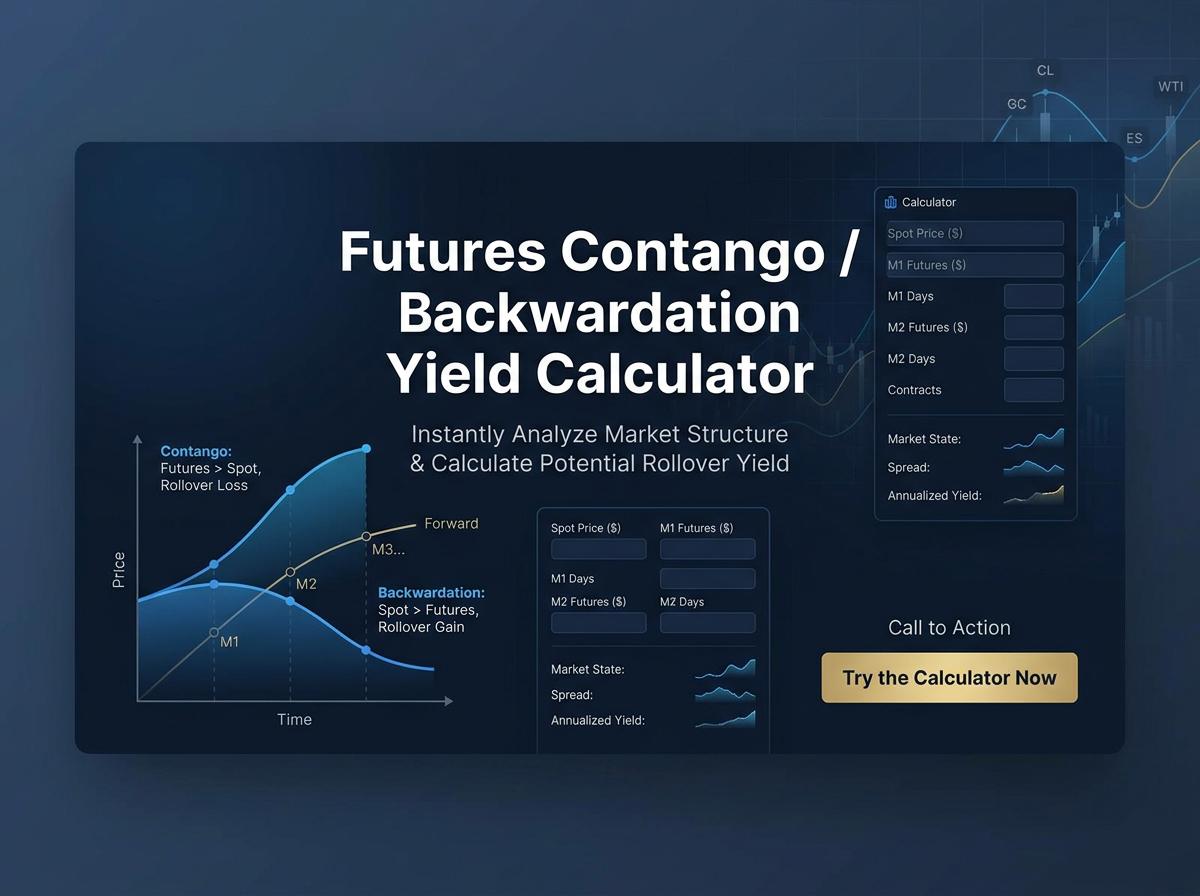

Calculate roll yield and annualized returns for any futures contract with our Contango and Backwardation Yield Calculator. Easily analyze the futures curve to determine premium or discount percentages between expirations. Ideal for commodity and crypto traders looking to optimize roll strategies, hedge risk, and maximize profits. Try our free calculator today!
Contango / Backwardation Yield
Market State: -
Basis / Price Diff: -
Period Yield: -
Annualized Yield: -
What defines a contango versus a backwardated futures market?
The shape of the futures curve defines these two distinct market conditions, based entirely on the relationship between current spot prices and future delivery prices.
| Market State | Definition | Curve Shape |
|---|---|---|
| Contango | Futures prices are higher than the expected future spot price. | Upward sloping |
| Backwardation | Futures prices are lower than the expected future spot price. | Downward sloping |
In contango, distant delivery months are more expensive than near-term months, generally due to the cost of storing the asset. Conversely, in backwardation, near-term contracts trade at a premium compared to deferred contracts, usually driven by immediate, urgent demand for the underlying physical asset.
How does roll yield generate positive or negative returns for investors?
Roll yield, or roll return, is the profit or loss generated when an investor replaces an expiring futures contract with a new one to maintain continuous market exposure. This return is strictly dictated by the futures curve:
- Negative Roll Yield (Contango): When the curve slopes upward, investors must sell cheaper expiring contracts and buy more expensive deferred contracts. This persistent "buy high, sell low" dynamic systematically erodes investment returns over time.
- Positive Roll Yield (Backwardation): In a downward-sloping market, the expiring contract is sold at a higher price, while the longer-dated replacement contract is purchased at a discount. This "sell high, buy low" scenario creates an automatic, positive yield for long positions.
What role does the cost of carry play in driving a market into contango?
The cost of carry is the primary driver of a contango market. It represents the total expense an entity incurs to hold a physical asset over time until its future delivery date. To compensate sellers for holding the asset, futures prices for longer maturities must increase. These costs primarily include:
- Storage Costs: The physical space and facility fees required to hold commodities like crude oil, wheat, or precious metals.
- Financing and Interest: The opportunity cost of capital or the actual interest paid on loans used to purchase the physical inventory.
- Insurance: Premiums paid to protect the asset against theft, damage, or degradation while stored.
Absent a supply shortage, these accumulated carrying costs naturally force the futures curve into an upward-sloping contango.
How does convenience yield cause a market to shift into backwardation?
Convenience yield is the implied premium or economic benefit a market participant receives from having immediate physical possession of a commodity, rather than merely holding a derivative contract. A market flips into backwardation when this convenience yield surpasses the cost of carry.
This shift typically occurs during supply shocks, geopolitical blockades, or sudden surges in consumer demand. Manufacturers and refiners willingly pay a high premium for spot or near-term delivery to keep their production lines active and avoid devastating stockouts. This intense short-term buying pressure drives spot and front-month futures prices significantly higher than longer-dated contracts. As a result, the curve inverts downward, signaling that the immediate benefit of holding the physical commodity far outweighs the costs of storing it.
Why do commodity ETFs often experience severe performance drag during contango?
Commodity Exchange-Traded Funds (ETFs) generally do not hold physical assets like oil barrels or bushels of corn; instead, they utilize futures contracts to replicate the commodity's price movements. Because futures contracts have expiration dates, ETF managers must continuously execute a "roll"—selling near-term contracts before they expire and buying the next active month.
When a market is in contango, longer-dated contracts are consistently more expensive than expiring ones. The ETF is thus forced to sell cheap contracts and buy expensive ones month after month. This structural negative roll yield acts as a severe, compounding drain on the fund's capital. Over extended periods, this continuous drag causes the ETF to vastly underperform the actual spot price of the underlying commodity.
How does rolling contracts in a backwardated market create a positive yield?
In a backwardated market, the futures curve has a downward trajectory, meaning contracts expiring soon are priced higher than those expiring further out. For a long investor, rolling a position forward in this environment naturally generates a positive yield.
As a futures contract nears expiration, its price traditionally converges upward toward the higher spot price. To maintain market exposure without taking physical delivery, the investor sells the expiring, higher-priced contract and purchases the next sequential contract, which is trading at a discount. Because the investor is effectively selling high and buying low during each roll execution, they capture the spread difference as profit. This consistent positive roll yield acts as an additive return stream, padding the overall portfolio regardless of spot price fluctuations.
What market signals dictate the steepness of the futures curve?
The steepness of a futures curve is dictated by several critical market signals that reflect the balance of macroeconomic factors, supply, and demand:
- Inventory Levels: Depleted stockpiles signal severe scarcity, steepening a backwardated curve as buyers panic. High inventories signal oversupply, steepening a contango curve.
- Interest Rates: High borrowing costs increase the cost of carry, which can dramatically steepen the contango curve for physical assets.
- Seasonality: Agricultural and energy markets experience predictable supply-demand shifts (e.g., harvest gluts or winter heating demands), causing seasonal curve steepening.
- Geopolitical Events: Wars, sanctions, or logistical bottlenecks create immediate supply fears, violently steepening front-month prices into deep backwardation.
How do short-term physical supply shortages affect the shape of the curve?
Short-term physical supply shortages have a sudden and aggressive impact on the futures curve, fundamentally changing its shape from an upward-sloping contango to a downward-sloping backwardation.
When a shortage arises—whether due to refinery explosions, adverse weather, or geopolitical embargoes—end-users panic to secure the raw materials necessary to maintain operations. This urgency creates an enormous surge in demand for immediate spot delivery and front-month futures. Consequently, prices for these near-term contracts spike exponentially. Meanwhile, longer-dated contracts remain relatively subdued, as the market assumes the temporary shortage will be rectified in the future. This pushes near-term prices far above long-term expectations, resulting in a steeply backwardated curve.
What strategies can traders use to capture backwardation yield?
Traders can employ several distinct strategies to monetize the structural positive roll yield found in a backwardated market:
- Long Calendar Spreads: A trader buys a deferred, cheaper futures contract and simultaneously sells a more expensive near-term contract. As time passes, the cheaper contract "rolls up" the curve to match spot prices, yielding a profit.
- Long Commodity ETFs: Because ETFs passively roll contracts, simply holding a long position in a fund tracking a backwardated asset allows the investor to indirectly collect the positive yield.
- Reverse Cash and Carry Arbitrage: Traders with existing inventory can short the expensive physical/spot market and go long the cheaper deferred futures contract, locking in a risk-free profit as the prices converge.
How do physical storage and insurance costs impact the expected futures yield?
Physical storage and insurance costs are the foundational elements of the "cost of carry," directly shaping expected futures yield by forcing markets into contango. When it is expensive to store, secure, and insure a physical commodity, distant futures prices must be priced higher than spot prices to incentivize market participants to hold the inventory.
For an investor holding a long futures position, these high costs directly translate into a negative expected yield. To avoid taking physical delivery and paying these storage and insurance fees, the investor must roll their position into longer-dated, premium-priced contracts. Buying these expensive contracts continuously chips away at their overall returns. Ultimately, negative roll yield is the indirect financial penalty paper investors pay to avoid physical commodity management.
Sources:
 Day Trading Wash Rule Violation Calculator