
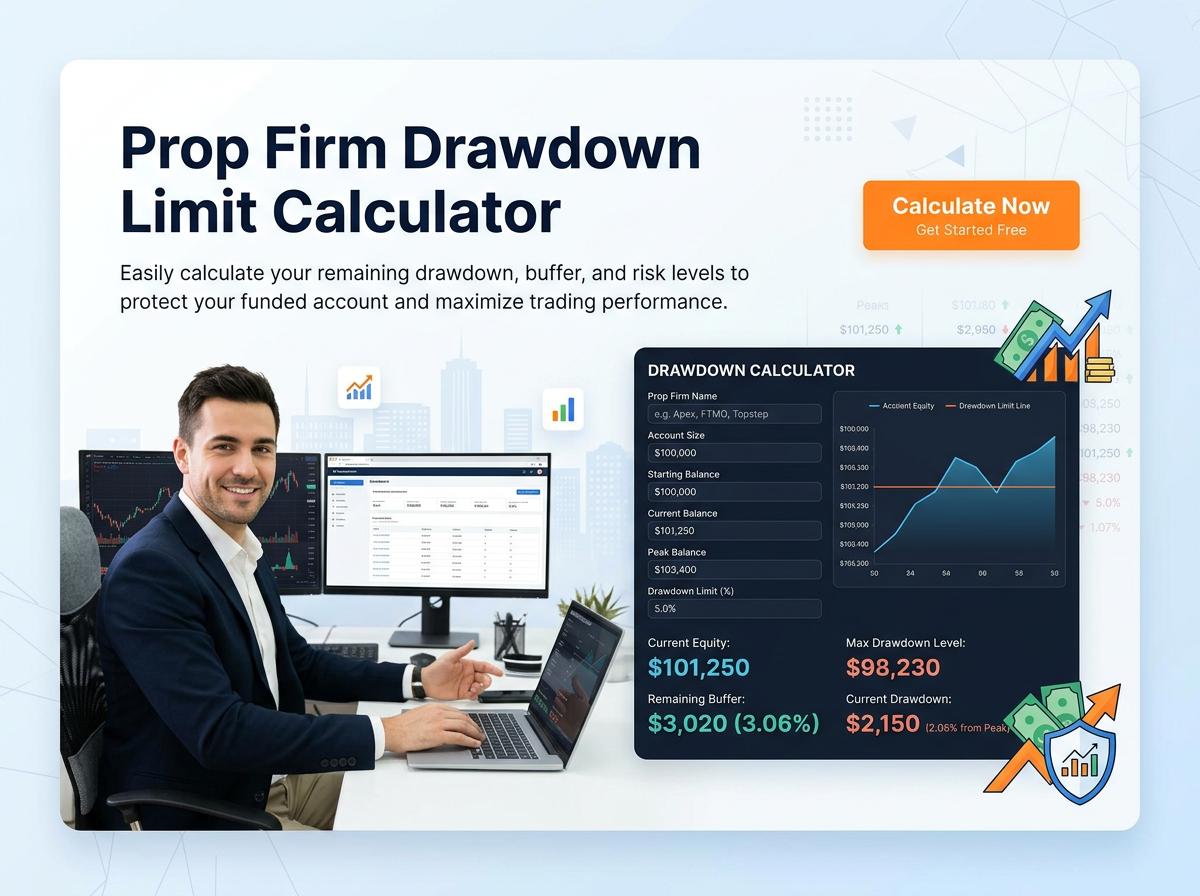

Easily calculate your daily and maximum loss limits with our Prop Firm Drawdown Calculator. Manage your risk accurately, avoid rule breaches, pass evaluations safely, and protect your funded trading account.
Prop Firm Drawdown Calculator
What is the difference between a daily drawdown and a maximum drawdown limit?
| Drawdown Type | Definition & Scope |
|---|---|
| Daily Drawdown | The maximum amount of money you are permitted to lose in a single, 24-hour trading day. It is usually based on the day's starting balance or equity. |
| Maximum Drawdown | The total overall cumulative loss allowed on the account over its entire lifetime. It is the absolute limit your account equity can drop before termination. |
Is the drawdown calculated based on closed balance or open floating equity?
In the proprietary trading industry, drawdowns are almost universally calculated based on open floating equity.
This means that any unrealized, floating losses from open trades actively count against your drawdown limits in real-time. If an open trade dips into a deep negative but later closes in profit, that temporary dip is still recorded. If that temporary floating loss breaches your limit, your account will be terminated, regardless of your closed balance.
Does the maximum drawdown trail my highest account profit or stay fixed?
This depends entirely on the specific proprietary firm's rules. There are two common structures:
- Static (Fixed) Drawdown: The maximum drawdown limit is calculated strictly from your initial starting balance and never moves. For example, a $100,000 account with a $10,000 fixed limit means you breach if your equity hits $90,000, regardless of how much profit you make.
- Trailing Drawdown: The drawdown threshold moves upward as your account balance or equity reaches new highs. Most trailing drawdowns eventually stop trailing and lock in once your account reaches its initial starting balance plus the drawdown amount.
At what specific time of day does the daily drawdown limit reset?
The daily drawdown limit reset depends on the broker's server time used by the prop firm. The two most standard reset times are:
- 5:00 PM EST (New York Time): This aligns with the daily closure of the traditional Forex markets.
- Midnight CE(S)T (Central European Time): Frequently used by European-based proprietary trading firms.
It is crucial to verify the exact server time in your firm's dashboard, as holding losing trades over the reset period will calculate them into the new day's drawdown limits.
What happens to my evaluation or funded account if I breach a drawdown rule?
Breaching a drawdown rule results in an immediate and automatic "hard breach." The consequences depend on your account stage:
- Evaluation/Challenge Phase: Your account is immediately disabled, and you fail the challenge. You will not be allowed to continue trading and must purchase a new challenge to try again.
- Funded Phase: You lose the funded account and forfeit your access to the firm's live capital. Any profits accumulated prior to the breach may also be forfeited, depending on the firm's payout policy regarding breached accounts.
Are trading commissions, fees, and overnight swaps included in the drawdown calculation?
Yes, all trading costs are fully included in the drawdown calculation.
Trading commissions, overnight swap fees, and any other broker charges are directly deducted from your real-time floating equity and account balance. Because drawdown tracking algorithms monitor your live equity tick-by-tick, accumulating high swap fees or trading heavily with high commissions will actively bring you closer to your daily and maximum drawdown limits.
Does the overall drawdown limit scale up as my account balance grows over time?
Generally, the percentage of your drawdown limit does not scale up, but the monetary buffer might.
If your prop firm offers a scaling plan and increases your initial capital (e.g., from $100k to $150k), your 10% maximum drawdown translates into a larger dollar amount (from $10,000 to $15,000). However, if you simply leave profits in your account without an official firm scale-up, a trailing drawdown usually locks at the initial balance, essentially giving you an infinitely growing buffer, while a fixed drawdown provides a strictly larger buffer based on your unwithdrawn profits.
What is a high-water mark and how does it affect trailing drawdowns?
A high-water mark refers to the highest peak value your account equity or closed balance has ever reached.
In a trailing drawdown model, the high-water mark is the anchor point for your limit. If you have a trailing drawdown of $5,000, the system subtracts $5,000 from your highest recorded high-water mark. If your account hits a new all-time high, the high-water mark updates, pulling your minimum drawdown threshold up along with it. If your account loses value, the high-water mark (and your failure threshold) stays firmly at its highest recorded point.
Can a sudden widening of spreads or price slippage cause an accidental drawdown failure?
Yes, absolutely.
Because automated drawdown monitors track real-time floating equity tick-by-tick, a sudden widening of the bid/ask spread—common during major economic news releases or the daily market rollover at 5:00 PM EST—can cause an instant drop in your floating equity. Even if the price hasn't actually moved, severe spread widening or negative slippage on a stop-loss execution can trigger a momentary dip below your daily or maximum limit, resulting in an automatic, irreversible rule breach.
Is there an option to purchase an account reset if I hit the maximum drawdown limit?
The availability of account resets depends on your current trading phase:
- During Evaluation: Almost all prop firms allow you to purchase an account reset (often at a 10% to 20% discount compared to a new account). This simply starts a fresh evaluation for you.
- During the Funded Phase: Resets are virtually never offered. If you blow a live funded account, it is permanently closed. You must return to the beginning and purchase a brand-new evaluation challenge at full price.
Sources used:
 Options Roll Forward Breakeven Calculator