
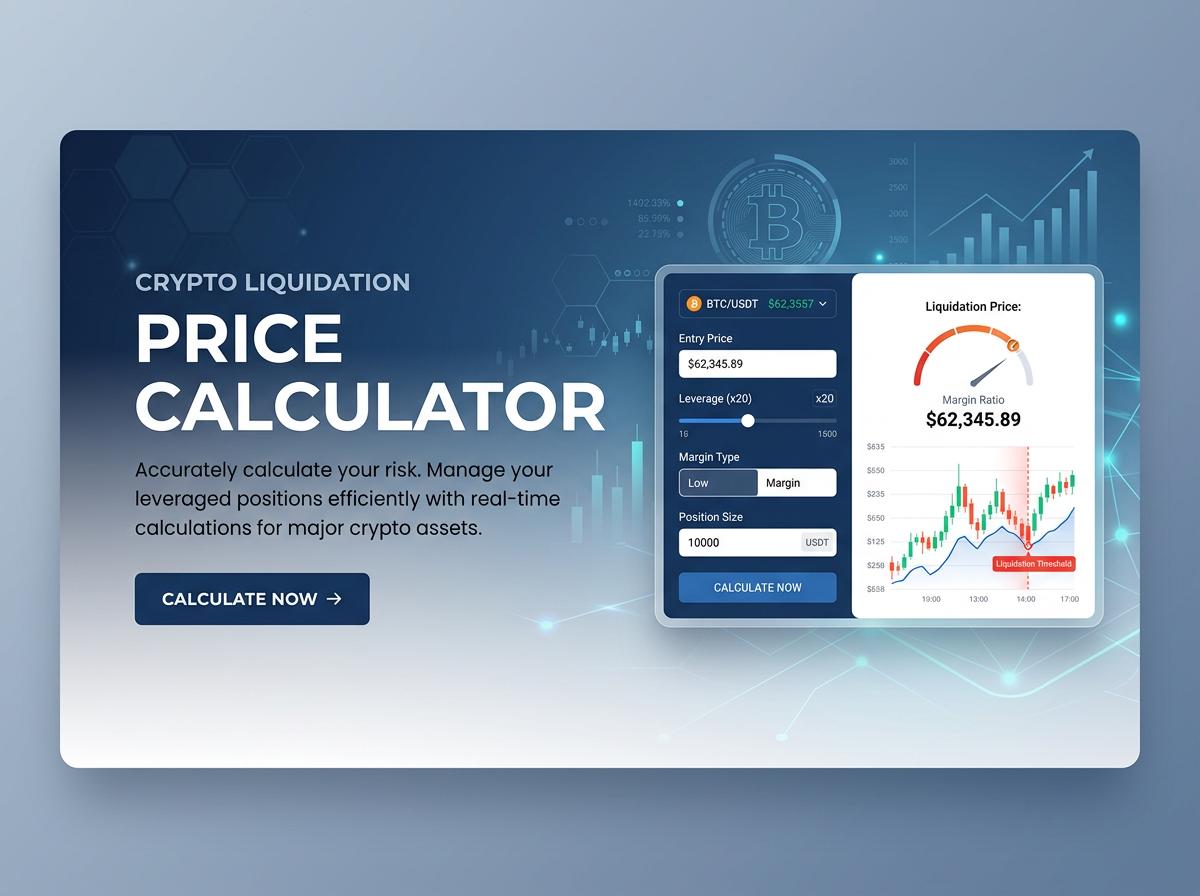

Prevent margin calls and protect your crypto portfolio. Use our free Crypto Liquidation Price Calculator to instantly determine the exact liquidation price for your long and short leveraged positions. Manage risk, plan your trades safely, and trade with confidence.
Liquidation Calculator
What is a crypto liquidation price?
A crypto liquidation price is the specific asset price at which a cryptocurrency exchange automatically closes your leveraged position. When you trade with margin, you are essentially borrowing funds from the exchange to increase your buying power. In exchange, you must maintain a minimum account balance to cover potential losses.
If the market moves against your trade and your collateral drops below this required threshold, the exchange liquidates your position to protect itself from default. Key factors determining this exact price point include:
- Your initial entry price
- The amount of leverage applied
- Your initial margin (the collateral you deposited)
How does leverage affect the liquidation price?
Leverage has an inverse relationship with your safety buffer: the higher the leverage, the closer your liquidation price is to your initial entry price. Because you are borrowing significantly more money with higher leverage, even a tiny market movement against you can completely wipe out your margin.
Here is an example demonstrating the effect of leverage on a $1,000 long position:
| Leverage Used | Margin Required | Price Drop Triggering Liquidation |
|---|---|---|
| 2x | $500 | ~50% |
| 10x | $100 | ~10% |
| 100x | $10 | ~1% |
What happens to your funds when this price is hit?
When the market hits your liquidation price, you lose control of your position, and your funds undergo a forced closure process:
- Position Closure: The exchange's risk engine automatically places a market order to close your trade immediately.
- Margin Confiscation: Your initial margin, used as collateral for that specific trade, is wiped out to cover the borrowed funds and market losses.
- Fee Deduction: Exchanges deduct an additional liquidation clearance fee or penalty from your collateral.
- Insurance Fund Deposit: Any tiny residual value left over after closing the position and paying fees is deposited into the exchange's insurance fund, meaning you usually walk away with $0.
How do exchanges calculate the liquidation price?
Exchanges use specific mathematical formulas to calculate the liquidation price. They generally rely on the "Mark Price" (an aggregated index price from multiple exchanges) rather than the localized "Last Price" to prevent unfair liquidations caused by temporary wicks or manipulation.
For a standard Long position, the automated calculation relies on three main variables:
- Entry Price: The exact price at which you opened the trade.
- Initial Margin: The funds you put up as collateral.
- Maintenance Margin Rate (MMR): The absolute minimum percentage of margin required to keep the trade open.
If the Mark Price falls to or below this calculated value, the liquidation engine takes over.
Can you change your liquidation price after opening a trade?
Yes, you can actively manage and change your liquidation price while a trade is still open. Traders typically do this to give their positions more breathing room during periods of high market volatility.
You can push your liquidation price further away by utilizing the following methods:
- Adding Margin: Depositing more collateral into your specific margin account increases your safety buffer.
- Lowering Leverage: Manually reducing your leverage multiplier effectively increases your required margin base.
- Closing Part of the Position: Taking partial losses reduces the overall position size, which favorably adjusts the margin requirements for the remainder of the trade.
How do isolated and cross margin modes affect liquidation?
The margin mode you select fundamentally changes your risk exposure and dictates how your liquidation price behaves:
- Isolated Margin: Your risk is strictly limited to the specific collateral assigned to that single trade. If liquidated, you only lose that isolated amount. The liquidation price remains fixed based solely on that specific margin.
- Cross Margin: The trade shares collateral with your entire account balance. If the trade loses money, it will pull available funds from your overall wallet to prevent liquidation. This pushes the liquidation price much further away, but if liquidation is eventually triggered, you lose your entire account balance.
Does the concept of liquidation apply to spot trading?
No, the concept of forced liquidation does not apply to standard spot trading. In the spot market, you are exchanging capital to buy and own the actual underlying cryptocurrency outright, rather than borrowing funds to trade price movements.
If you buy 1 Bitcoin on the spot market and its fiat value drops by 90%, you still own exactly 1 Bitcoin. Your portfolio's dollar value will be significantly lower, but the exchange will never forcibly sell your asset or close your position. Liquidation is strictly a mechanism for margin, futures, and options trading.
What role does maintenance margin play in liquidation?
The maintenance margin is the critical trigger threshold for a forced liquidation. While the "initial margin" is the amount of collateral required to open a leveraged position, the "maintenance margin" is the absolute minimum equity you must hold to keep it open.
As your trade incurs floating losses, your total margin equity drops. Liquidation does not happen when your margin hits zero; it happens the exact moment your remaining margin drops below the maintenance margin level. This ensures there are always enough funds to cover the counterparty and trading fees.
Are there penalty fees associated with being liquidated?
Yes, being liquidated is almost always more expensive than closing a losing trade manually. Cryptocurrency exchanges impose severe financial penalties to heavily discourage traders from letting their accounts reach the point of default.
These liquidation penalties typically include:
- Clearance Fees: A flat percentage fee charged on the entire nominal value of your position, not just your initial margin.
- Taker Fees: Forced liquidations are executed instantly as market orders, meaning you will pay the more expensive "taker" trading fee rate.
- Insurance Fund Forfeiture: Any remaining fractional margin left after the position is closed is seized by the exchange's insurance fund.
How can you prevent your trade from hitting the liquidation price?
Preventing liquidation requires highly disciplined risk management. Here are the most effective strategies to protect your account balance:
- Use Stop-Loss Orders: Always set a strict stop-loss order placed comfortably ahead of your liquidation price. This ensures the trade is closed with a controlled, known loss before the exchange intervenes.
- Trade with Lower Leverage: Keep leverage low (e.g., 2x to 5x) to give your position a massive buffer against normal cryptocurrency market volatility.
- Monitor Margin Ratios: Keep a close eye on your maintenance margin. Preemptively add more funds to your isolated margin if a trade is struggling.
- Avoid Overtrading: Do not commit 100% of your portfolio to margin trades.
Sources:
 Impermanent Loss Calculator (DeFi Liquidity Pools)