
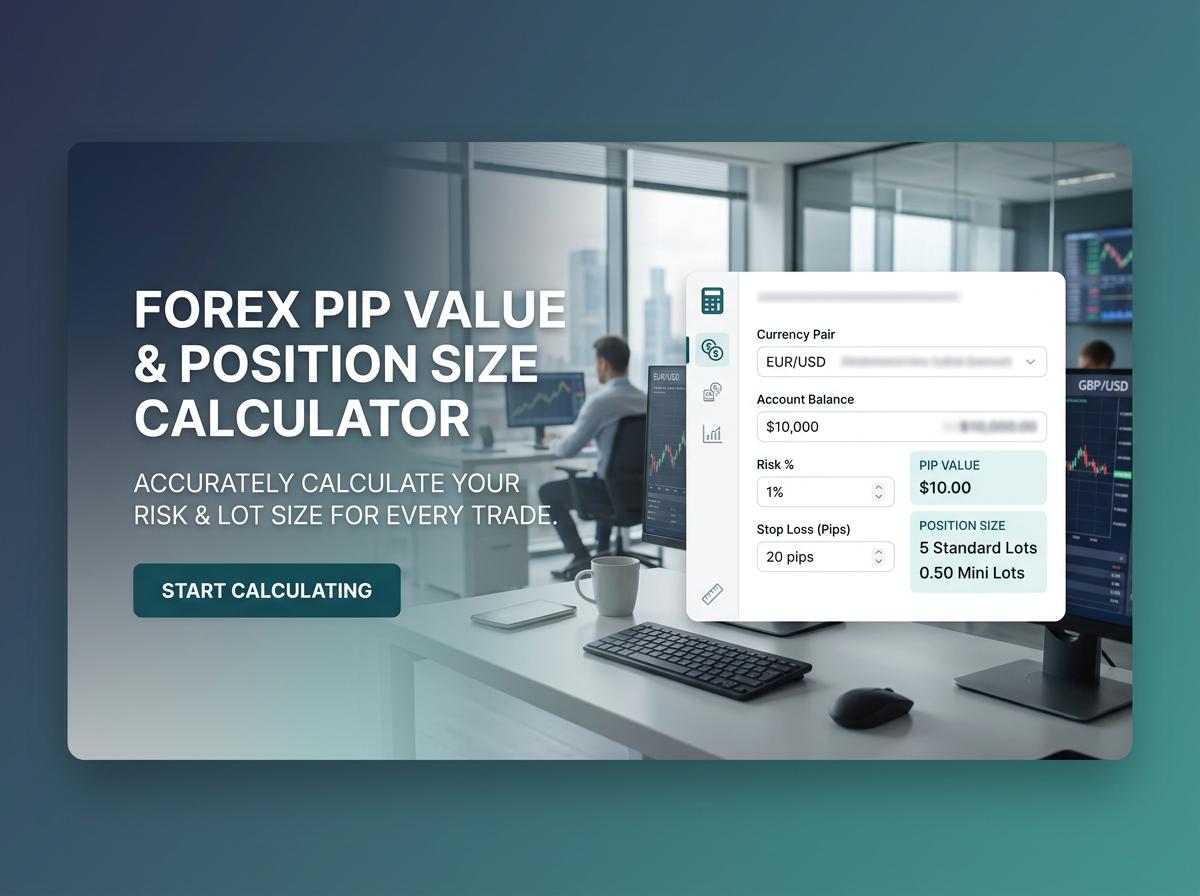

Optimize your forex trading with our free Pip Value & Position Size Calculator. Quickly determine exact pip values and your ideal lot size based on your account balance, stop loss, and risk tolerance. Manage your trades effectively, protect your capital, and trade with confidence. Calculate your precise trade size instantly!
Forex Position Size Calculator
What exactly is a pip in forex trading?
A "pip" (Percentage in Point) is the standard unit of measurement for price movements in forex trading. It represents the smallest standardized price change an exchange rate can make.
- Most Pairs: A pip is the fourth decimal place (e.g., 0.0001).
- Yen Pairs: A pip is the second decimal place (e.g., 0.01).
For example, if the EUR/USD pair moves from 1.1050 to 1.1051, that is a one-pip movement. Many modern brokers also quote fractional pips, called "pipettes," which add an extra decimal place (5th or 3rd) for greater pricing precision.
How is the value of a single pip calculated?
The value of a single pip is calculated using the position size (lot size) and the current exchange rate of the currency pair. The basic formula is:
Pip Value = (One Pip / Exchange Rate) × Lot Size
To calculate it manually:
- Identify the pip decimal (0.0001 for most pairs, 0.01 for JPY pairs).
- Divide that decimal by the current exchange rate.
- Multiply the result by your trade size (e.g., 100,000 for a standard lot).
If USD is the quote currency (e.g., EUR/USD), the calculation simplifies perfectly: a 1-pip movement on a standard 100,000-unit lot always equals exactly $10.00.
Why do pip values differ across various currency pairs?
Pip values differ across currency pairs primarily because the quote currency (the second currency in the pair) varies. The baseline pip value is always inherently calculated in the quote currency of the pair being traded.
For example:
- In EUR/USD, the pip value is initially calculated in US Dollars.
- In EUR/GBP, the pip value is calculated in British Pounds.
- In USD/JPY, the pip value is calculated in Japanese Yen.
Because these global currencies have different exchange rates relative to each other, the converted financial value of a pip will constantly fluctuate based on real-time market rates.
How does your account base currency affect the pip value?
Your account base currency dictates the final monetary value of a pip that you see on your trading platform. While a pip's intrinsic value relies on the pair's quote currency, your broker must convert this amount into your account's base currency.
If your account is denominated in USD:
- Trading a pair with USD as the quote currency (e.g., GBP/USD) requires no conversion.
- Trading a pair with a different quote currency (e.g., EUR/GBP) means the broker converts the resulting GBP pip value into USD using the live GBP/USD exchange rate.
Therefore, as exchange rates fluctuate, the actual dollar pip value of non-USD quote pairs will shift.
What is the difference between standard, mini, and micro lots?
In forex, a "lot" represents the standardized quantity of currency you are trading. The primary differences lie in the number of units controlled and the corresponding pip value.
| Lot Type | Units of Currency | Volume / Size | Estimated Pip Value (USD Quote) |
|---|---|---|---|
| Standard | 100,000 | 1.0 | $10.00 |
| Mini | 10,000 | 0.1 | $1.00 |
| Micro | 1,000 | 0.01 | $0.10 |
Micro lots are ideal for beginners testing strategies with low risk, while standard lots are used by experienced retail and institutional traders.
How does lot size directly influence your overall position size?
Lot size is the direct multiplier that determines your overall position size and your financial exposure in the market. When you choose a lot size, you are deciding exactly how many units of the base currency you are buying or selling.
If you buy 2 standard lots of EUR/USD, your position size is exactly 200,000 Euros. Consequently, your lot size dictates your pip value. A larger lot size yields a higher pip value, resulting in drastically larger potential profits or steeper losses for every single pip the market moves.
What is the formula for calculating position size based on account risk?
To calculate the proper position size based on a strict risk management framework, you need your account balance, risk percentage, stop-loss distance, and pip value.
Position Size (in lots) = Risk Amount / (Stop-Loss in Pips × Pip Value per Lot)
Here is how it breaks down:
- Risk Amount: Multiply your account balance by your risk percentage (e.g., $10,000 × 1% = $100 risk).
- Stop-Loss: Determine the distance to your stop-loss (e.g., 50 pips).
- Calculate: Divide the risk amount by the stop-loss multiplied by the pip value ($100 / (50 pips × $10) = 0.2 lots).
How do you accurately measure stop-loss distance in pips?
Measuring stop-loss distance in pips involves calculating the absolute mathematical difference between your entry price and your predetermined stop-loss price. Most trading platforms feature a crosshair tool to measure this visually.
To calculate it manually:
- For standard pairs (4 decimals): If you buy EUR/USD at 1.1050 and place a stop-loss at 1.1000, subtract the two: 1.1050 - 1.1000 = 0.0050. Drop the decimal to get 50 pips.
- For JPY pairs (2 decimals): If you short USD/JPY at 150.50 with a stop-loss at 151.25, subtract the two: 151.25 - 150.50 = 0.75. Drop the decimal to get 75 pips.
How does account leverage impact your maximum allowable position size?
Account leverage directly dictates your purchasing power by lowering the margin requirement needed to open a trade. It allows you to control a massive position size using only a fraction of your own capital.
For example, to trade one standard lot ($100,000) without leverage (1:1), you need the full $100,000. However, with 100:1 leverage, your broker requires only 1% of the position size as margin. Therefore, you only need $1,000 in free margin to open that same $100,000 trade.
While high leverage dramatically increases your allowable position size, it does not change the pip value. It simply allows you to assume larger market exposure.
Why is strict position sizing essential for long-term risk management?
Strict position sizing is the absolute cornerstone of long-term risk management because it is your primary defense against the mathematical certainty of losing streaks. By calculating precise lot sizes based on a fixed risk percentage (usually 1-2%), you ensure no single loss ruins your portfolio.
Key benefits include:
- Capital Preservation: Keeps you in the game long enough to let a profitable trading edge play out over a large sample size of trades.
- Emotional Control: Removes the psychological panic of excessive financial exposure.
- Drawdown Prevention: Recovering from a 50% drawdown requires a 100% gain, but recovering from a 5% drawdown only requires a highly achievable 5.2% gain.
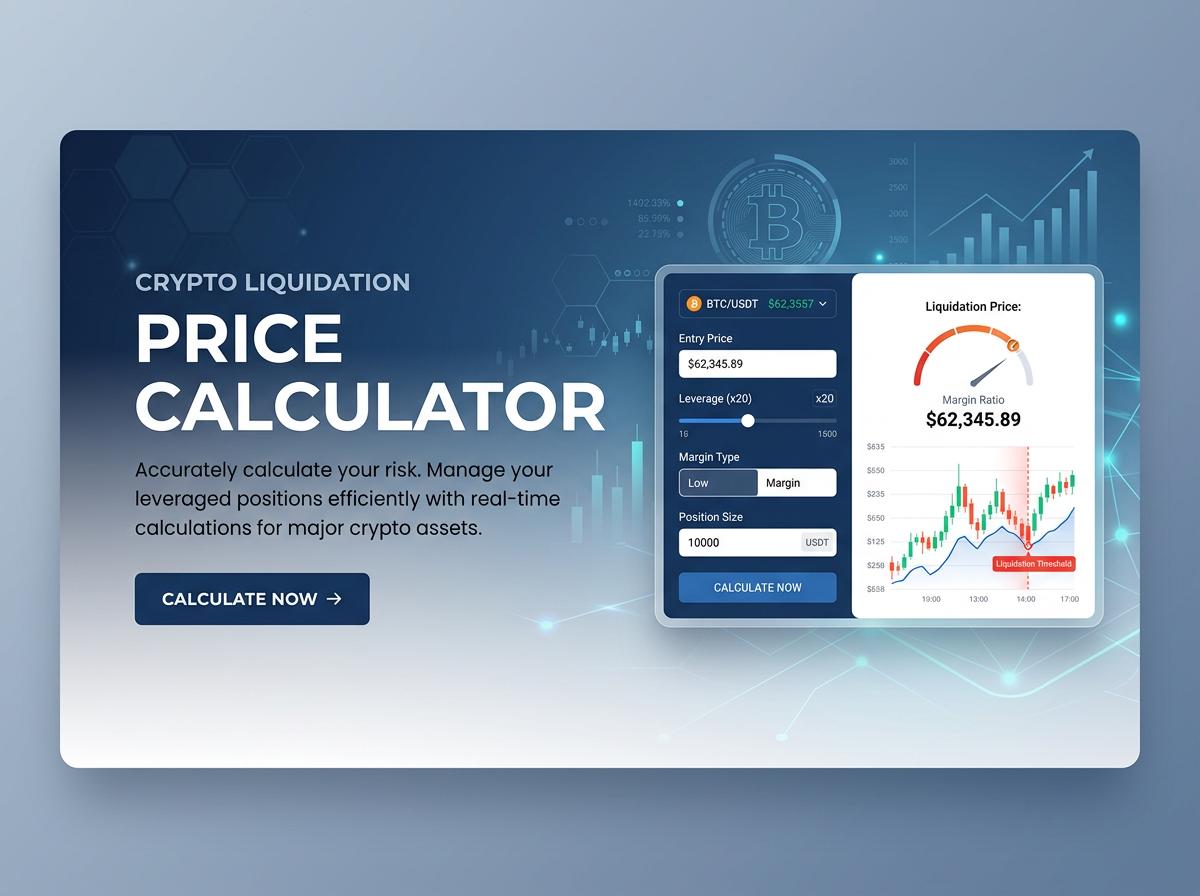 Crypto Liquidation Price Calculator