
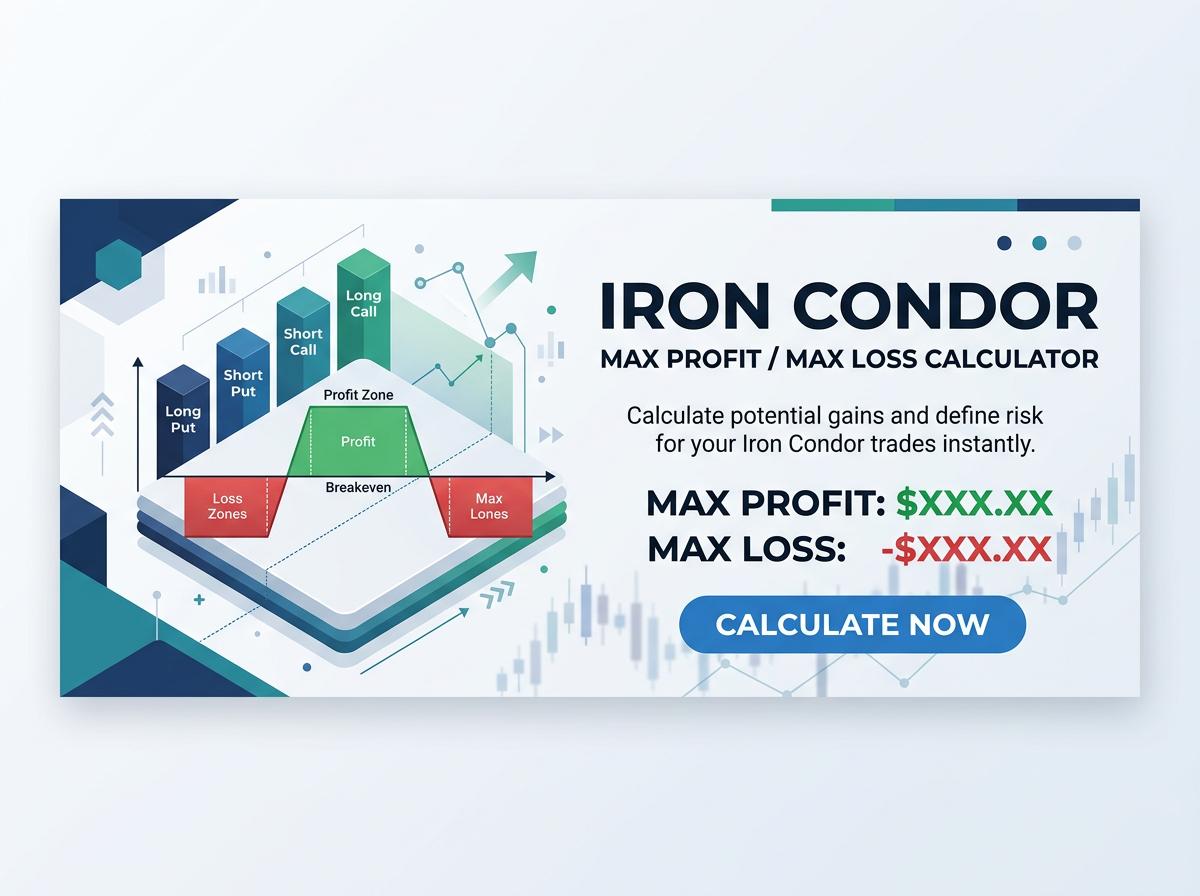

Optimize your options trades with our free Iron Condor Calculator. Instantly calculate your maximum profit, maximum loss, and break-even points to manage risk perfectly. Enter your strike prices and premiums to plan your next trade with confidence.
Iron Condor Calculator
How is the maximum profit calculated for an iron condor?
The maximum profit for an iron condor is strictly equal to the net premium received when the position is first opened, minus any commissions and fees. An iron condor consists of selling an out-of-the-money (OTM) put spread and an OTM call spread. Because the credit received from selling the short options is greater than the debit paid to buy the long options, the trader collects a net credit upfront. This net credit represents the absolute ceiling of profitability.
Under what specific market conditions does the maximum profit occur?
Maximum profit is achieved when the underlying asset's price closes between the strike prices of the two short options at expiration. Under these conditions, the market is usually experiencing low volatility or range-bound price action. As a result, all four options in the strategy expire worthless:
- The short call and long call expire worthless.
- The short put and long put expire worthless.
Because there is no obligation to buy or sell the underlying asset upon expiration, the trader gets to keep the entire initial net premium received.
How do you calculate the exact maximum loss for this strategy?
The exact maximum loss is calculated by taking the difference between the strike prices of the wider spread, multiplying it by the contract multiplier (usually 100), and subtracting the initial net premium received.
| Variable | Formula Component |
|---|---|
| Spread Width | Higher Strike - Lower Strike (of the wider wing) |
| Gross Risk | Spread Width × 100 |
| Max Loss | Gross Risk − Net Premium Received |
At what underlying asset price points does the maximum loss happen?
Maximum loss occurs if the underlying asset's price at expiration moves drastically outside the protection of your short strikes and exceeds your long wings. Specifically, it happens when the price is:
- Above the long call strike price: This triggers the maximum loss on the call credit spread side.
- Below the long put strike price: This triggers the maximum loss on the put credit spread side.
At these exact points or beyond, the maximum intrinsic value of either the call spread or the put spread is fully realized, capping out the loss.
How does the width of the credit spreads affect the maximum loss?
The width of the credit spreads dictates your capital at risk. A wider spread directly increases the maximum potential loss, but it generally yields a higher initial premium and a wider breakeven range, improving the probability of profit. Conversely, a narrower spread restricts the maximum loss but yields less premium upfront.
If the call spread is $5 wide and the put spread is $3 wide, the maximum loss calculation is based solely on the wider $5 spread, since the underlying price can only move against one side of the iron condor at expiration.
Does the initial net premium received increase or decrease your maximum loss?
The initial net premium received decreases your maximum loss. Because an iron condor is a net credit strategy, the cash you collect upfront acts as a financial buffer against the maximum width of the spread.
For example, if the width of your spread represents a $500 gross risk and you collect $100 in premium when opening the trade, your maximum loss is reduced to $400. Collecting a higher premium further reduces the maximum potential loss.
Can the maximum loss occur on both sides of the trade simultaneously?
No, the maximum loss cannot occur on both sides simultaneously. An underlying asset can only have one closing price at expiration. It is mathematically impossible for the price to close above the highest long call strike and below the lowest long put strike at the exact same time.
Because only one side (either the call spread or the put spread) can be breached at expiration, your maximum risk is confined to the single wider side of the iron condor, rather than the combined widths of both spreads.
How do trading commissions and fees impact the actual maximum profit?
Trading commissions and fees directly reduce your actual maximum profit and increase your maximum loss. An iron condor is a four-legged strategy (involving two short and two long options), meaning it incurs higher transaction costs than single-leg or two-leg strategies.
If you collect $100 in net premium but pay $4 in commissions to open the trade, your true max profit drops to $96. Furthermore, if you close the position early to secure profits or stop losses, additional closing commissions will further erode the net profitability.
What is the typical risk-to-reward ratio between max loss and max profit?
The typical risk-to-reward ratio for an iron condor is heavily skewed toward risk, meaning traders risk more capital than they stand to gain. A common setup frequently risks 2 to 4 times the potential reward (e.g., risking $300 to make $100, which is a 3:1 ratio).
| Strategy Trait | Typical Range |
|---|---|
| Risk / Reward | 2:1 to 4:1 |
| Probability of Profit | 70% to 85% |
This unfavorable payout ratio is offset by a mathematically higher probability of the trade being a winner.
How does the risk of early assignment alter the expected maximum loss?
While early assignment does not mathematically change the theoretical maximum loss, it can cause secondary financial impacts that increase actual losses. Early assignment on a short leg forces you into a long or short position of 100 shares of the underlying asset.
Handling this unexpected stock position requires significant margin. If your account lacks sufficient capital, the broker may force immediate liquidation. The slippage, widened bid-ask spreads, and extra transaction fees incurred while manually exiting the assigned stock and the remaining long option can push the real-world loss slightly past the calculated theoretical max loss.
Sources:
 Forex Pip Value & Position Size Calculator