
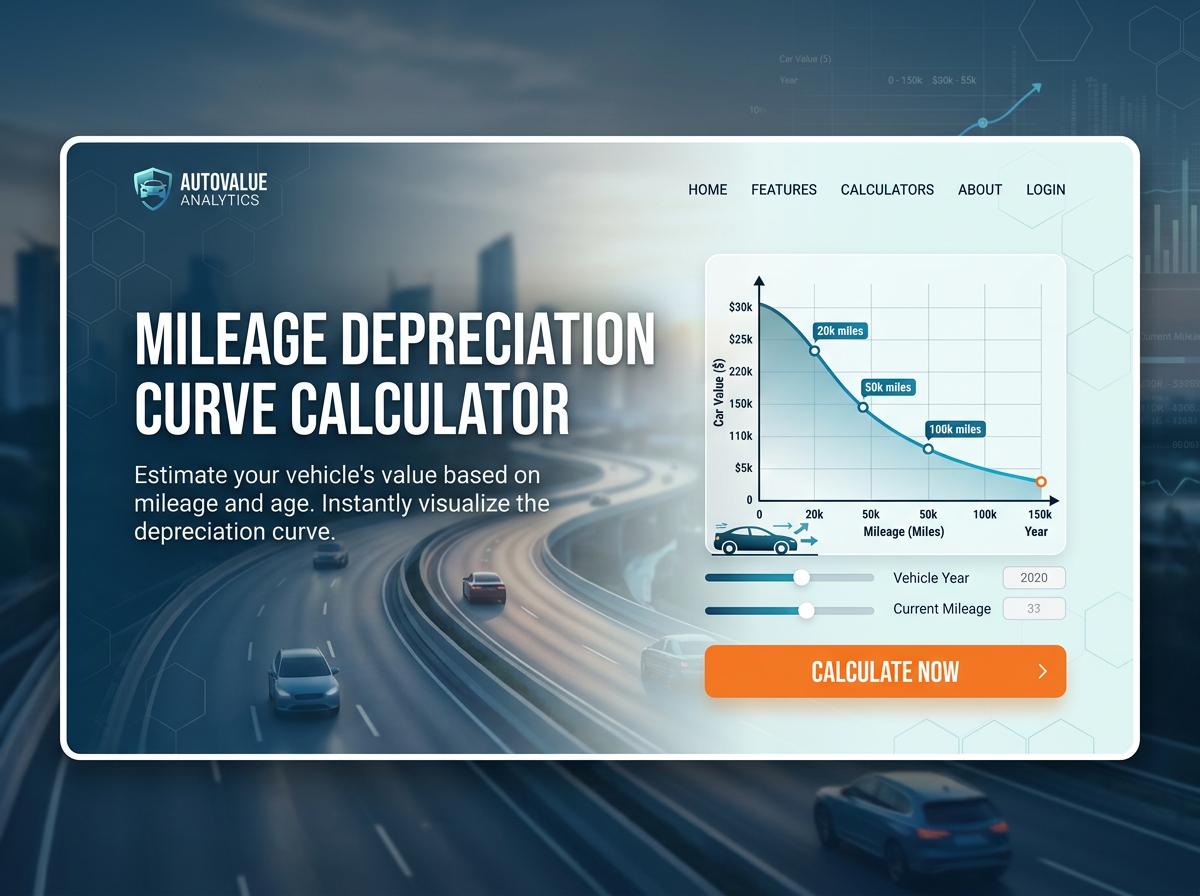

Discover how much value your car loses per mile with our free Mileage Depreciation Curve Calculator. Visualize your vehicle's depreciation rate, estimate future resale value, and make smarter buying or selling decisions today. Try it now!
Mileage Depreciation Curve Calculator
What exactly is a mileage depreciation curve?
A mileage depreciation curve illustrates how a vehicle's financial value decreases as its total accumulated miles increase. Unlike time-based depreciation (age), this curve isolates the wear-and-tear factor represented by the odometer reading.
Visually, the curve typically starts steep—indicating rapid value loss during the first few tens of thousands of miles—and gradually flattens out as the car reaches high mileage. Key components include:
- X-Axis: Accumulated miles (e.g., 0 to 200,000+).
- Y-Axis: Retained vehicle value or percentage of the original price.
Understanding this curve helps owners predict future value, optimize trade-in times, and calculate the true cost of driving.
How do accumulated miles directly impact a vehicle's resale value?
Accumulated miles directly correlate with mechanical wear and tear, serving as the primary metric buyers and dealers use to gauge a vehicle's remaining lifespan. As miles rack up, vital components like the transmission, engine, suspension, and exhaust systems approach the end of their usable life.
Consequently, higher mileage increases the statistical likelihood of expensive repairs. The used car market prices this risk directly into the vehicle's resale value. For every additional mile driven, a fraction of the car's value is permanently lost. On average, a standard vehicle loses between $0.05 and $0.10 in resale value per mile driven, though this rate fluctuates based on the specific segment of the depreciation curve the vehicle is currently on.
Are there specific mileage milestones where a car's value drops sharply?
Yes, cars often experience sharp drops in value at specific, psychologically and financially significant mileage milestones. These sudden depreciations are usually tied to warranty expirations and major scheduled maintenance intervals.
| Milestone | Impact on Value |
|---|---|
| 36,000 Miles | First sharp drop. This typically marks the end of the manufacturer's bumper-to-bumper warranty. |
| 60,000 Miles | Often the end of the powertrain warranty; generally requires major fluid flushes and brake work. |
| 100,000 Miles | A major psychological barrier for buyers. Value plummets as the car formally shifts into the "high mileage" category. |
Crossing the 100,000-mile mark causes the steepest instantaneous depreciation, as many financing institutions restrict or refuse loans for vehicles past this threshold.
How does the depreciation curve vary between different car brands and models?
The depreciation curve varies drastically based on a brand's reputation for reliability, maintenance costs, and market demand.
- Reliable Economy Brands: Brands like Toyota, Honda, and Subaru have relatively flat depreciation curves. Buyers trust these cars to run well past 150,000 miles, so high mileage penalizes their value much less.
- Luxury Brands: Vehicles from BMW, Mercedes-Benz, and Audi experience incredibly steep mileage curves. Because their parts and labor are expensive, the used market heavily penalizes them as they approach out-of-warranty mileage.
- Trucks and SUVs: Heavy-duty trucks (e.g., Ford F-Series, Toyota Tacoma) retain value exceptionally well despite high mileage due to their rugged utility and durable builds.
Ultimately, high perceived reliability flattens the curve, while high expected repair costs make it plunge.
Which factor accelerates depreciation more between vehicle age and mileage?
The dominant factor shifts depending on the vehicle's lifespan phase. During the first 1 to 3 years, vehicle age accelerates depreciation more aggressively. Simply driving a new car off the lot causes an immediate drop, and model-year obsolescence (new body styles, updated tech) pushes value down regardless of how few miles are on the odometer.
However, after a car is 5 to 7 years old, the age depreciation curve flattens out, and mileage takes over as the primary driver of value loss. For example, a 10-year-old car with 50,000 miles will be worth significantly more than a 10-year-old car with 150,000 miles. Ultimately, age dictates early depreciation, while accumulated mileage dictates late-stage depreciation.
How can buyers use this curve to identify the best used car deals?
Savvy buyers use the mileage depreciation curve to find "sweet spots" where a car has lost the maximum amount of financial value but still retains the majority of its mechanical life.
- Buy post-milestone: Purchasing a car right after it crosses a major psychological barrier (like 100,000 miles) yields massive discounts, even though the car is mechanically similar to one with 95,000 miles.
- Target the 3-year/36k mark: Off-lease vehicles at this point have absorbed the steepest part of the depreciation curve (losing up to 40% of value) but still have plenty of life remaining.
- Analyze the plateau: Buying a reliable vehicle between 60,000 and 80,000 miles allows a buyer to ride the "flat" part of the curve, minimizing future depreciation losses.
At what point on the curve is it financially optimal to sell a vehicle?
There are two financially optimal points to sell a vehicle, depending on your overall goals:
1. Before Major Mileage Milestones: If you want to maximize your cash return, sell just before the curve drops sharply. Ideal points are around 30,000 miles (before the basic warranty expires), 55,000 miles (before major 60k services), or roughly 90,000 to 95,000 miles (before the dreaded 100k-mile psychological barrier).
2. The "Drive it into the Ground" Approach: The absolute most cost-effective point to sell is at the very end of the curve (150,000+ miles). By this point, the curve is completely flat, meaning the car loses almost no additional value per year. You have successfully squeezed every dollar of utility out of the vehicle.
How does the depreciation curve dictate lease mileage limits and penalties?
A car lease is fundamentally an agreement where you pay for the exact amount of depreciation a vehicle experiences while you drive it. Leasing companies rely heavily on the mileage depreciation curve to estimate the car's "residual value" at the end of the term.
Because every mile driven pushes the car further down the value curve, lessors enforce strict limits (usually 10,000 to 12,000 miles per year). If you exceed these limits, the vehicle will be worth less at auction than the leasing company projected. To protect their margins, lessors charge mileage penalties—typically $0.15 to $0.25 per excess mile. This fee directly mirrors the steepness of the depreciation curve to cover the financial value those extra miles destroyed.
Can a flawless maintenance history help flatten a steep depreciation curve?
Yes, a flawless, documented maintenance history can partially flatten a steep depreciation curve, though it cannot eliminate it entirely. As mileage increases, the primary reason a car's value drops is the buyer's fear of imminent mechanical failure. Comprehensive service records directly alleviate this anxiety.
While a pristine Carfax report won't magically make a 100,000-mile car price out like a 50,000-mile car, it allows the seller to demand the absolute top-tier "Excellent" Kelley Blue Book value. For notoriously unreliable or high-maintenance luxury vehicles, meticulous records are often the only way to prevent the mileage curve from falling into a complete nosedive, preserving thousands of dollars in resale value compared to similar cars with spotty histories.
Is the loss of value from mileage constant or does it slow down over time?
The loss of value from mileage is not constant; it slows down significantly over time. The depreciation curve resembles a downward slope that gradually levels off, commonly known as an asymptotic curve.
The first 30,000 miles are the most expensive. Driving a new car from 0 to 30,000 miles might wipe out 40% of its total value. However, driving that same car from 100,000 to 130,000 miles might only reduce its value by an additional 5% to 10%. As the car transitions into the "high mileage" category, its value reaches a baseline floor dictated by its utility as basic transportation. Once a car's value drops to around $3,000 to $5,000, the mileage depreciation curve becomes almost entirely flat.
Sources:
 Buy Here Pay Here Hidden Interest Calculator