

Uncover the true cost of your auto loan with our Buy Here Pay Here Hidden Interest Calculator. Easily reveal undisclosed markups, actual APR, and hidden dealership fees before you sign. Protect yourself from overpriced dealer financing and make informed car-buying decisions. Calculate your real payment today!
BHPH Hidden Interest Calculator
Total Amount Paid:
Hidden Interest / Markup:
Effective APR:
How does an inflated car price disguise the true interest rate?
When a dealership offers a highly attractive interest rate—such as 0% APR—they often compensate by inflating the vehicle's base price. This practice effectively hides the cost of borrowing within the principal amount.
For example, if a car is worth $20,000 but the dealer insists on a non-negotiable price of $23,000 to qualify for "free financing," that extra $3,000 is the disguised interest. You are paying the cost of the loan upfront through the artificially raised purchase price rather than over time through a standard Annual Percentage Rate (APR). Legally, the cash price of the vehicle should remain identical regardless of whether you pay in full or finance the purchase.
Are mandatory dealership warranties actually hidden finance charges?
Yes, in many cases they are. Under the Truth in Lending Act (TILA), any charge imposed as a condition of the extension of credit is legally considered a finance charge.
If a dealership requires you to purchase an extended warranty, service contract, or "protection package" specifically because you are financing the vehicle—but waives this requirement for cash buyers—it acts as a hidden finance charge. Because dealerships often roll the cost of these mandatory warranties into your loan principal, you end up paying both the inflated price of the unwanted warranty and the compounding interest on that warranty over the life of your loan.
What is the exact difference between the cash price and the financed price?
The exact difference lies in the total cost of borrowing, which includes interest, mandatory finance charges, and financing-specific fees. Here is a breakdown of how they differ:
| Component | Cash Price | Financed Price |
|---|---|---|
| Base Vehicle Price | Yes | Yes |
| Taxes & State Fees | Yes | Yes |
| Loan Interest | No | Yes |
| Origination/Lender Fees | No | Yes |
| Mandatory GAP/Warranties | No | Often added |
The financed price represents the Total of Payments over the loan term. Subtracting the cash price from the total financed price reveals your exact finance charge.
How do forced weekly or bi-weekly payments alter the total interest paid?
Forced weekly or bi-weekly payment schedules, commonly used by subprime "Buy Here Pay Here" dealerships, alter your total interest and borrowing costs in a few ways:
- Faster Amortization: True bi-weekly payments result in 26 half-payments a year (equal to 13 full months). This pays down the principal faster, slightly reducing total interest.
- Higher Default Risk: If forced to align with paychecks, a single missed weekly payment can trigger immediate, aggressive late fees.
- Convenience Fees: Dealers often charge processing fees for each individual payment. Four weekly payments incur four separate transaction fees, increasing your actual out-of-pocket borrowing costs compared to standard monthly payments.
Do hidden dealer prep fees get rolled into the principal loan amount?
Yes. Dealer prep fees—which cover minor administrative tasks, car washing, fluid top-offs, or removing factory plastic—are frequently added to the out-the-door price of the vehicle.
When you finance the car, these inflated, often arbitrary fees are rolled directly into the loan principal. As a result, you do not just pay the one-time $500 to $1,000 prep fee; you pay compounding interest on that amount over the entire 36 to 84-month term of the loan. This drastically increases the overall profitability of the loan for the dealer or lender while secretly driving up your total cost of ownership.
Are mandatory installation fees for GPS trackers acting as extra interest?
Legally and financially, yes. Subprime auto lenders often require the installation of GPS trackers and starter-interrupt devices to easily locate and repossess the vehicle if you default.
If the dealership charges the buyer an installation fee for this device, and this fee is only required for buyers who finance (not cash buyers), it meets the legal definition of a finance charge under federal law. When dealerships obscure this by rolling the GPS fee into the principal rather than disclosing it in the Annual Percentage Rate (APR), it acts as hidden interest, falsely lowering the stated APR on the contract.
How do aggressive late fee policies compound your overall borrowing costs?
Aggressive late fee policies compound borrowing costs through a cascading debt cycle. This usually happens in three stages:
- Capitalization: When a late fee is assessed, some lenders add it directly to your principal loan balance.
- Payment Misallocation: When you make your next payment, the lender applies your money to the late fee first, leaving a portion of your actual principal and scheduled interest unpaid.
- Interest Generation: Because the principal balance was not reduced as originally scheduled, your daily interest accrues at a higher rate.
Over time, frequent late fees can completely derail your amortization schedule, meaning you pay significantly more total interest before the loan is satisfied.
Does the contract include prepayment penalties to trap you into paying full interest?
Many auto loans, especially subprime ones, contain clauses designed to trap you into paying the maximum amount of interest, even if you pay the loan off early.
While standard prepayment penalties (a flat fee for early payoff) are illegal in some states, lenders use alternative traps like Precomputed Interest or the Rule of 78s. Under these contracts, the total interest for the entire loan term is calculated upfront and heavily front-loaded into your early payments. If you trade in the car or pay off the loan in the first year, you will find that almost none of your payments went toward the principal, effectively penalizing you for early payoff.
Why does the legally stated APR often differ from the actual out-of-pocket cost?
The legally stated Annual Percentage Rate (APR) is meant to reflect the true cost of borrowing, but legal loopholes exist. The APR calculates the interest rate plus standardized lender fees (like origination fees). However, it does not include several major out-of-pocket expenses that inflate your loan.
Costs such as state taxes, registration, title fees, credit life insurance, GAP insurance, and late payment penalties are excluded from the APR calculation. Dealerships intentionally classify forced add-ons as "voluntary" or "ancillary" products to keep the stated APR legally compliant and seemingly low, while drastically increasing your actual monthly payment and total out-of-pocket expenditure.
Can forced auto insurance policies bought directly from the dealer hide extra interest?
Yes, through a practice known as Collateral Protection Insurance (CPI) or forced-placed insurance. If your primary auto insurance lapses, the lender has the right to buy insurance to protect their collateral (the car) and pass the cost on to you.
This forced-placed insurance is notoriously overpriced. Furthermore, lenders roll these massive premium costs directly into your existing loan principal. Consequently, your loan balance spikes, and you are immediately charged your standard loan interest rate on top of the new insurance premium. This acts as a highly profitable mechanism for the lender, disguising steep interest yields inside forced insurance premiums.
Sources:
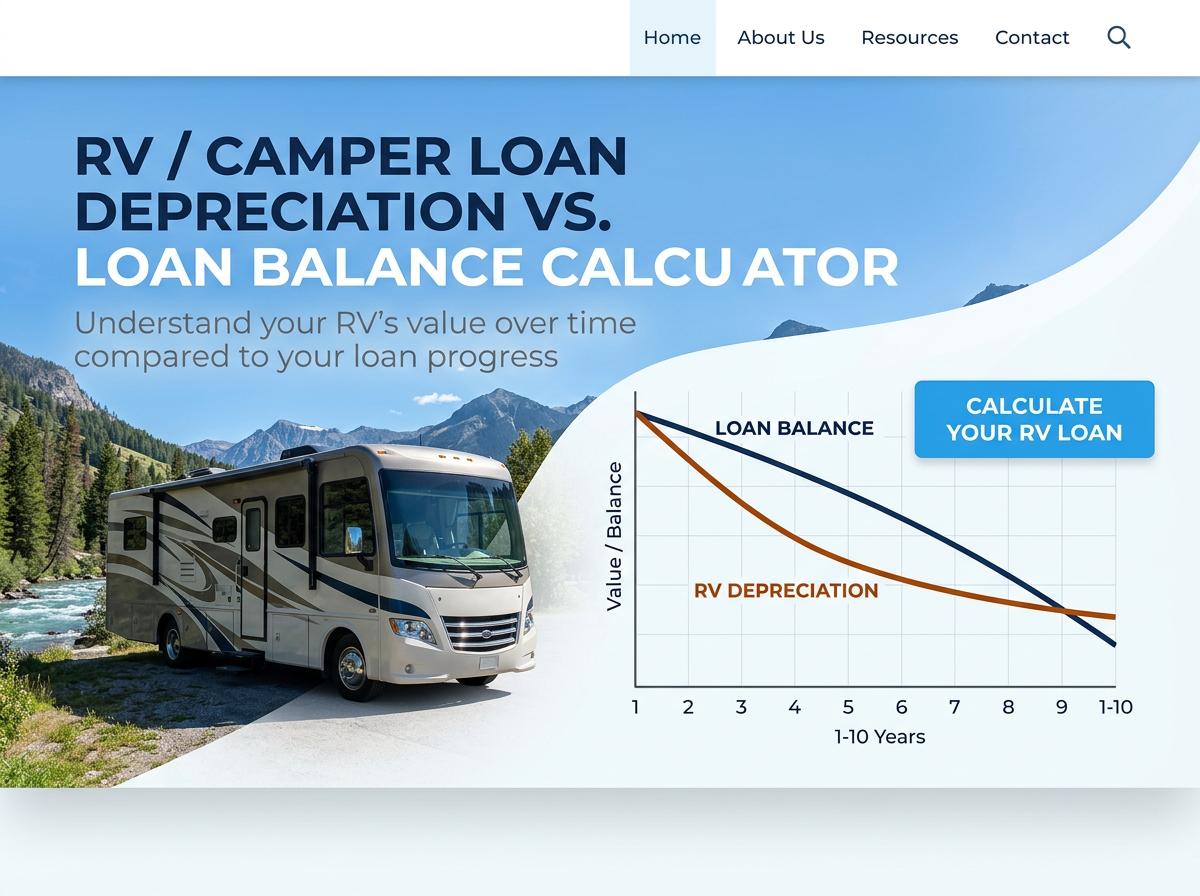 RV / Camper Loan Depreciation vs. Loan Balance Calculator