
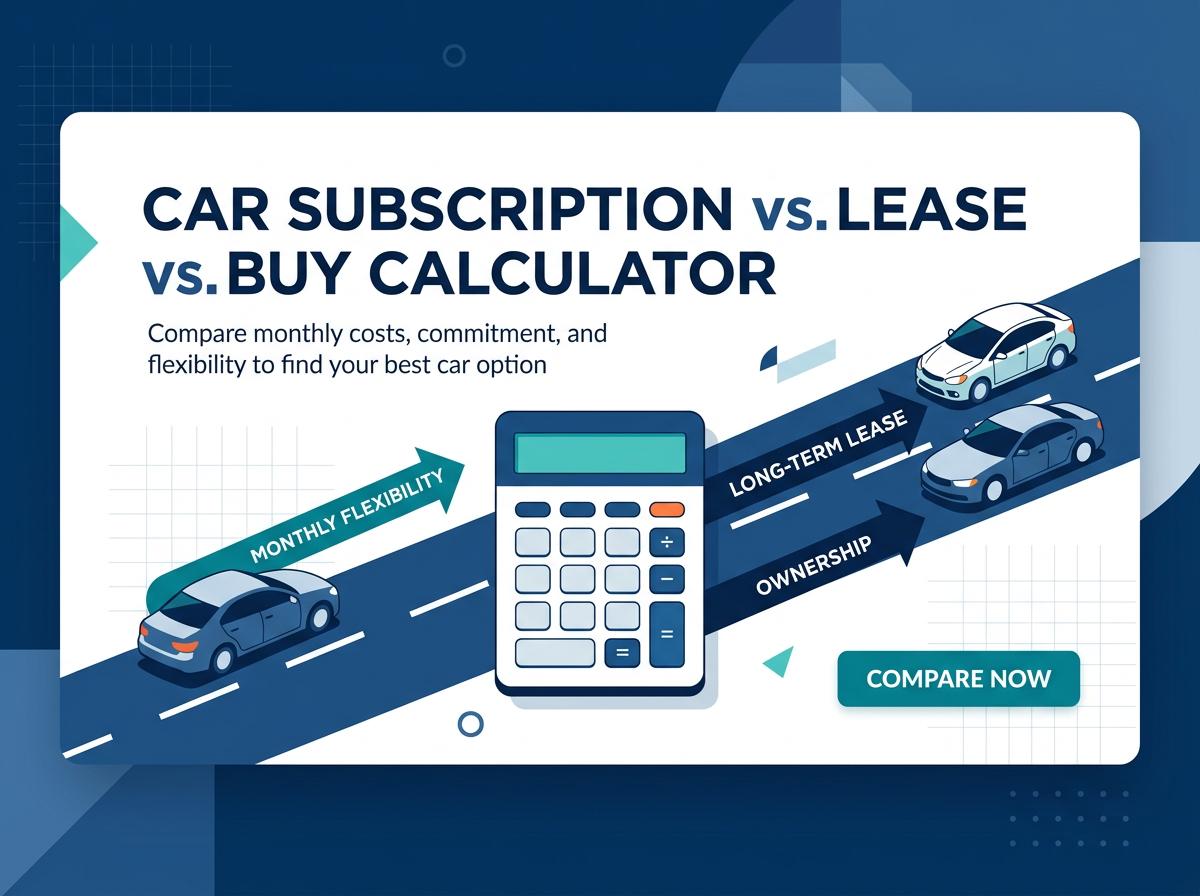

Use our free Car Subscription vs. Lease / Buy Calculator to compare the true costs of your next vehicle. Easily evaluate total expenses, including monthly payments, down payments, insurance, maintenance, and hidden fees, to find the most cost-effective and flexible option for your lifestyle and budget.
Car Subscription vs. Lease vs. Buy Calculator
Buy / Finance
Lease
Subscription
Estimated Net Cost over 36 Months
Do I want long-term vehicle equity or short-term flexibility?
Your choice depends heavily on your financial goals and current lifestyle.
- Long-term Equity (Buying): You build ownership value over time. Once the auto loan is paid off, the car becomes an asset you can sell or trade in. This is best for those who plan to keep their vehicles for five or more years.
- Short-term Flexibility (Leasing/Subscriptions): You pay for the vehicle's usage and depreciation rather than ownership. Subscriptions offer month-to-month commitments, allowing you to easily switch cars or walk away without debt. This is ideal for those anticipating life changes, temporary relocations, or who simply enjoy driving newer models frequently.
What are the total upfront costs and hidden activation fees?
Upfront costs vary significantly across different vehicle acquisition methods. Always read the fine print to identify non-refundable fees before signing.
| Method | Typical Upfront Costs | Potential Hidden Fees |
|---|---|---|
| Buying | 10-20% Down payment, taxes, registration | Dealer markup, documentation fees |
| Leasing | Capitalized cost reduction, first month's payment | Acquisition fee, security deposit |
| Subscription | Activation or joining fee (often $200-$500) | Delivery fees, background check fees |
Are routine maintenance and comprehensive insurance included in the payment?
This is a major differentiator between vehicle acquisition models:
- Car Subscriptions: Most all-inclusive subscriptions cover routine maintenance, roadside assistance, and comprehensive/collision auto insurance in one flat monthly payment.
- Leasing: Some luxury leases cover routine scheduled maintenance for the first couple of years, but you are strictly responsible for securing and paying for your own comprehensive insurance.
- Buying: You are fully responsible for all maintenance, post-warranty repairs, and insurance premiums.
If choosing a subscription, verify the insurance deductible amount and coverage limits, as these are pre-set by the provider and may not fit your specific needs.
How strict are the mileage limits and what are the overage penalties?
If you do not buy the vehicle outright, you will face mileage restrictions that are strictly enforced.
- Leases: Typically limit you to 10,000 to 12,000 miles per year. Overage penalties are charged at the end of the lease, usually ranging from $0.15 to $0.30 per additional mile.
- Subscriptions: Generally offer monthly mileage caps (e.g., 800 to 1,200 miles/month). Penalties for exceeding this limit are billed in your next monthly cycle. However, many services allow you to upgrade your mileage tier mid-month to avoid harsh penalties.
If you have an unpredictable commute or take frequent road trips, these limits require careful tracking.
Can I pause the agreement or swap vehicles if my lifestyle changes?
The ability to pause or swap vehicles is the primary benefit of a car subscription service. Many providers allow you to "flip" or swap into a different vehicle class (e.g., trading a daily commuter sedan for an SUV for a winter trip) with minimal notice, though swap fees may apply.
Additionally, if you are traveling or do not need a car for a few months, you can usually pause or cancel a subscription with just 14 to 30 days' notice.
In contrast, buying or leasing locks you into a specific vehicle. Swapping requires breaking your lease or trading in your financed car, which often results in steep financial losses.
What are the exact financial penalties for canceling the contract early?
Early termination penalties vary drastically depending on your contract:
- Car Subscriptions: Penalties are minimal. Because they operate on a month-to-month basis, you usually only lose your initial non-refundable activation fee provided you give the required notice (typically 30 days).
- Leasing: Penalties are extremely punitive. Breaking a lease early means you may be responsible for the remaining balance of the lease payments, an early termination fee, and vehicle disposal costs.
- Buying: There are no cancellation fees, but if you sell the car early while financing, you risk being "underwater" (owing more on the loan than the car's depreciated value).
Does this option require a hard credit check for approval?
Traditional auto financing and leasing almost always require a hard credit check. Dealerships and lenders rely heavily on your FICO score to determine your interest rate, monthly payment, and overall approval. This hard inquiry will temporarily lower your credit score by a few points.
Alternatively, many car subscription services only perform a soft credit check, which does not impact your credit score. Instead of focusing solely on credit history, subscription providers look at soft credit data combined with an extensive background check, a motor vehicle driving record check (MVR), and proof of income to verify eligibility.
Am I comfortable driving a lightly used vehicle instead of a brand-new one?
This is an important lifestyle and psychological consideration. When you lease a car, you are almost always getting a brand-new vehicle straight off the dealership lot with zero miles on the odometer.
When using a vehicle subscription service, you are typically getting a lightly used fleet vehicle. While these cars are professionally detailed, fully inspected, and usually only one to three years old, they have been driven by previous subscribers. If having that "new car smell" and knowing you are the sole driver is highly important to you, traditional buying or leasing is the better fit.
Are there geographic restrictions on where I can drive or live with the car?
Yes, geographic limitations can be quite strict depending on your agreement.
Subscriptions: Most providers operate in specific regional zones. While you can usually drive out of state for a short trip, you are strictly prohibited from moving permanently outside the service area. Additionally, almost all subscriptions prohibit taking the vehicle across international borders.
Leasing/Buying: If you buy a car, you have no geographic limits. Leased vehicles can generally be moved across state lines, though you must notify the leasing company to update registration and tax information. Note that ridesharing (Uber/Lyft) is universally restricted on both leases and subscriptions.
How much time am I willing to spend negotiating with dealers and insurers?
Your tolerance for administrative friction is a massive factor. Traditional buying and leasing require significant time investments. You must negotiate the vehicle price, haggle over interest rates, sit through the finance office pitches, and separately shop around for the best auto insurance rates.
Car subscriptions are designed for convenience and speed. The process is entirely digital, often completed via a smartphone app in minutes. Pricing is fixed with no haggling, and insurance, maintenance, and registration are automatically bundled. If you despise the dealership experience and value your time, the premium price of a subscription may be worth it.
 Auto Refinance Title Transfer Fee Calculator