
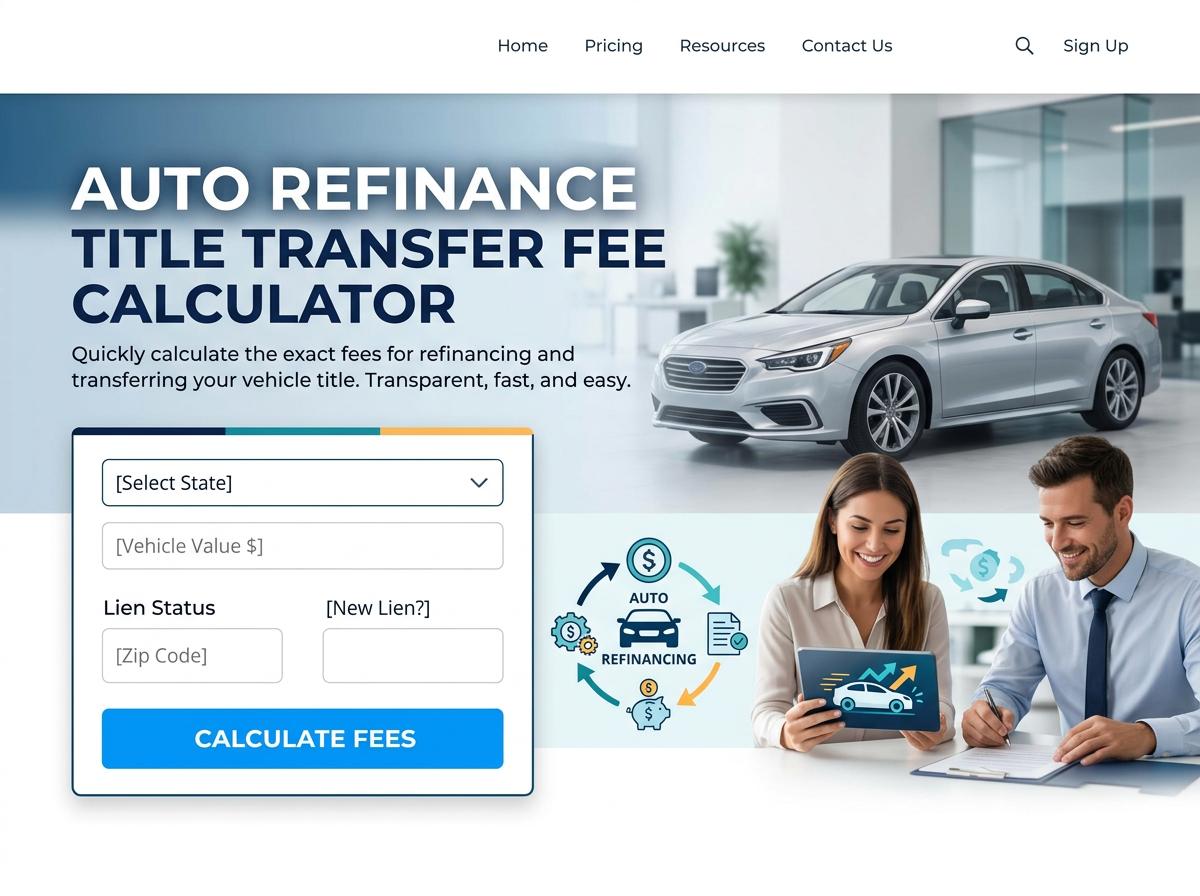

Planning to refinance your car? Use our free Auto Refinance Title Transfer Fee Calculator to instantly estimate your state-specific DMV title transfer costs. Avoid surprise charges, budget accurately, and see exactly what to expect when updating your auto loan. Try it now for fast, accurate fee calculations!
Auto Refinance Title Transfer Fee Calculator
What is an auto refinance title transfer fee?
An auto refinance title transfer fee is a mandatory state fee charged by the Department of Motor Vehicles (DMV) or equivalent agency to update your vehicle's certificate of title. When you refinance your car, you are essentially changing the lienholder—the lender who technically owns the car until the loan is fully paid off. This fee covers the administrative costs associated with removing the old lender's name and legally recording the new lender's name on the title document.
How much does a title transfer fee usually cost?
The cost of a title transfer fee is generally quite affordable, usually ranging from $10 to $50. However, the exact amount depends entirely on the state where the vehicle is registered. Here are a few examples of average state fees:
| State | Approximate Title Transfer Fee |
|---|---|
| California | $15 |
| Texas | $28 - $33 |
| New York | $50 |
Can the transfer fee be rolled into the new loan?
Yes, in many cases, the title transfer fee can be rolled into your new auto loan. Lenders frequently allow borrowers to finance this fee along with the remaining principal of the car loan to minimize out-of-pocket expenses at closing. However, it is important to note that by rolling the fee into the loan, you will pay interest on that small amount over the life of the loan. Some borrowers prefer to pay the fee upfront to avoid these extra interest charges.
Do title transfer fees vary by state?
Yes, title transfer fees vary significantly from state to state. Because vehicle registration and titling are handled entirely at the state level, each state establishes its own unique fee schedule. Depending on where you live, you might encounter:
- Flat fees: A standard, set rate applied to all title transfers.
- Variable fees: Costs that change based on vehicle type, weight, or age.
- Local taxes: Additional county or municipal processing charges added to the state base fee.
Who pays the title transfer fee during a refinance?
The borrower (the vehicle owner) is solely responsible for paying the title transfer fee during an auto refinance. Even though the new lender requires the title transfer to legally protect their financial interest in the vehicle, the financial burden of the DMV administrative costs falls on you. You will either pay this fee directly out-of-pocket when finalizing the refinance or have it financed into your new loan balance.
Does the new lender handle the title transfer process?
Yes, the new lender typically handles the title transfer process on your behalf. Since it is in their best financial interest to ensure their name is legally recorded as the new lienholder, they usually manage the paperwork. The process usually follows these steps:
- The new lender pays off your old auto loan.
- The old lender officially releases the lien on the vehicle.
- The new lender submits the lien release and title transfer paperwork directly to the state DMV.
Are there other DMV fees associated with refinancing?
While the title transfer fee is the most common, there may be other DMV or state-related fees when refinancing your vehicle:
- Lien recording fee: A specific, separate charge just for adding the new lienholder's name to the state registry.
- Registration fees: Usually not required unless your registration is actively expiring, but some states require updates.
- Document or processing fees: Small administrative fees for filing paperwork electronically or manually.
Keep in mind that lenders may also charge their own origination fees, which are completely separate from DMV fees.
How long does the title transfer take to process?
The timeline for a title transfer varies depending on your state's DMV and the responsiveness of the lenders involved. Typically, the entire process takes between 2 to 6 weeks. The timeline generally flows as follows:
- Days 1-5: The new lender sends the payoff amount to the old lender.
- Days 5-15: The old lender processes the payment and releases the existing lien.
- Days 15-30+: The new lender files paperwork with the DMV, and the DMV processes the updated title. Electronic titles (e-titles) usually process much faster than physical paper titles.
Do I need to visit the DMV to pay this fee?
In most auto refinancing situations, you do not need to visit the DMV in person. Your new lender will collect the necessary title transfer and lien recording fees from you during the loan closing process. The lender, or their designated third-party title service, will then submit the fees and the required paperwork directly to the DMV on your behalf.
What happens if the title transfer fee is not paid?
If the title transfer fee is not paid, the DMV will simply not process the title update. This creates several major legal and financial issues:
- The new lender cannot be legally recorded as the lienholder, leaving their loan unsecured.
- Because the loan is unsecured, the lender may penalize you, cancel the refinance agreement, or convert the loan to a personal loan with a drastically higher interest rate.
- You will face legal and administrative roadblocks if you try to sell or trade in the vehicle later.
Sources:
 Dealership Doc Fee Impact Calculator