
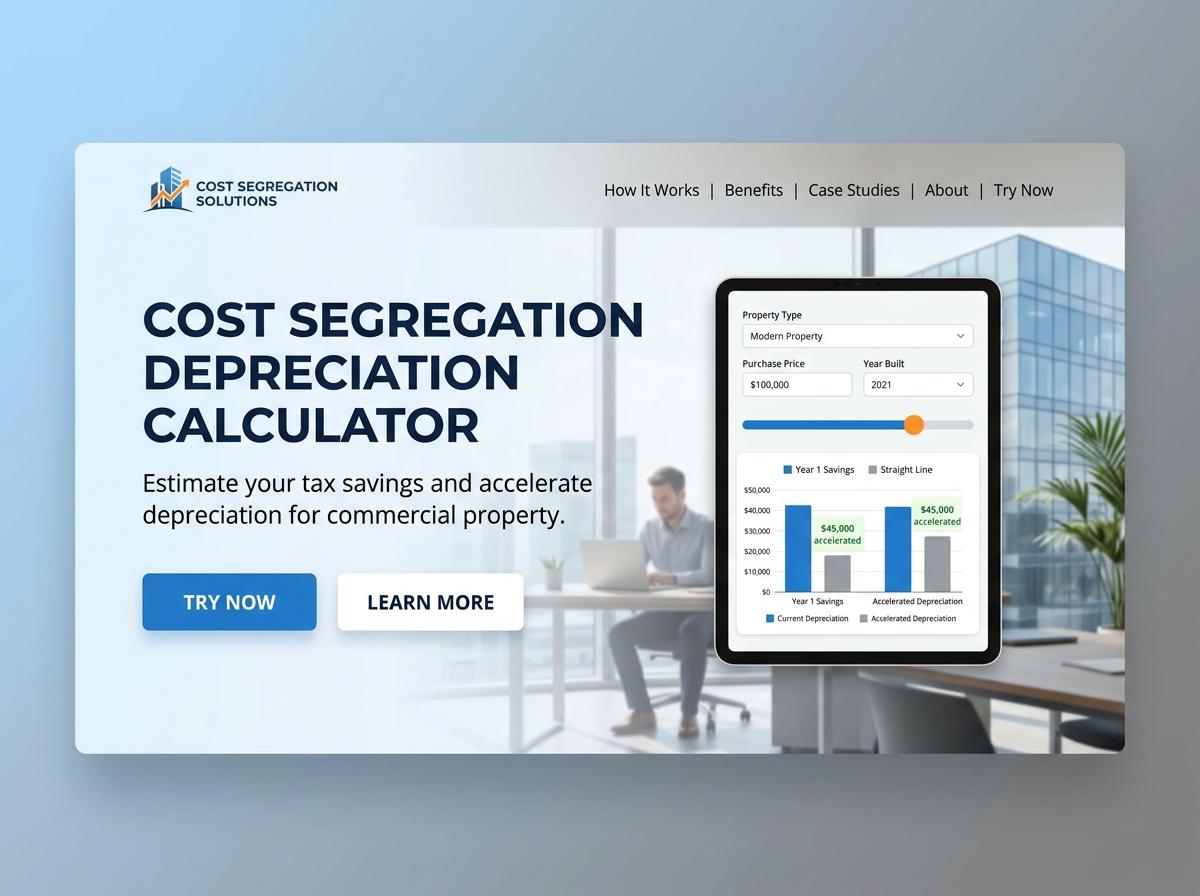

Maximize your real estate tax savings with our Cost Segregation Depreciation Calculator. Instantly estimate accelerated depreciation, uncover hidden tax deductions, and boost your property's cash flow. Calculate your potential savings today!
Cost Segregation Depreciation Calculator
What exactly is cost segregation depreciation?
Cost segregation is a strategic tax planning tool used by real estate owners to accelerate depreciation deductions. Instead of depreciating a property entirely over the standard schedule, this method identifies and reclassifies specific personal property assets to shorten their depreciation time.
- Residential Property: Standard timeline is 27.5 years.
- Commercial Property: Standard timeline is 39 years.
- Reclassified Assets: Shortened to 5, 7, or 15 years.
By accelerating these deductions, property owners can significantly reduce their current income tax liabilities, defer taxes, and increase their near-term cash flow.
How does a cost segregation study work?
A cost segregation study is a detailed engineering and financial analysis typically conducted by a team of qualified tax specialists and engineers. The process generally involves:
- Feasibility Analysis: Evaluating the property to estimate potential tax savings and determine if the study is cost-effective.
- Site Inspection: Engineers physically inspect the property to identify structural components versus personal property.
- Document Review: Analyzing architectural drawings, blueprints, and construction contracts.
- Cost Allocation: Assigning accurate values to the reclassified assets based on IRS guidelines.
- Final Report: Producing an IRS-compliant report that the owner's CPA uses to claim the accelerated deductions.
What types of real estate qualify for this tax strategy?
Virtually any income-producing real estate constructed, purchased, or renovated since 1987 qualifies for a cost segregation study. This includes both commercial and residential rental properties. Common examples include:
- Multifamily apartment complexes
- Office buildings and medical facilities
- Manufacturing and industrial plants
- Hotels, motels, and resorts
- Retail centers and restaurants
- Short-term rentals (e.g., Airbnb)
The best candidates are usually properties with a purchase price or construction cost exceeding $200,000, ensuring the tax savings significantly outweigh the consulting costs.
How does it accelerate depreciation and increase cash flow?
Cost segregation accelerates depreciation by front-loading tax deductions into the early years of property ownership. Under normal rules, a commercial building's cost is spread evenly over 39 years. However, by identifying elements like carpeting, specialized wiring, or landscaping, those specific costs can be deducted over 5, 7, or 15 years instead.
This rapid write-off significantly lowers a property owner's current taxable income. Because the owner pays less in income taxes during these early years, they retain more capital. This generated cash flow can then be reinvested into new properties or used to pay down existing debt.
What is the difference between personal property and real property?
In cost segregation, distinguishing between real and personal property is crucial for determining depreciation timelines.
| Category | Definition | Timeline | Examples |
|---|---|---|---|
| Real Property | The core structural components of a building that are permanently affixed. | 27.5 or 39 years | Roofs, walls, foundations, standard HVAC, plumbing. |
| Personal Property | Non-permanent, tangible assets that can theoretically be removed. | 5 or 7 years | Carpeting, decorative lighting, dedicated outlets, appliances. |
| Land Improvements | Enhancements added to the exterior land. | 15 years | Paving, fences, retaining walls, landscaping. |
When is the best time to perform a cost segregation study?
While a cost segregation study can be performed at any time, certain timing maximizes its benefits:
- Year of Purchase/Construction: This is the optimal time. Conducting the study in the first year allows owners to maximize cash flow immediately from day one.
- Post-Renovation: After significant remodels or expansions, a study can reclassify the newly added assets.
- Retroactively (Look-Back): The IRS allows owners to use Form 3115 to claim missed depreciation from prior years as a one-time "catch-up" deduction in the current tax year, without needing to amend past returns.
How does bonus depreciation impact cost segregation?
Bonus depreciation acts as a massive multiplier for cost segregation benefits. When a study identifies assets with a lifespan of 20 years or less, bonus depreciation allows owners to deduct a substantial percentage of those costs in the very first year.
The Tax Cuts and Jobs Act (TCJA) of 2017 allowed for 100% bonus depreciation for qualifying assets placed in service between late 2017 and 2022. However, this rate is currently phasing out:
- 2023: 80% bonus depreciation
- 2024: 60% bonus depreciation
- 2025: 40% bonus depreciation
Even with phase-outs, pairing bonus depreciation with cost segregation remains highly lucrative.
What are the upfront costs of hiring a qualified professional?
The cost of a professional cost segregation study varies based on the size, scope, and complexity of the property. For a standard commercial or multifamily property, fees typically range from $5,000 to $15,000. Smaller residential rentals might cost between $1,000 and $3,000 using software-assisted studies.
Reputable firms charge a flat fee rather than a percentage of the tax savings, as the IRS strictly prohibits contingent fee structures for these studies. Because quality studies yield massive tax savings, they usually provide a 10-to-1 return on investment or higher.
Are there risks of an IRS audit when using this method?
While utilizing any advanced tax strategy carries a theoretical risk of an IRS audit, cost segregation is a legally accepted practice outlined explicitly in the U.S. tax code. The primary risk lies in the quality of the study.
If a study relies on "rule of thumb" estimates or is conducted by unqualified individuals, it can trigger IRS scrutiny. However, if conducted by a reputable firm using engineering-based methodologies that comply with the IRS Audit Techniques Guide (ATG), the risk is minimal. High-quality providers also offer audit defense as part of their service.
How does depreciation recapture affect future property sales?
Depreciation recapture is the "catch" to the upfront tax benefits. When you sell a property for a profit, the IRS requires you to pay taxes on the depreciation deductions you previously claimed. Because cost segregation front-loads deductions, your property's tax basis is lower, resulting in a larger taxable gain upon sale.
Personal property components are recaptured and taxed at ordinary income tax rates (up to 37%), rather than the lower capital gains rate. However, real estate investors frequently defer this recapture tax indefinitely by utilizing a 1031 Like-Kind Exchange to roll proceeds into a new property.
 Airbnb / Short-Term Rental Arbitrage Calculator