
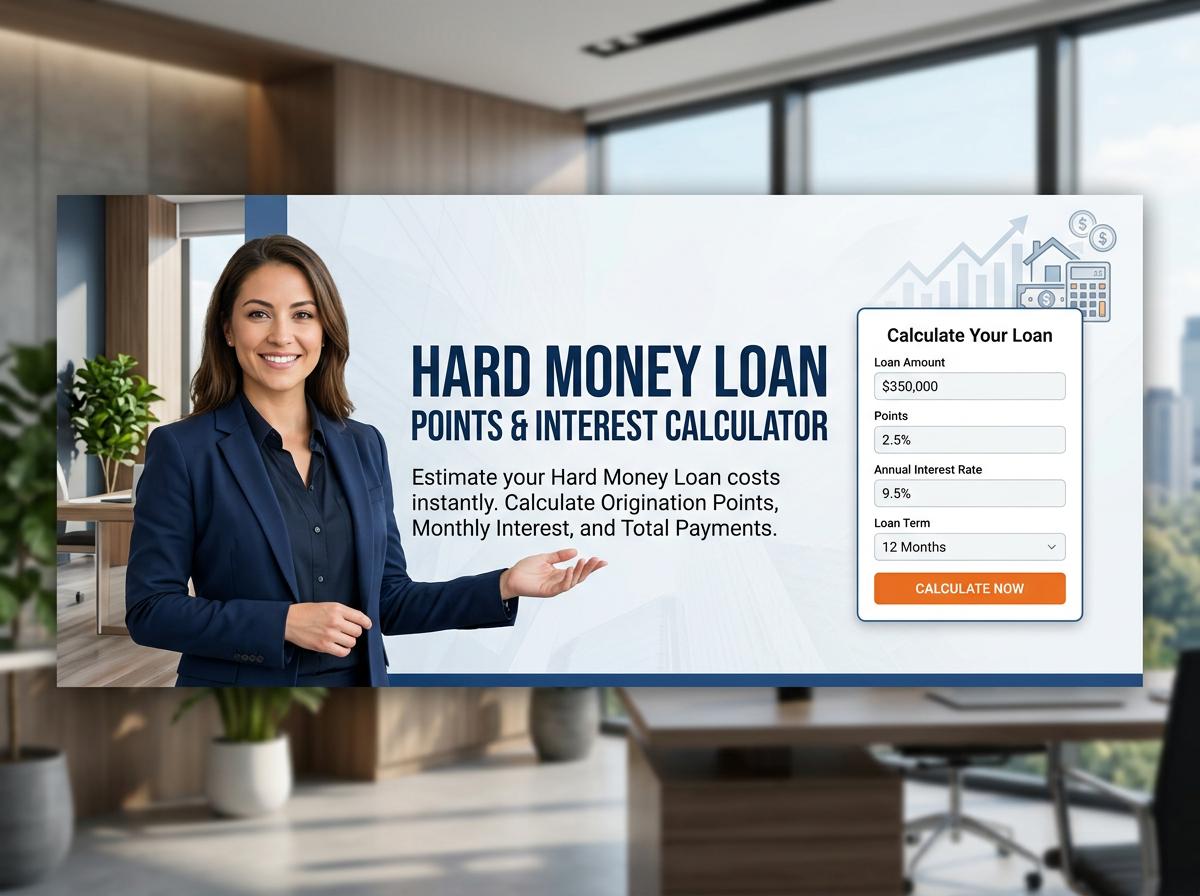

Estimate the true cost of your real estate financing with our Hard Money Loan Points & Interest Calculator. Instantly calculate upfront origination points, monthly interest payments, and total payoff amounts. Perfect for real estate investors and house flippers to analyze loan profitability and make informed borrowing decisions. Free, fast, and easy to use!
Hard Money Loan Calculator
What exactly is a point in a hard money loan?
A "point" (or origination point) in a hard money loan is an upfront fee charged by the lender for processing and funding the loan. Each point is equal to 1% of the total loan amount.
For example, if you borrow $150,000, one point equals $1,500. Lenders use points to generate immediate revenue and to compensate for the higher risk and short duration associated with hard money lending. Most hard money loans charge between 1 and 5 points, depending on the risk of the project and the borrower's experience level.
How much do hard money interest rates typically run?
Hard money loan interest rates are generally higher than traditional bank mortgages due to the elevated risk of lending on distressed properties or to real estate investors. Typically, these rates range from 8% to 15%.
The specific rate you receive will depend on several variables:
- Borrower experience: Proven investors get the lowest rates.
- Loan-to-Value (LTV): Lower LTV ratios represent less risk, resulting in better rates.
- Property type: Standard residential flips are usually cheaper to finance than commercial deals.
- Location: Competitive, high-demand real estate markets often drive rates down.
Are hard money loan interest rates fixed or variable?
Hard money loan interest rates are overwhelmingly fixed.
Because these are short-term loans—typically ranging from 6 to 24 months—a fixed rate provides essential predictability for both the borrower and the lender. Fixed rates allow real estate investors to accurately calculate their monthly holding costs and project their ultimate profit margins without worrying about economic market fluctuations changing their monthly payments. Variable rates are highly uncommon in the standard fix-and-flip lending space.
Do I pay the loan points upfront or at closing?
Loan points on a hard money loan are almost exclusively paid at closing, not upfront during the initial application process. They are structured as a standard closing cost.
When the deal closes, the cost of the points is either paid out-of-pocket by the borrower alongside other closing fees (like title insurance) or deducted directly from the gross loan proceeds. Legitimate hard money lenders rarely ask for large point fees upfront before a loan is approved; requesting huge upfront fees is often a warning sign of a loan scam.
Can points be rolled into the total loan amount?
Yes, points can sometimes be rolled into the total loan balance, but this depends entirely on the lender's guidelines and the deal's Loan-to-Value (LTV) limits.
If financing the points keeps the total loan amount within the lender's maximum allowable LTV threshold (e.g., 70% of the After-Repair Value), the lender may allow it. This strategy helps the borrower reduce their out-of-pocket cash requirements at closing. However, strict lenders may demand points be paid in cash to ensure the investor brings sufficient "skin in the game."
Are monthly payments usually interest-only or amortized?
Monthly payments on hard money loans are typically interest-only.
Instead of paying down the principal balance each month like a traditional amortized 30-year mortgage, your monthly payments cover only the interest accrued. This structure heavily benefits real estate investors by keeping monthly holding costs as low as possible while they renovate the property.
The entire principal balance becomes due as a large "balloon payment" at the end of the loan term, which is typically satisfied by selling the property or refinancing it into a conventional loan.
How does my real estate experience affect the interest rate?
Your real estate experience is one of the most critical factors in determining your hard money interest rate. Lenders view a proven track record of successful flips as a massive risk mitigator.
| Experience Level | Typical Impact on Loan Terms |
|---|---|
| Beginner (0-2 deals) | Highest rates (12-15%) and higher points (3-5) due to maximum execution risk. |
| Intermediate (3-5 deals) | Moderate rates (10-12%) and average points (2-3). |
| Expert (6+ deals) | Lowest rates (8-10%) and lowest points (1-2), often with higher LTV limits. |
Are hard money points and interest rates negotiable?
Yes, hard money points and interest rates are highly negotiable. Unlike conventional banks with rigid, computer-generated underwriting matrices, hard money lenders are private individuals or funds with the flexibility to make deal-by-deal decisions.
You have the most negotiating leverage when:
- You are a repeat borrower with a flawless payoff history.
- You are bringing a substantial amount of your own cash to the deal (low LTV).
- You are purchasing a highly liquid property in a prime location.
How do points impact the overall cost of the loan?
Points significantly increase the overall cost of borrowing, which heavily impacts the Annual Percentage Rate (APR) due to the short lifespan of the loan.
Consider a $100,000 loan at 10% interest for 6 months, charging 3 points:
- Interest Cost: $100,000 × 10% = $10,000 annually. For 6 months, interest is $5,000.
- Points Cost: 3 points = 3% of $100,000 = $3,000.
- Total Cost: $5,000 (interest) + $3,000 (points) = $8,000.
Because the upfront points are amortized over just a few months, your effective annualized cost of borrowing is much higher than the stated 10% interest rate.
Do prepayment penalties apply if I pay the loan off early?
While traditional prepayment penalties (like a flat percentage fee for early payoff) are rare, many hard money lenders implement a guaranteed minimum interest clause.
For example, a lender might issue a 12-month loan but stipulate a minimum of 4 months of guaranteed interest. If you flip and sell the property in just 2 months, you will still be required to pay the remaining 2 months of interest out of your sale proceeds at closing. Always verify early payoff terms in your loan commitment letter.
Sources:
 Real Estate Syndication Waterfall Calculator