
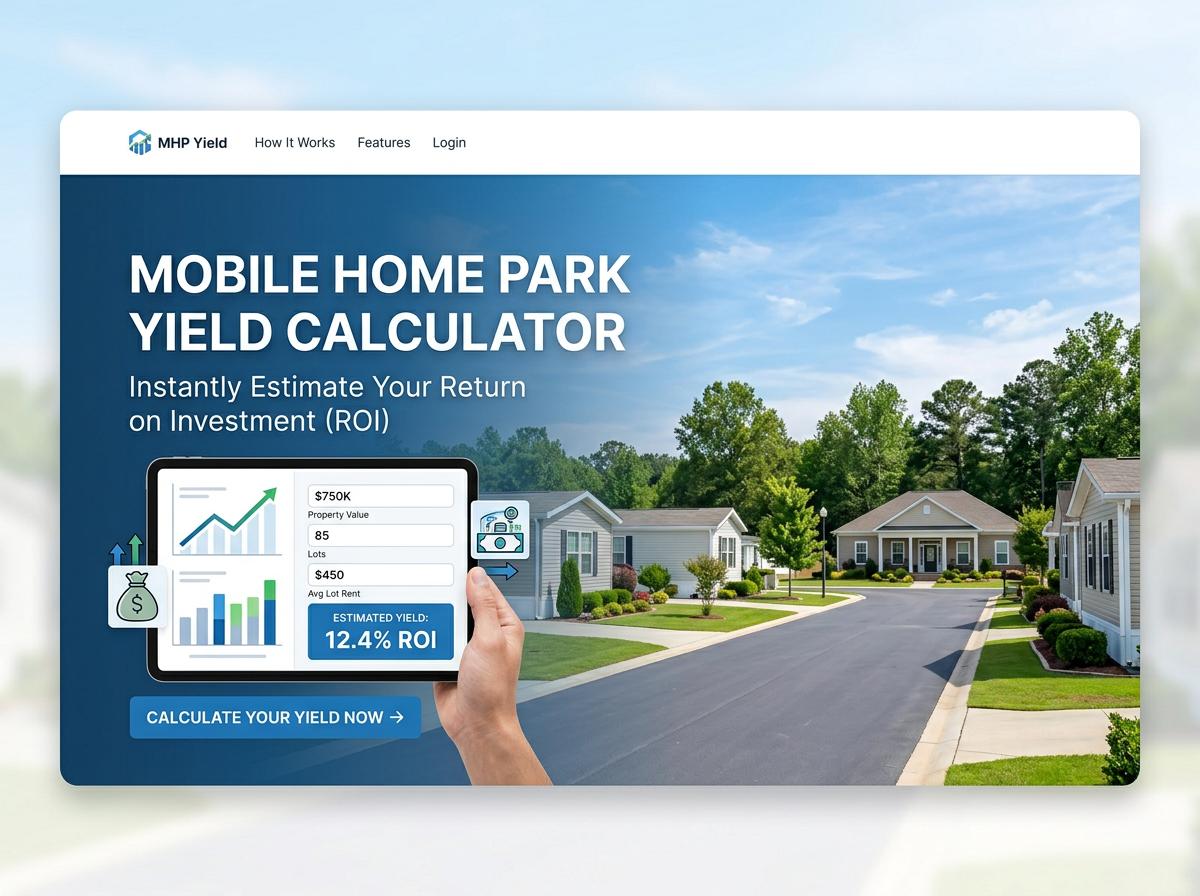

Maximize your real estate investments with our Mobile Home Park Yield Calculator. Easily analyze cap rates, cash-on-cash returns, and projected ROI to make informed buying decisions. Start calculating your potential profits today!
Mobile Home Park Yield
What is a good capitalization rate for a mobile home park?
A "good" capitalization (cap) rate for a mobile home park generally ranges between 6% and 10%, depending heavily on the property's asset class, geographic location, and infrastructure condition. Investors typically seek slightly higher cap rates in this sector compared to multifamily apartments to offset perceived operational risks.
| Asset Class | Typical Cap Rate | Characteristics |
|---|---|---|
| Class A | 5% - 7% | Paved roads, public utilities, rich amenities, low yield but low risk. |
| Class B & C | 7% - 10%+ | Value-add potential, older infrastructure, higher cash flow. |
How do park-owned homes impact overall property yield?
Park-owned homes (POHs) initially appear to increase overall yield by generating higher monthly rental income, but they typically drag down the long-term net yield. Here is how they impact profitability:
- Increased Maintenance: The park owner is responsible for all structural, plumbing, and appliance repairs, which eats into cash flow.
- Higher Expense Ratios: Parks with many POHs often see expense ratios jump from 30% up to 50-60%.
- Higher Turnover: Renters leave more frequently than homeowners, leading to vacancy losses and expensive unit turnaround costs.
Most investors prefer transitioning POHs to tenant-owned homes (TOHs) to stabilize yield and eliminate home maintenance liabilities.
What is the typical expense ratio for this type of asset?
The typical expense ratio for a mobile home park ranges from 30% to 50% of gross income. This ratio is highly dependent on two primary operational factors:
- Utilities: Parks with submetered utilities (where tenants pay for their own water, sewer, and electricity) trend toward a highly efficient 30-40% expense ratio. Parks that pay bulk utility bills for tenants lean toward 40-50%.
- Home Ownership: Parks consisting strictly of tenant-owned homes have much lower expense ratios because the park is only responsible for maintaining the land, roads, and common areas.
How does tenant turnover affect cash flow and profitability?
Tenant turnover negatively impacts cash flow due to lost rent, unit turnaround costs, and marketing fees. However, mobile home parks uniquely benefit from extremely low turnover rates compared to other real estate assets.
Because it costs between $5,000 and $10,000 to physically move a manufactured home, tenants who own their homes rarely leave. This "sticky" tenant base provides highly stable, predictable cash flow and significantly lowers vacancy loss. Conversely, if a park has high turnover (usually driven by park-owned home renters), cash flow takes a massive hit due to frequent cleaning, repairs, and the administrative burden needed to secure new renters.
Why are submetered utilities critical for maximizing return?
Submetered utilities are critical for maximizing return because they shift variable operating expenses directly to the residents. When a park owner pays for bulk water, sewer, or electricity, it suppresses Net Operating Income (NOI) and exposes the owner to sudden utility rate hikes and tenant waste.
- Cost Recovery: Submetering allows owners to legally bill back usage to residents.
- Conservation: Tenants consume up to 30% less water when paying for their own usage, reducing wear on park infrastructure.
- Valuation Boost: Every dollar saved in utility expenses drops straight to the bottom line NOI, significantly boosting the property's overall valuation based on standard cap rate formulas.
How do you accurately calculate net operating income here?
To accurately calculate Net Operating Income (NOI) for a mobile home park, you must subtract all operating expenses from the gross operating income, ensuring you exclude non-operating costs.
The Formula:
Gross Scheduled Income - Vacancy/Credit Loss = Effective Gross Income (EGI)
EGI + Other Income (laundry, pet fees) = Gross Operating Income (GOI)
GOI - Operating Expenses = NOI
Key Inclusions (Operating Expenses): Property taxes, insurance, management fees, maintenance, common area utilities, and landscaping.
Key Exclusions: Debt service (mortgage payments), depreciation, amortization, capital expenditures (like repaving an entire road), and owner income taxes.
What hidden maintenance costs threaten to reduce total yield?
While mobile home parks require less maintenance than apartment buildings, several hidden capital expenditure (CapEx) and maintenance costs can destroy projected yields:
- Underground Infrastructure: Aging water lines, collapsing terracotta sewer pipes, or failing private utility systems (septic tanks, lagoons, well pumps) can cost hundreds of thousands of dollars to replace.
- Tree Management: Large, mature trees require regular pruning or removal to prevent damage to homes. A single hazard tree removal can cost upwards of $2,000.
- Electrical Upgrades: Upgrading outdated electrical pedestals (e.g., from 50 amps to 100 or 200 amps) to accommodate modern homes is highly expensive.
- Road Repairs: Patching potholes or entirely repaving asphalt roads is a massive recurring expense.
How does infilling vacant lots accelerate investment returns?
Infilling vacant lots is one of the most powerful value-add strategies in mobile home park investing. It accelerates returns by instantly boosting Gross Income without significantly increasing fixed property expenses.
When an owner purchases and places a new or used home on an existing vacant pad, they activate a dormant revenue stream. Because the land, utility hookups, and roads are already paid for, the new lot rent flows almost entirely into the Net Operating Income (NOI). At a standard 8% cap rate, adding just one tenant paying $400 a month in lot rent ($4,800/year) increases the overall valuation of the park by $60,000.
Which financing structures provide the best cash-on-cash yield?
Securing the right financing structure is paramount for maximizing your cash-on-cash (CoC) return. The most effective structures include:
- Seller Financing: Often provides the highest CoC yield. Investors can negotiate lower interest rates, low down payments (10-20%), and interest-only periods directly with the seller, avoiding hefty bank origination fees.
- Agency Debt (Fannie Mae / Freddie Mac): For stabilized parks, agency loans offer highly competitive, non-recourse, long-term fixed rates with up to 80% Loan-to-Value (LTV). They frequently include several years of interest-only payments.
- Assumable Mortgages: Taking over an existing loan with a historically low, locked-in interest rate drastically boosts initial cash flow compared to originating a new loan at current market rates.
How do local rent control laws restrict future park revenue?
Local rent control laws restrict future revenue by legally capping the percentage by which a park owner can increase annual lot rents. These ordinances are designed to protect affordable housing but can severely stifle an investor's yield.
In strict rent-control states, ordinances might tie rent bumps directly to the Consumer Price Index (CPI) or mandate a hard ceiling (e.g., a maximum of 3% annually). This restricts an owner’s ability to force appreciation or adjust revenue to cover sudden spikes in operating expenses, like soaring property taxes or insurance premiums. Furthermore, some rent control laws enact strict "just cause" eviction protections, making it costly to remove non-paying tenants.
Sources:
 1031 Exchange Boot Calculator