
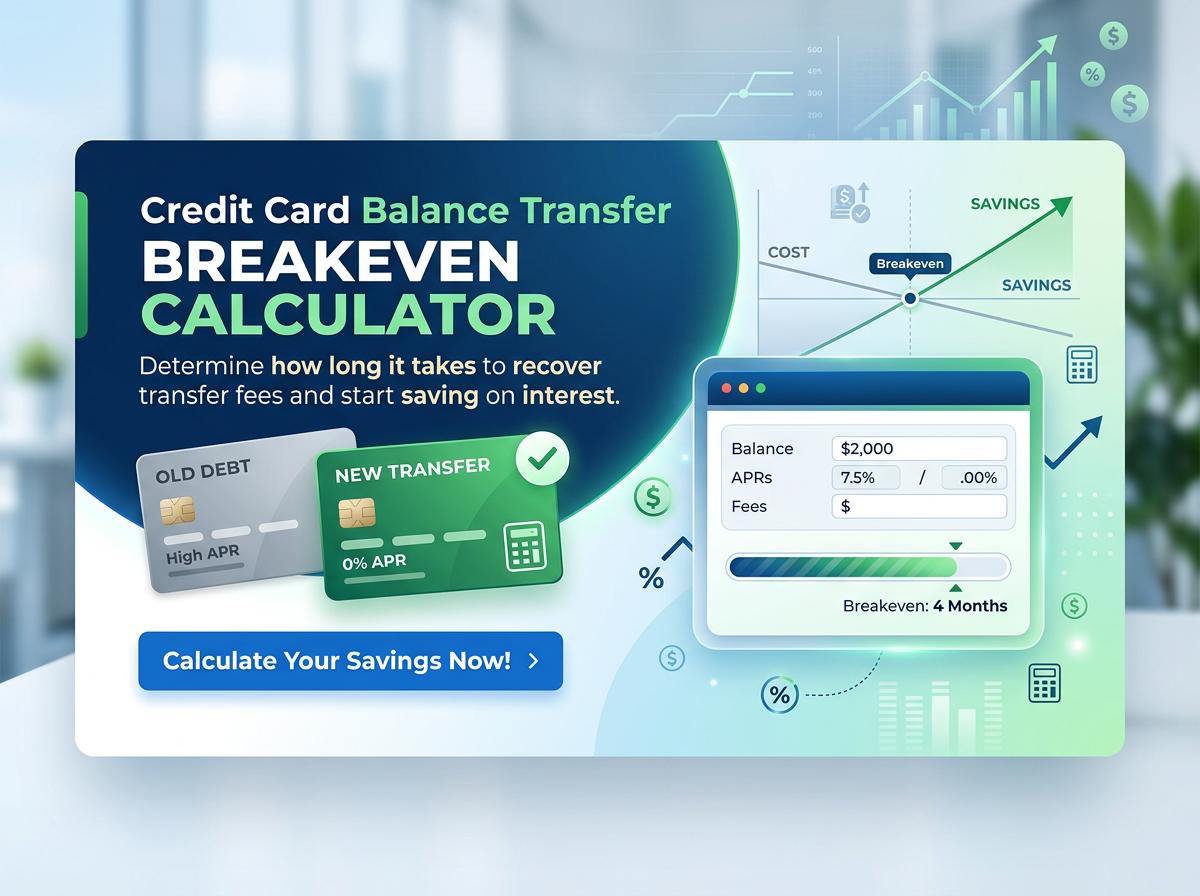

Determine if a balance transfer is worth the cost with our Credit Card Balance Transfer Breakeven Calculator. Easily compare transfer fees against interest savings to find your exact breakeven month. Make smart financial decisions, pay off debt faster, and maximize your savings. Try our free calculator today!
Balance Transfer Breakeven Calculator
What is the exact percentage or flat rate of the balance transfer fee?
Balance transfer fees are generally charged in one of two ways, depending on your credit card issuer's terms:
- Percentage-based: Typically ranges from 3% to 5% of the total amount being transferred.
- Flat rate: A minimum fixed fee, usually between $5 and $10.
The issuer will almost always charge whichever amount is greater. For example, transferring $5,000 with a 3% fee will cost exactly $150.
What is the current interest rate on your existing credit card debt?
To determine if a balance transfer is worthwhile, you must check the current Annual Percentage Rate (APR) on your existing debt. The national average credit card interest rate usually sits between 20% and 24%.
You can find your exact APR by:
- Logging into your current credit card's online portal.
- Checking the "Interest Charge Calculation" section on your most recent PDF billing statement.
- Calling the customer service number on the back of your card.
How many months does the introductory promotional interest period last?
The length of the 0% introductory APR period varies strictly by credit card issuer and current market offers. Generally, these promotional periods last between 12 and 21 months.
It is crucial to note the exact expiration date of this period, as your balance will begin accruing standard interest immediately after the promotional window closes.
How much total debt are you planning to transfer to the new card?
The amount of debt you can realistically transfer depends on the credit limit approved by your new card issuer. You generally cannot transfer an amount that exceeds your new credit limit.
Furthermore, most issuers cap balance transfers at 75% to 100% of your total approved credit limit, including the transfer fee. It is best to calculate your total debt beforehand and have a backup plan if your approved limit is lower than your total debt.
How many months will it take for your interest savings to offset the transfer fee?
Your breakeven point occurs when the interest you would have paid on your old card equals the one-time transfer fee on the new card. Because standard credit card APRs are so high, this usually takes just 1 to 3 months.
| Transfer Amount | 3% Transfer Fee | Old Card Monthly Interest (24% APR) | Breakeven Time |
|---|---|---|---|
| $5,000 | $150 | ~$100 | 1.5 Months |
| $10,000 | $300 | ~$200 | 1.5 Months |
What will the standard interest rate be after the promotional period expires?
Once your introductory 0% APR period concludes, any remaining balance will be subject to the card's standard variable APR. Depending on your creditworthiness, this standard rate typically ranges from 18% to 29.99%.
Because this variable rate is tied to the Prime Rate, it can fluctuate over time. Always check your cardmember agreement to understand exactly what your post-promotional APR will be so you aren't caught off guard.
Can you afford the monthly payments required to pay off the debt before the promotion ends?
To maximize the benefit of a balance transfer, your goal should be to reach a $0 balance before the promotional period expires. You can determine your required monthly payment using a simple calculation:
(Total Debt + Balance Transfer Fee) ÷ Months in Promo Period = Required Monthly Payment
For example, to pay off a $5,150 total balance over a 15-month 0% APR period, you must confidently afford $343.33 per month. If you only pay the minimum due, you will be left with high-interest debt.
Will you be charged retroactive interest if the balance is not paid off in time?
This depends on whether your card offers a "true 0% APR" or "deferred interest."
- True 0% APR: Standard credit cards usually only charge interest on the remaining balance after the promo ends. No retroactive interest is applied.
- Deferred Interest: Common with store credit cards (e.g., "No interest if paid in full by 12 months"). If you leave even $1 unpaid by the deadline, you will be retroactively charged interest on the entire original balance from day one.
Does the new credit card charge an annual fee that adds to your breakeven cost?
While many of the top balance transfer credit cards offer a $0 annual fee, some premium or rewards cards do charge an annual fee (typically ranging from $95 to over $250).
If your new card has an annual fee, you must add it to the balance transfer fee to calculate your true cost. If the total fees exceed the interest you would save, the transfer is not financially sensible.
Will making a late monthly payment void your promotional interest rate?
Yes, in most cases, failing to pay on time will severely penalize you. Credit card agreements usually contain strict clauses regarding late payments during introductory periods.
- Your 0% promotional APR can be immediately revoked.
- Your remaining balance may instantly be subject to a Penalty APR, which can be as high as 29.99%.
- You will be charged a late fee (often up to $40).
Setting up automatic payments for at least the minimum amount is highly recommended to protect your promotional rate.
 0% APR Expiration Interest Shock Calculator