
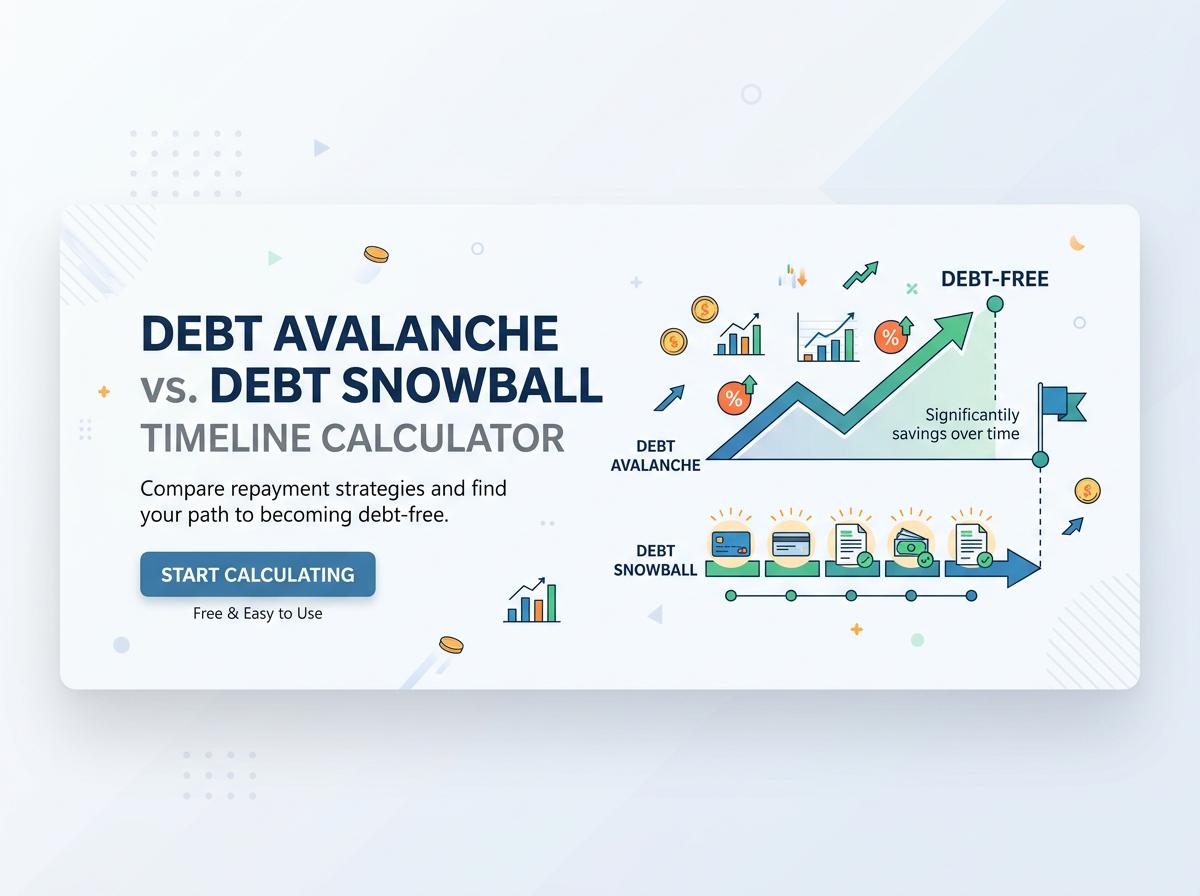

Compare the Debt Avalanche and Debt Snowball methods with our free timeline calculator. Enter your balances and interest rates to instantly see which strategy pays off your debt faster and saves you the most money. Discover your optimal debt-free plan today!
Debt Avalanche vs. Debt Snowball
Debt Snowball
Pays lowest balances first
Debt Avalanche
Pays highest interest rates first
Which strategy mathematically guarantees the fastest overall payoff date?
The Debt Avalanche method mathematically guarantees the fastest overall payoff date. By focusing your extra payments on the account with the highest interest rate first, you minimize the amount of compounding interest that accrues over time. Because less of your money is wasted on interest charges, a significantly larger portion of your monthly payment goes directly toward reducing the principal balance, accelerating your path to becoming debt-free.
Why does the snowball method feel much quicker in the beginning?
The Debt Snowball feels quicker initially because it ignores interest rates to target your smallest balance first. This strategy provides immediate psychological benefits:
- Instant Gratification: You eliminate an entire debt account relatively quickly.
- Visual Progress: The total number of open accounts and monthly bills decreases rapidly.
- Dopamine Hits: Crossing a debt off your list provides a profound sense of accomplishment.
By securing these fast, early victories, you build a tangible sense of momentum, keeping you excited about the process.
How much longer does the snowball timeline typically take to complete?
The exact time difference depends heavily on your specific debt profile, but the snowball method generally extends the timeline anywhere from a few months to over a year.
| Debt Profile | Estimated Timeline Extension |
|---|---|
| Low total debt, similar interest rates | 1 to 3 months longer |
| Moderate debt, varying interest rates | 4 to 8 months longer |
| High debt, extreme interest rate gaps | 12+ months longer |
Because the snowball method allows high-interest debts to sit longer, the compounding interest adds extra payments to the back end of your journey.
Does the avalanche method require more patience before the first account hits zero?
Yes, it often requires significant patience. Because the avalanche method strictly targets the highest interest rate, that specific debt might also be your largest balance—such as a massive credit card bill or a hefty personal loan.
Instead of clearing a small $500 medical bill in just a few weeks, you might spend a year or more chipping away at a $10,000 credit card before experiencing the satisfaction of closing an account. This lack of early "wins" requires heavy discipline.
How severely do high interest rates extend the snowball method timeline?
Extremely high interest rates (like 25% APR on credit cards) can severely extend your timeline and cost thousands of extra dollars. When you ignore these high-interest debts to pay off smaller, low-interest loans first, the high-interest balances compound aggressively.
In extreme cases, your minimum payments on those cards might barely cover the monthly interest charges. By the time you finally reach them in your snowball sequence, the principal balances may have grown, adding significant time to your payoff date.
Which payoff timeline has a higher success rate for long-term motivation?
The Debt Snowball method consistently boasts a higher success rate for long-term motivation. Behavioral finance studies show that humans are highly motivated by small, frequent victories.
Because paying off debt is often more about behavioral modification than pure math, the quick wins achieved by eliminating small accounts keep people engaged. The psychological boost of seeing bills permanently disappear prevents burnout, making borrowers much more likely to stick to their budget until they reach a zero balance.
How does the total interest saved actually shorten the avalanche timeline?
Saving money on interest directly shortens your timeline through an accelerating compounding effect. Here is the mechanism:
- Less Money Wasted: By targeting the highest rate, less of your payment goes to the bank as a fee.
- More Principal Reduction: Every dollar saved on interest is a dollar applied directly to the principal balance.
- Slower Compounding: A smaller principal generates less interest the following month.
As this cycle repeats, your balances shrink faster, wiping out the debt months earlier.
Can switching from snowball to avalanche midway accelerate your remaining timeline?
Absolutely. Many financial experts recommend a hybrid approach to maximize both motivation and mathematics. You can start with the debt snowball to clear out small, annoying balances that clutter your mind and budget.
Once you have eliminated those small accounts, built confidence, and freed up cash flow, you can pivot to the avalanche method. Directing your massive rolled-over payments toward the remaining debt with the highest interest rate will stop severe interest compounding and accelerate you to the finish line.
Do the timelines differ if all of your debts happen to have identical interest rates?
No. If every single one of your debts carries the exact same interest rate, the mathematical payoff timeline and the total amount of interest paid will be identical, regardless of the order in which you pay them off.
Because the cost of borrowing is uniform across the board, in this rare scenario, you should always default to the debt snowball method to gain the psychological benefit of clearing individual accounts early.
How do extra monthly payments shrink the timeline gap between the two methods?
Extra monthly payments act as a great equalizer. The mathematical gap between snowball and avalanche is entirely driven by how long interest is allowed to compound.
When you apply aggressive, extra cash (like tax refunds, bonuses, or side-hustle income) to your debt, you destroy the principal balances so rapidly that the interest simply doesn't have time to compound severely. The faster you pay off the overall debt, the less the interest rates matter, dramatically shrinking the difference between the two strategies.
Sources:
 Credit Card Balance Transfer Breakeven Calculator