
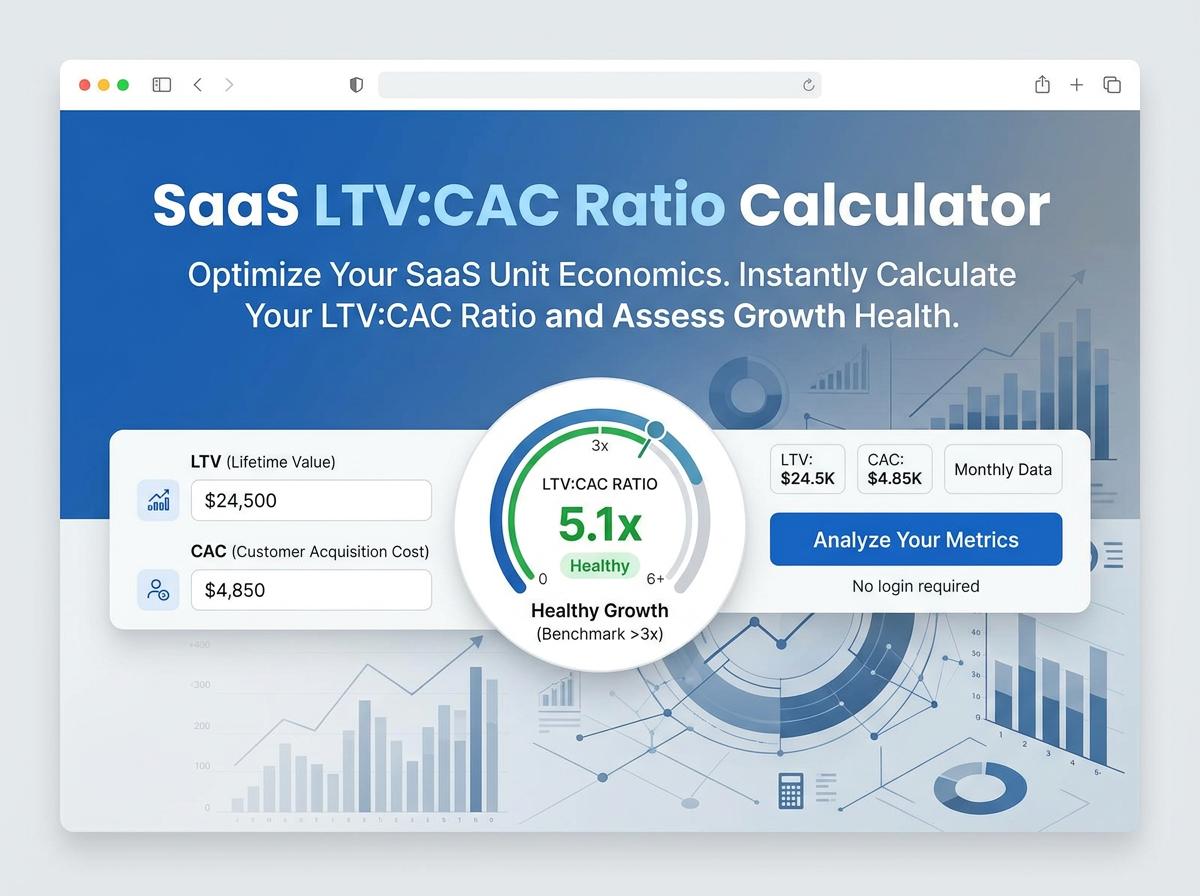

Optimize your SaaS growth with our free LTV:CAC Ratio Calculator. Instantly measure Customer Lifetime Value against Customer Acquisition Cost to evaluate profitability, optimize marketing spend, and ensure sustainable subscription scaling. Enter your metrics today for actionable insights!
SaaS LTV:CAC Calculator
What is the standard formula for calculating the SaaS LTV:CAC ratio?
The SaaS LTV:CAC ratio compares the Lifetime Value (LTV) of a customer to the Customer Acquisition Cost (CAC). To calculate it, you must first determine both metrics individually before dividing LTV by CAC.
- LTV (Lifetime Value): (Average Revenue Per User × Gross Margin) / Customer Churn Rate
- CAC (Customer Acquisition Cost): Total Sales & Marketing Expenses / Number of New Customers Acquired
Standard Formula:
LTV:CAC Ratio = LTV ÷ CAC
For example, if a customer brings in $3,000 in lifetime value and costs $1,000 to acquire, your LTV:CAC ratio is 3:1.
What is considered the ideal industry benchmark for a healthy ratio?
In the SaaS industry, the universally accepted benchmark for a healthy LTV:CAC ratio is 3:1. This means a company generates three dollars of value for every one dollar spent on acquiring a customer.
| Ratio | Industry Interpretation |
|---|---|
| < 1:1 | Unsustainable (losing money on every customer) |
| 1:1 - 2:1 | Struggling (low profitability, high acquisition costs) |
| 3:1 | Ideal / Healthy (balanced growth and profitability) |
| > 5:1 | Underinvesting in marketing (missing growth opportunities) |
A 3:1 ratio proves a sustainable business model where the company covers acquisition costs, supports ongoing operations, and remains profitable.
How does gross margin factor into an accurate LTV calculation?
Gross margin is a critical, yet frequently overlooked, component of an accurate LTV calculation. It represents the percentage of total sales revenue that the company retains after incurring the direct costs associated with delivering its software (Cost of Goods Sold or COGS, like hosting and customer support).
If you calculate LTV using only top-line revenue without factoring in gross margin, you will falsely inflate your customer's value. The formula adjustment looks like this:
Accurate LTV = (Average Revenue Per User × Gross Margin %) / Churn Rate
By factoring in gross margin, you ensure that the LTV represents the actual profit contribution of the customer, giving a true picture of how much money is genuinely available to offset acquisition costs.
Why do venture capitalists and investors heavily scrutinize this metric?
Venture capitalists (VCs) and investors scrutinize the LTV:CAC ratio because it is the ultimate indicator of a SaaS company's capital efficiency, scalability, and long-term viability. It answers a fundamental question: If we pour money into this company's sales and marketing engine, will it generate a profitable return?
- Capital Efficiency: A strong ratio proves the business can generate significantly more value than it burns to acquire users.
- Scalability: It shows that the sales and marketing model is repeatable and predictable.
- Runway and Survival: A poor ratio signals high cash burn, meaning the company will likely run out of money before achieving profitability.
For investors, this metric isolates the underlying unit economics from top-line revenue growth, revealing true financial health.
What are the immediate financial risks if the ratio falls below 1:1?
An LTV:CAC ratio below 1:1 means a SaaS company spends more money to acquire a customer than that customer will ever generate in lifetime profit. The immediate financial risks include:
- Accelerated Cash Burn: The faster the company grows its customer base, the faster it bleeds cash. Growth becomes financially toxic.
- Shortened Runway: High acquisition costs combined with low lifetime value quickly drain cash reserves, leaving less time to achieve profitability or secure new funding.
- Margin Squeeze: Operations lack the financial buffer needed to cover fixed overhead costs, such as research and development or administrative expenses.
- Bankruptcy Risk: Ultimately, without an immediate reduction in marketing spend or a drastic improvement in retention, a ratio below 1:1 is a direct path to insolvency.
What does an extremely high ratio indicate about underinvesting in growth?
While an extremely high LTV:CAC ratio (e.g., 5:1, 7:1, or higher) might initially seem like a massive success, it usually signals a strategic flaw: underinvesting in growth.
If a company's ratio is excessively high, it means they are generating massive value per customer but spending very little to acquire them. The implications include:
- Missed Market Share: Competitors who spend more aggressively on marketing can easily capture the market, even with a lower (but healthy) 3:1 ratio.
- Stunted Growth: The company is being too conservative. By increasing sales and marketing budgets, they could acquire significantly more customers and scale faster.
In short, an exceptionally high ratio means the company is leaving money on the table and prioritizing short-term margins over long-term market dominance.
How does the customer churn rate directly impact the lifetime value component?
Customer churn rate—the percentage of customers who cancel their subscriptions over a given period—has an inversely proportional and direct impact on Lifetime Value (LTV). In fact, churn is the denominator in the standard LTV formula:
LTV = Average Profit Per User / Customer Churn Rate
Because it acts as the divisor, even small fluctuations in churn drastically alter LTV:
- High Churn: If churn is high, the expected lifespan of a customer is short. This severely decreases LTV, bringing down the overall LTV:CAC ratio and making it harder to recover acquisition costs.
- Low Churn: Reducing churn extends the customer lifespan. If a customer stays longer, they pay more over time, which exponentially increases LTV and creates a much healthier unit economic model.
What are the most effective strategies to lower customer acquisition costs?
Lowering Customer Acquisition Cost (CAC) requires optimizing the efficiency of sales and marketing efforts. Effective strategies include:
- Invest in Inbound Marketing: Shift focus from expensive paid ads to organic channels like SEO and content marketing. These have higher upfront costs but yield compounded, low-cost leads over time.
- Implement Referral Programs: Incentivize existing, happy users to refer new customers. Word-of-mouth acquisition carries a near-zero marginal cost.
- Optimize Conversion Rates (CRO): Improve landing pages, streamline onboarding, and implement A/B testing. Converting a higher percentage of existing website traffic is cheaper than buying more traffic.
- Shorten the Sales Cycle: Utilize product-led growth (PLG) strategies, such as freemium models or self-serve trials, to reduce the need for expensive, labor-intensive sales teams.
How do upselling and cross-selling improve the overall balance of this ratio?
Upselling (upgrading a customer to a higher-tier plan) and cross-selling (selling additional features or complementary products) are powerful levers for improving the LTV:CAC ratio because they dramatically increase LTV while bypassing new acquisition costs.
When you successfully upsell or cross-sell, you achieve two things:
- Increased ARPU: The Average Revenue Per User rises, which directly inflates the Lifetime Value.
- Negative Churn: Expansion revenue from existing customers can outpace the revenue lost from canceling customers, resulting in net negative churn.
Because the cost to expand an existing customer is significantly cheaper than acquiring a net-new one (the initial CAC has already been paid), these strategies widen the gap between LTV and CAC, driving the ratio upward and maximizing profitability.
How often should growing SaaS companies recalculate and review this metric?
The frequency of calculating and reviewing the LTV:CAC ratio depends on the growth stage and stability of the SaaS company:
- Early-Stage Startups: Should review the metric monthly. Startups are constantly tweaking pricing, experimenting with new marketing channels, and experiencing volatile churn. Monthly monitoring ensures rapid course correction if cash burn gets out of hand.
- Growth and Mature SaaS: Should review the metric quarterly. As the customer base stabilizes, month-over-month fluctuations become less meaningful. Quarterly reviews provide a clearer picture of sustained trends.
Additionally, companies should analyze this metric using cohort analysis rather than relying purely on a company-wide blended average. Reviewing the ratio by customer segments or acquisition channels reveals targeted insights that broad averages often obscure.
Sources:
 Churn Rate Revenue Leakage Calculator