
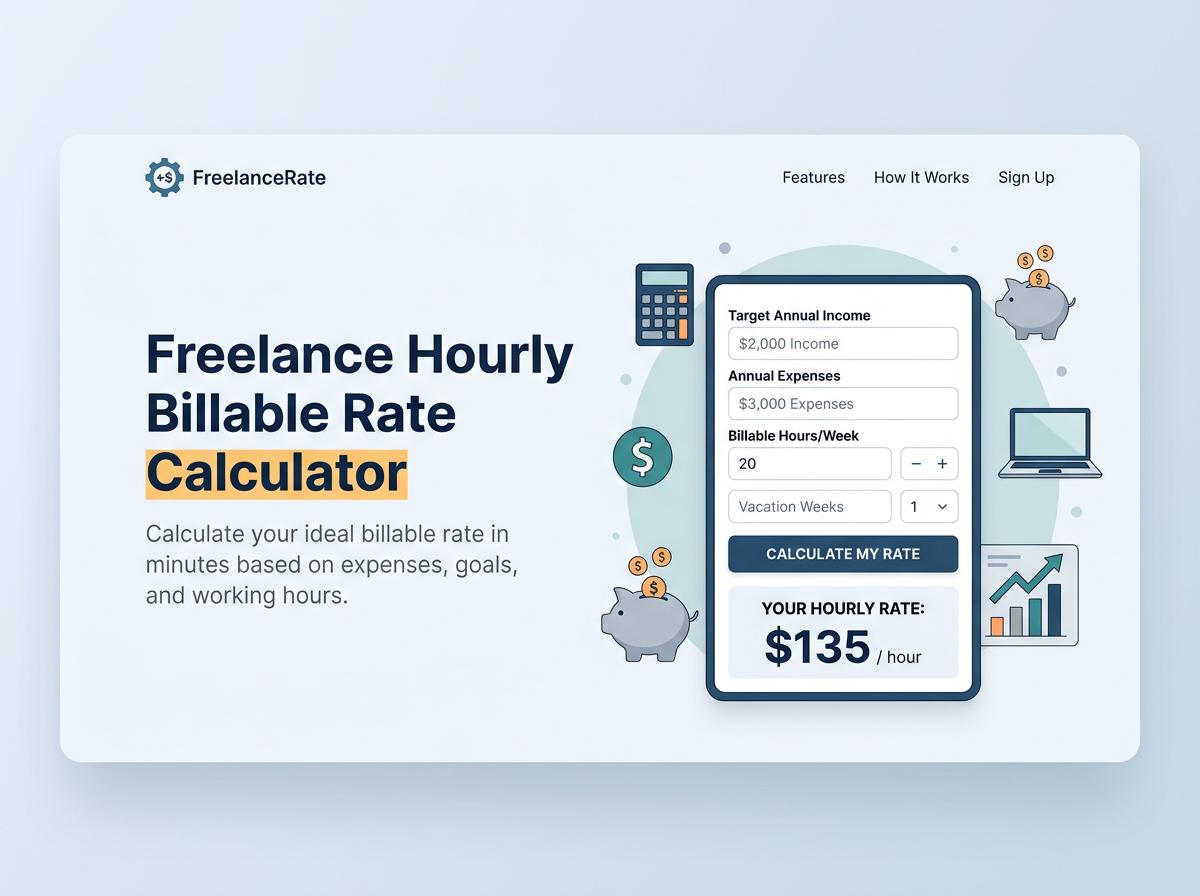

Stop guessing what to charge. Use our free Freelance Hourly Billable Rate Calculator to easily determine your ideal hourly rate. Simply factor in your target income, business expenses, and unbillable time to ensure your freelance business is profitable and sustainable. Calculate your true worth and start pricing your services with confidence today!
Hourly Rate Calculator
Your Target Hourly Rate:
$0.00How do I calculate my minimum hourly rate to cover living and business expenses?
To calculate your minimum hourly rate, follow these steps to determine your baseline costs:
- Determine Annual Personal Expenses: Calculate rent, food, utilities, personal insurance, and debt payments.
- Calculate Annual Business Expenses: Add up software subscriptions, equipment, marketing, and internet.
- Add Desired Profit/Savings: Include a buffer for taxes, retirement, and emergencies (typically 20-30%).
- Estimate Billable Hours: Determine total hours worked minus vacations, holidays, and non-billable admin time.
Add your personal expenses, business expenses, and profit margin together. Divide this total by your estimated annual billable hours. For example, if your total financial need is $80,000 and you realistically work 1,000 billable hours per year, your absolute minimum hourly rate is $80/hour.
What taxes and self-employment costs must be factored into my rate?
As an independent contractor, you carry the financial burden typically handled by an employer. You must factor the following into your hourly rate:
- Self-Employment Tax: Covers Social Security and Medicare (roughly 15.3% in the US).
- Income Tax: Federal, state, and local taxes based on your income bracket.
- Health Insurance: Full premium costs for medical, dental, and vision coverage.
- Retirement Contributions: Funding your own IRA, SEP, or 401(k).
- Paid Time Off (PTO): Padding your rate to cover sick days, holidays, and unpaid vacations.
A safe rule of thumb is to add at least 25% to 35% to your base rate calculation to comfortably cover these tax liabilities and self-employment benefits.
How many realistically billable hours can I expect to work per week?
You cannot bill for every hour you work. A standard 40-hour workweek usually yields only 20 to 25 billable hours (around 50-60% capacity). The remaining time is consumed by essential business operations.
| Task Category | Estimated Weekly Hours |
|---|---|
| Billable Client Work | 20 - 25 hours |
| Marketing & Pitching | 5 - 8 hours |
| Admin, Bookkeeping & Invoicing | 3 - 5 hours |
| General Communication | 4 - 5 hours |
When calculating your annual rate, do not assume 2,080 billable hours. Instead, base your math on roughly 1,000 to 1,200 annual billable hours.
What is the exact difference between billable and non-billable hours?
Understanding this distinction is vital for accurate pricing and profitability:
- Billable Hours: Time spent directly executing work for a client that can be charged to an invoice. This includes content creation, project-specific research, coding, design, and mandatory client strategy meetings.
- Non-Billable Hours: Time spent running and growing your own business. You cannot charge a client for these tasks. Examples include bookkeeping, writing proposals, networking, updating your portfolio, and general email management.
Your billable rate must be high enough to subsidize all the unpaid, non-billable hours required to keep your business fully operational.
Should my rate be based on my experience level or the market average?
Your rate should be a strategic combination of both factors, alongside the specific value you provide.
Market Average: This sets your baseline. Research what freelancers in your industry and region charge. If you price yourself drastically below the market, clients may perceive your work as low quality. If you price too high without justification, you will lose bids.
Experience Level: As you gain expertise, speed, and a stronger portfolio, you should push toward the higher end of the market average. Senior professionals charge more because their experience allows them to solve problems faster and yield better results.
Let the market guide your range, but let your experience define your exact number.
How do I adjust my hourly rate for rush jobs or short-term projects?
Rush jobs and micro-projects disrupt your schedule and require immediate attention, justifying a premium rate.
- Rush Fees: Add a multiplier to your standard rate. A common industry standard is charging 25% to 50% more for expedited timelines (e.g., weekend work or 24-hour turnarounds). For extreme emergencies, some freelancers charge up to 100% extra.
- Short-Term Projects: Small projects require the same administrative onboarding as large ones but yield less revenue. Consider implementing a higher hourly rate for short gigs, or establish a minimum engagement fee (e.g., requiring a minimum of 3 to 5 hours billed) to ensure the administrative hassle is worthwhile.
Is it acceptable to charge different clients different hourly rates?
Yes, it is entirely acceptable and common practice to charge different clients varying rates based on several factors:
- Legacy Clients: You may have long-term clients on an older, slightly lower "grandfathered" rate.
- Volume and Retainers: Clients who guarantee a high volume of consistent monthly work often receive a discounted hourly rate compared to one-off clients.
- Client Type: You might charge premium corporate rates for Fortune 500 companies while offering a discounted rate to non-profits or local startups.
- Project Complexity: A client requiring highly specialized consulting may be charged more than one needing basic execution.
Ensure you keep meticulous records of your pricing agreements to avoid invoicing errors.
How often should I evaluate and increase my billable rate?
You should evaluate your billable rate at least once a year. Inflation, rising software costs, and standard cost-of-living increases necessitate an annual adjustment of about 3% to 5% just to maintain your current lifestyle.
However, you should consider increasing your rate more significantly (10% to 20%) under these conditions:
- You are consistently booked solid for months in advance.
- You have acquired a new certification, degree, or highly sought-after technical skill.
- Your client turnover is virtually zero, which often implies your rates are too low.
Communicate rate increases to existing clients with at least 30 to 60 days of advance notice.
How do I accurately track and report my billable time to clients?
Accuracy and transparency are key to maintaining client trust. Avoid guessing your hours by using professional time-tracking methodologies:
- Use Software: Utilize digital tools like Toggl, Harvest, or Clockify. These apps allow you to start a timer the second you begin a task and assign that time directly to a specific client and project.
- Track in Real-Time: Never try to remember your hours at the end of the week. Start and stop timers exactly as you work.
- Detailed Reporting: When invoicing, provide an itemized timesheet. Group hours by specific tasks (e.g., "Drafting wireframes - 2.5 hours" instead of a vague "Design work - 10 hours").
Rounding to the nearest 15-minute increment (0.25 hours) is standard industry practice.
When is charging an hourly rate better than a fixed project fee?
While fixed project fees reward speed and efficiency, hourly billing is the safer, superior choice in specific scenarios:
- Undefined Scope: When a client does not have a clear brief or the project parameters are constantly shifting, hourly billing protects you from endless revisions and "scope creep."
- Maintenance and Ongoing Support: Tasks like weekly website updates, occasional IT support, or ad-hoc design tweaks are difficult to predict and best handled via an hourly model.
- Consulting and Meetings: If a client wants to "pick your brain" or requires excessive meetings, charging hourly ensures you are compensated for that time.
Use hourly rates whenever the total time required to complete the work is highly unpredictable.
Sources:
 Burn Rate and Runway Extrapolation Calculator