
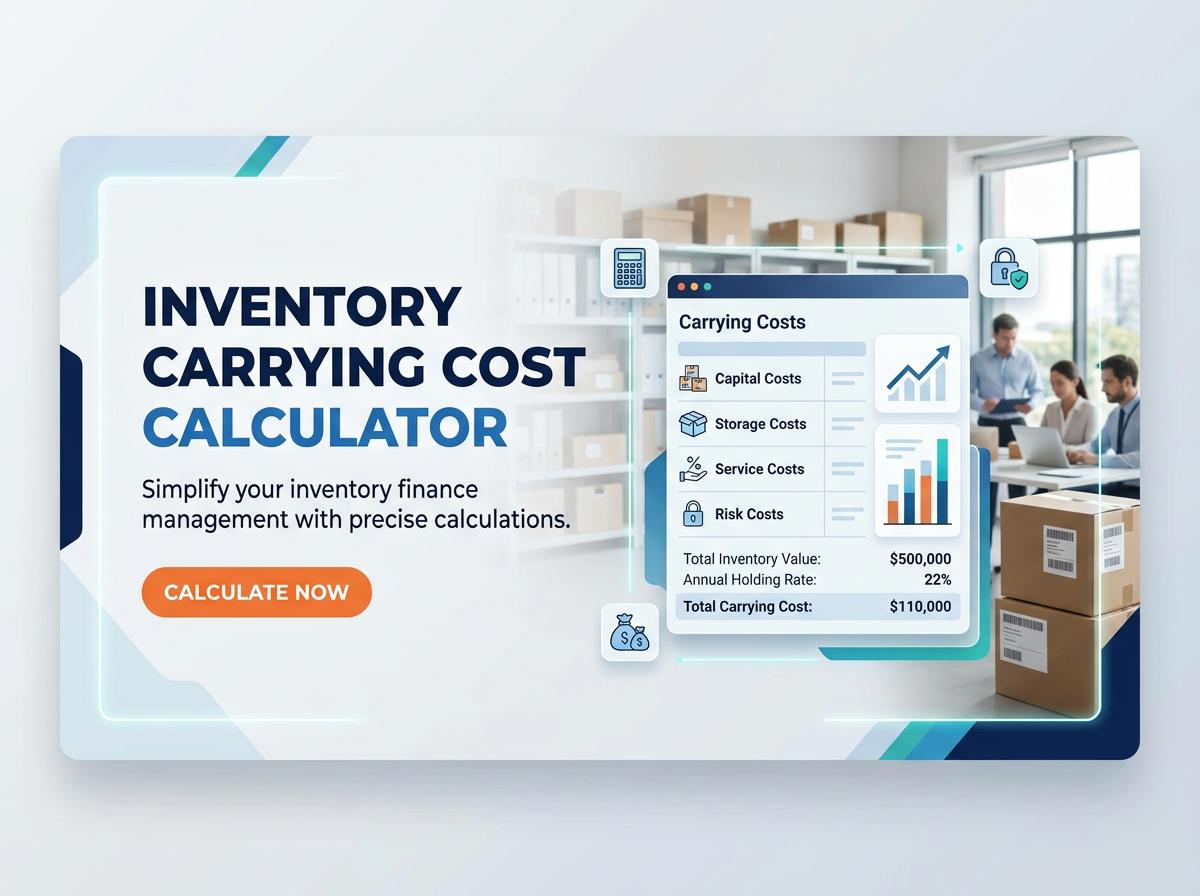

Calculate your holding expenses instantly with our free Inventory Carrying Cost Calculator. Optimize warehouse storage, reduce overhead, and boost your profitability today.
Inventory Carrying Cost Calculator
What exactly is inventory carrying cost?
Inventory carrying cost, also known as holding cost, refers to the total expenses a business incurs for storing and maintaining unsold goods over a specific period. It acts as a primary metric in supply chain management to evaluate how efficiently a company manages its stock.
Instead of just looking at the purchase price of products, carrying costs account for the hidden expenses of keeping those products on warehouse shelves. These costs accumulate continuously until the inventory is sold or disposed of. Understanding this metric is essential for businesses because excessive carrying costs can severely drain cash flow and reduce overall profit margins, indicating that a company may be overstocked or managing its warehouse inefficiently.
How do you calculate the carrying cost of inventory?
To calculate the carrying cost of inventory, you divide your total inventory holding expenses by the total value of your inventory, then express it as a percentage.
Formula: (Total Holding Costs / Total Inventory Value) x 100 = Carrying Cost (%)
Total holding costs involve summing up all expenses related to storing the goods over a year, which generally include:
- Storage space rent and utilities
- Employee salaries (warehouse staff)
- Insurance premiums and taxes
- Depreciation and obsolescence
- Opportunity costs
For example, if a business spends $25,000 annually on holding costs and the total average value of their inventory is $100,000, the calculation is ($25,000 / $100,000) x 100, resulting in a carrying cost of 25%.
What are the four main components of carrying costs?
- Capital Costs: This is the largest component, encompassing the money tied up in purchasing inventory and the financing charges (interest) or opportunity costs of that trapped capital.
- Storage Space Costs: Expenses related directly to the physical warehouse. This includes rent or mortgage payments, utilities, security, and facility maintenance.
- Inventory Service Costs: The administrative and logistical expenses of handling the stock. This covers warehouse labor, IT hardware/software for inventory management, inventory taxes, and insurance premiums.
- Inventory Risk Costs: The financial loss incurred when items lose value while in storage. This includes shrinkage (theft or loss), physical damage, expiration, and obsolescence.
How does opportunity cost factor into inventory storage?
Opportunity cost is a massive, often invisible, factor in inventory storage. It represents the potential financial benefits a company misses out on when its capital is tied up in unsold stock.
When cash is used to buy and hold excess inventory, those same funds cannot be used for other revenue-generating activities. For example, the tied-up cash could have been invested in marketing campaigns, research and development for new products, high-yield financial investments, or paying down high-interest business debt. Therefore, the opportunity cost of inventory is the return on investment (ROI) the business sacrificed by leaving that money sitting on warehouse shelves in the form of physical goods. It is usually the largest single component of total carrying costs.
What is the average carrying cost percentage for most businesses?
For most businesses, the average inventory carrying cost ranges between 15% and 30% of the total inventory value per year. However, this percentage fluctuates heavily depending on the specific industry, the type of products being stored, and the current economic climate.
| Industry / Product Type | Estimated Carrying Cost (%) |
|---|---|
| Non-Perishable Retail | 15% - 20% |
| Technology & Electronics | 20% - 25% |
| Fashion & Apparel | 25% - 30% |
| Perishable Foods & Beverage | 25% - 30%+ |
Products that require specialized storage (like cold-chain logistics) or items that quickly become obsolete sit at the higher end of the spectrum.
How can a company actively reduce its inventory carrying costs?
A company can reduce inventory carrying costs through several strategic supply chain optimizations:
- Implement Just-In-Time (JIT) Inventory: Order goods only as they are needed for production or sales to minimize stock on hand.
- Improve Demand Forecasting: Use historical data and analytics software to accurately predict customer demand and avoid over-ordering.
- Negotiate Minimum Order Quantities (MOQs): Work with suppliers to lower MOQs, preventing the accumulation of excess stock.
- Get Rid of Dead Stock: Regularly audit inventory and discount, liquidate, or donate obsolete items to free up valuable warehouse space.
- Optimize Warehouse Layout: Redesign storage spaces to improve picking efficiency, thereby reducing labor and utility expenditures.
How do carrying costs impact a company's overall profitability?
Carrying costs have a direct, inverse relationship with a company's overall profitability. Because carrying costs represent continuous cash outflows—such as warehouse rent, insurance, and labor—every dollar spent holding inventory is a dollar subtracted from the bottom line.
If a company overstocks and inflates its carrying costs, its profit margins shrink. Furthermore, excessive carrying costs drain liquidity. When cash is trapped in unsold inventory, a business may struggle to cover short-term liabilities or invest in growth opportunities, potentially leading to increased borrowing and interest expenses. Conversely, businesses that tightly control and minimize their holding costs experience improved cash flow, higher net profit margins, and greater financial agility in competitive markets.
What is the relationship between carrying cost and economic order quantity?
Carrying cost and Economic Order Quantity (EOQ) are deeply intertwined. EOQ is a mathematical formula used by businesses to determine the ideal order size that minimizes total inventory costs, which include both ordering costs and carrying costs.
The relationship works as a financial balancing act. If a company orders in large quantities, its ordering costs decrease, but its carrying costs increase because more warehouse space and capital are needed to hold the stock. Conversely, ordering in smaller quantities reduces carrying costs but drives up ordering expenses. The EOQ formula calculates the exact "sweet spot" where the combined total of carrying costs and ordering costs is at its absolute minimum.
How do insurance and taxes affect inventory holding expenses?
Insurance and taxes are fixed expenses that fall under the "inventory service costs" category, reliably driving up holding expenses.
Local governments often levy property taxes on the assessed value of a business's physical inventory. The more inventory a company holds at the end of a tax period, the higher its tax liability will be. Similarly, businesses must insure their inventory against risks like fire, theft, floods, and natural disasters. Insurance premiums are directly tied to the total replacement value of the goods stored. Therefore, holding excess or high-value inventory inevitably inflates both insurance premiums and tax bills, adding significantly to the total carrying cost.
What role does inventory shrinkage and obsolescence play in carrying costs?
Shrinkage and obsolescence fall under "inventory risk costs" and represent a total loss of investment, making them highly detrimental components of carrying costs.
- Shrinkage occurs when inventory is lost between the point of purchase and the point of sale due to employee theft, shoplifting, vendor fraud, or administrative errors.
- Obsolescence happens when products lose their market value entirely before they can be sold. This is common with perishable goods that spoil, technology that becomes outdated, or seasonal fashion that goes out of style.
Both scenarios mean the business paid for the goods, paid to store them, and received zero revenue in return, dramatically inflating carrying costs.
Sources:
 Operating Leverage Degree Calculator