
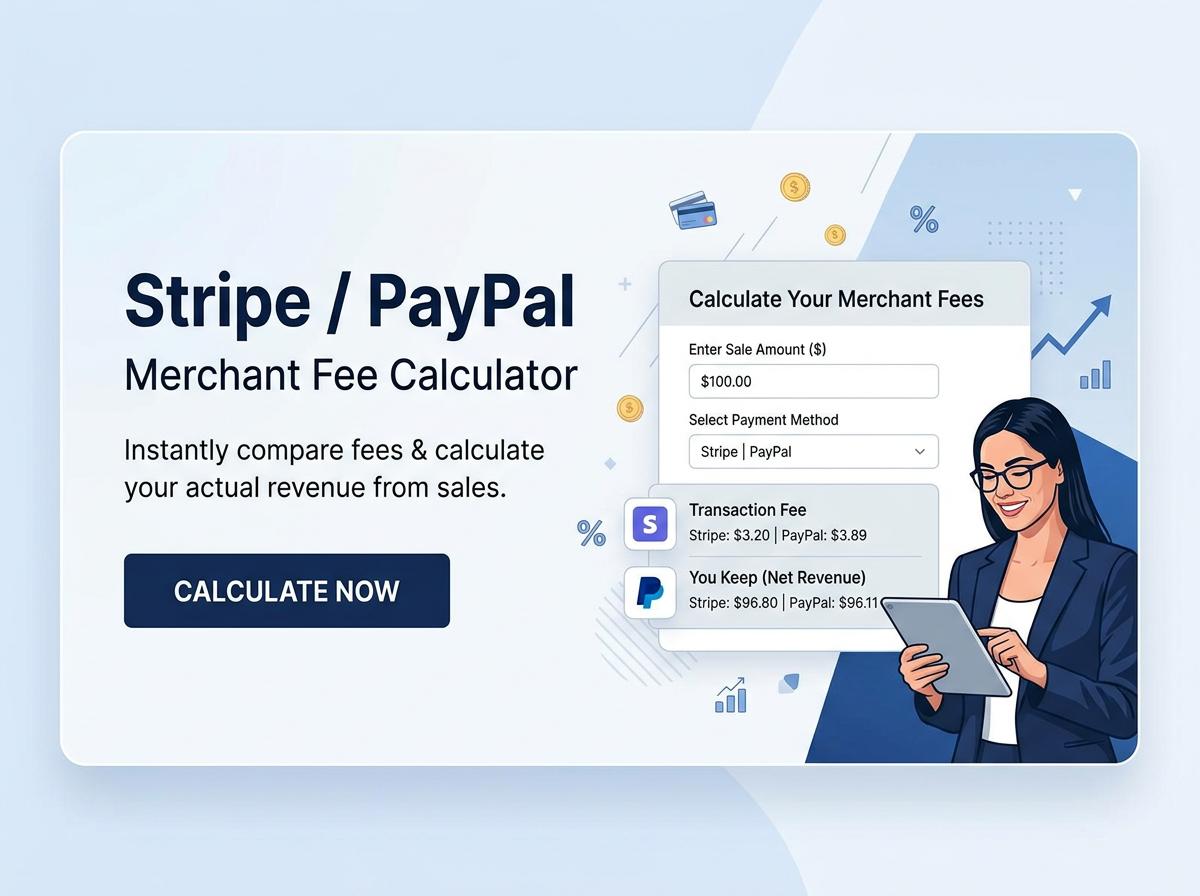

Quickly calculate and compare Stripe and PayPal merchant fees with our free online calculator. Enter your transaction amount to instantly see your exact processing costs, percentage rates, and net payout. Perfect for freelancers, e-commerce stores, and small businesses looking to optimize pricing and maximize profits. Stop guessing and calculate your actual take-home earnings today!
Merchant Fee Calculator
you should charge: $103.30
What is the base transaction rate for domestic online payments?
For most major modern payment processors (such as Stripe, PayPal, and Square), domestic online transactions follow a standard flat-rate pricing model. The industry standard base rate is typically:
- 2.9% + $0.30 per successful transaction.
This rate generally applies to standard credit and debit cards processed through an online checkout or invoicing platform. Traditional merchant accounts might use an "Interchange-plus" model instead, where the base rate fluctuates depending on wholesale card network costs plus a small processor markup.
Do they keep the merchant fee if a refund is issued to the customer?
Yes, the current industry standard is that payment processors do not return the original processing fees when you issue a full or partial refund to a customer.
For example, if a customer buys a $100 item, you pay approximately $3.20 in fees (receiving $96.80). If you refund the customer, the full $100 is returned to their card, but the processor keeps the $3.20 fee. You must cover that $3.20 deficit out of your own business account balance.
How much extra do international transactions and currency conversions cost?
Accepting payments from international customers usually incurs additional surcharges on top of your base domestic rate. These extra fees are broken down into two main categories:
- International Card Fee: An additional 1% to 1.5% is charged if the customer's credit card was issued by a bank outside of your country.
- Currency Conversion Fee: If the transaction requires converting a foreign currency into your local settlement currency, expect an additional 1% to 2% fee.
Combined, an international payment requiring currency conversion will often add roughly 2% to 3.5% to your standard base processing rate.
What is the penalty fee for handling a chargeback or customer dispute?
When a customer disputes a charge directly with their bank or credit card issuer, the payment processor will levy a chargeback penalty fee to cover their administrative and network costs.
- The standard fee typically ranges from $15 to $20 per dispute.
This penalty fee is automatically deducted from your account balance along with the disputed transaction amount. If you submit evidence and win the dispute, the transaction funds are returned to you. Some processors will also refund the penalty fee if you win, while others keep it regardless of the outcome.
Are there any hidden setup, monthly, or cancellation fees?
If you are using a modern "Pay-As-You-Go" payment service provider, there are typically no hidden costs. Their standard account structure is usually:
| Fee Type | Standard Cost |
|---|---|
| Setup / Gateway Fees | $0 |
| Monthly Minimums | $0 |
| Cancellation / Early Termination | $0 |
However, if you sign a contract with a traditional merchant acquirer, you must read the fine print carefully. Traditional accounts frequently charge monthly statement fees, monthly PCI compliance fees, and hefty early termination fees if you cancel your contract early.
How do in-person hardware transaction fees compare to online rates?
In-person transactions (Card-Present) are notably cheaper than online transactions (Card-Not-Present). Because the physical card is present and verified via a secure EMV chip or contactless tap, the risk of fraud is significantly lower. This lower risk translates to lower processing costs.
| Transaction Type | Average Industry Rate |
|---|---|
| Online (Card-Not-Present) | 2.9% + $0.30 |
| In-Person (Card-Present) | 2.6% + $0.10 |
Merchants utilizing Point of Sale (POS) hardware save money on a per-transaction basis, though they must account for the initial upfront cost of purchasing the card reader hardware.
Can I negotiate lower transaction fees if I have a high sales volume?
Yes, virtually all payment processors offer volume discounts for large merchants. If your business processes a high monthly volume (typically exceeding $50,000 to $100,000 per month) or has exceptionally high average order values, you can secure custom pricing.
- Contact Sales: Reach out directly to the processor's enterprise sales team.
- Provide Processing History: Supply statements proving your high processing volume and low chargeback rates.
- Request Interchange-Plus: Ask to be moved from flat-rate pricing to an Interchange-plus model, which is almost always cheaper at scale because you pay wholesale network rates plus a negotiated markup.
What are the costs associated with instant payouts to my bank account?
Standard payouts, which automatically deposit funds into your bank account via ACH within 1 to 3 business days, are entirely free. However, if you need immediate cash flow, processors offer an Instant Payout feature.
The cost for an instant payout is usually an additional percentage of the payout amount:
- Average Instant Payout Fee: 1% to 1.5% of the total transfer volume.
These instant transfers are routed through supported debit card networks rather than the standard ACH network, allowing funds to appear in your bank account in under 30 minutes, even on weekends and bank holidays.
Are there special discounted rate structures available for micropayments?
Yes, some processors offer specific micropayment pricing designed for businesses processing very small transactions (typically under $5 or $10).
Because the standard $0.30 fixed fee would consume an unmanageable portion of a $1 or $2 sale, micropayment models lower the fixed fee in exchange for a slightly higher percentage rate.
- Standard Rate Example: 2.9% + $0.30
- Micropayment Rate Example: 5.0% + $0.05
While PayPal explicitly offers this structure, others like Stripe may not have official out-of-the-box micropayment plans and often recommend that merchants aggregate smaller charges into a single, larger monthly transaction.
Does the transaction fee change depending on the specific type of card used?
This entirely depends on your payment processor's pricing model:
- Flat-Rate Pricing: The fee does not change. You pay the exact same rate (e.g., 2.9% + $0.30) whether the customer uses a basic debit card or a high-tier American Express corporate rewards card.
- Interchange-Plus Pricing: The fee fluctuates per transaction. You pay the true wholesale cost of the card (the interchange rate) plus a fixed processor markup. Basic debit cards will cost much less to process, while premium corporate or travel rewards cards will cost significantly more.
Sources:
 Employee Turnover Cost Calculator