
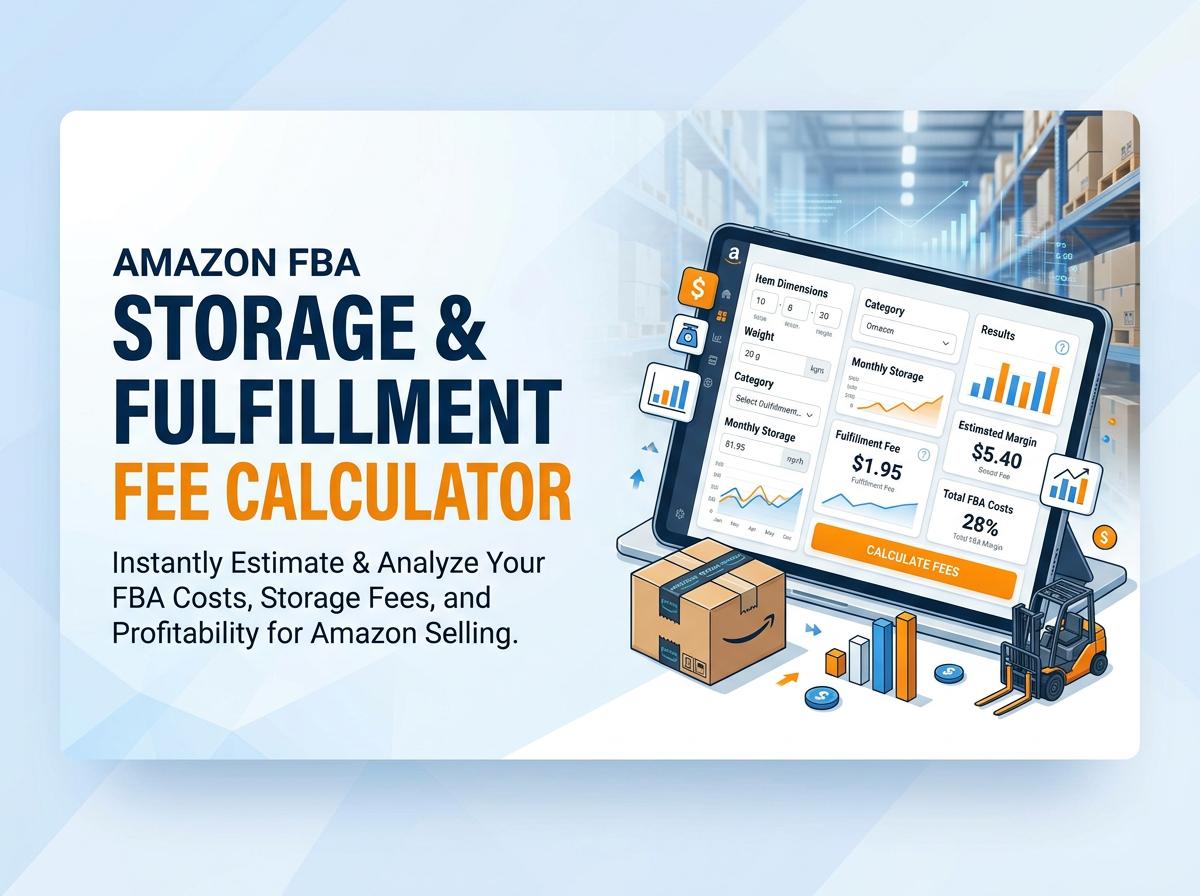

Maximize your Amazon profits with our free FBA Storage & Fulfillment Fee Calculator. Accurately estimate monthly storage, picking, and packing costs in seconds to optimize your pricing strategy. Try it now!
FBA Fee Calculator
How are FBA fulfillment fees calculated for each product?
FBA fulfillment fees are flat, per-unit rates calculated based on three primary factors:
- Size Tier: Determined by the item's packaged dimensions (e.g., Small Standard, Large Standard, Large Bulky).
- Shipping Weight: Calculated using the item's actual weight or dimensional weight, depending on the size tier. Amazon charges based on whichever is greater.
- Product Category: Specific rate cards apply depending on the product type, such as Apparel, Non-apparel, or Dangerous Goods.
Once these factors are determined, Amazon applies a specific tier rate from their fulfillment fee schedule. This single fee comprehensively covers picking, packing, shipping, handling, and customer service for that unit.
What is the difference between monthly and long-term storage fees?
Both fees relate to warehouse space, but they apply differently based on the duration your inventory remains unsold:
| Fee Type | When it Applies | How it is Billed |
|---|---|---|
| Monthly Storage Fee | Ongoing, for all inventory stored in Amazon fulfillment centers. | Charged monthly based on the daily average volume (in cubic feet) your items occupy. |
| Aged Inventory Surcharge (Long-Term) | When inventory remains unsold for more than 181 days. | Assessed monthly as a heavy premium on top of the standard fee, with rates increasing significantly after 365 days. |
How do product dimensions and weight determine the size tier?
Amazon determines your product's size tier through a strict measurement process of the final, packaged item:
- Measure Dimensions: Amazon captures the item's maximum length, width, and height in inches.
- Weigh the Item: The actual unit weight is recorded.
- Calculate Dimensional Weight: For certain tiers, dimensional weight ((Length x Width x Height) / 139) is calculated to account for bulky but light items.
- Apply Thresholds: The dimensions and the greater of the actual or dimensional weight are matched against Amazon's tier limits.
If any single measurement or weight metric exceeds a tier's maximum limit, the product is bumped up to the next larger size tier, resulting in a higher fulfillment fee.
What are the peak season storage rates during Q4?
During the busy holiday shopping season, Amazon implements "peak season" storage fees to encourage sellers to optimize inventory and free up warehouse space. These higher rates apply from October 1st through December 31st.
| Season | Standard-Size Rate (per cubic foot) | Oversize/Bulky Rate (per cubic foot) |
|---|---|---|
| Jan - Sep (Off-Peak) | $0.78 - $0.87 | $0.56 |
| Oct - Dec (Peak) | $2.40 | $1.40 |
Peak rates are generally around three times higher than non-peak months. Note: Specific rates may vary slightly for dangerous goods.
Are there extra fulfillment fees for oversized or dangerous goods?
Yes, both oversized items and dangerous goods incur significantly higher FBA fees compared to standard products.
Oversized/Bulky Items: These items fall into Large Bulky or Extra-Large tiers. The base fulfillment fee is much higher due to the physical space required on delivery trucks and the specialized manual labor needed to safely move heavy boxes.
Dangerous Goods (Hazmat): Items containing flammable liquids, pressurized aerosols, or lithium batteries require special handling and specialized storage facilities. Because of the regulatory and safety requirements, Amazon utilizes an entirely separate, more expensive rate card for Dangerous Goods. Even a lightweight hazardous item costs noticeably more to fulfill.
How does the inbound placement service fee work?
The FBA Inbound Placement Service fee was introduced to cover the cost Amazon incurs when distributing your inventory across its network. When creating a shipping plan, you have a few options that dictate this fee:
- Minimal Shipment Splits: You send all your inventory to a single fulfillment center. Amazon handles the cross-country distribution, but you pay a higher per-unit placement fee.
- Partial Shipment Splits: You send inventory to two or three designated locations, incurring a reduced placement fee.
- Optimized Shipment Splits: You send inventory to four or more locations chosen by Amazon. In exchange for doing the distribution work yourself, you pay no inbound placement fee.
What is the low-inventory-level fee and how is it triggered?
The low-inventory-level fee is a surcharge applied to standard-size products that chronically maintain inadequate inventory levels relative to their customer demand. Amazon charges this because low stock limits their ability to distribute products to local warehouses, which increases their shipping costs.
How it is triggered: The fee applies when both the long-term (last 90 days) and short-term (last 30 days) historical days of supply drop below 28 days. The fee is charged per unit shipped while your inventory remains below this critical threshold.
Sellers can avoid this fee by ensuring they consistently maintain at least four weeks' worth of stock based on recent sales velocity.
Do I still pay fulfillment fees if a customer returns an item?
Yes. The initial FBA fulfillment fee you paid when the item was shipped to the customer is not refunded when an item is returned. Amazon keeps this fee because they already performed the labor of picking, packing, and shipping the product.
Additionally, you may incur further costs during a return:
- Returns Processing Fee: For products in categories with high return rates (like Apparel and Shoes), Amazon charges a fee to cover the cost of receiving and inspecting the returned item.
- Removal Fees: If the returned item is damaged and unfulfillable, you must pay a removal or disposal fee to get it out of the warehouse.
When exactly does Amazon deduct the monthly inventory storage fee?
Amazon calculates and deducts the monthly inventory storage fee in arrears. This means you are charged for the storage space you used during the previous month.
These fees are typically deducted from your Amazon seller account balance between the 7th and the 15th day of the following month. For example, the storage fees for the inventory you held throughout January will be calculated and charged to your account between February 7th and February 15th.
If your account balance does not have sufficient funds to cover these fees, Amazon will charge the primary credit card you have on file.
How can I accurately estimate my FBA fees before sending inventory?
To accurately project your profitability and estimate FBA fees before shipping inventory, you should use the following strategies:
- FBA Revenue Calculator: This free Amazon tool is the most accurate method. Search for an existing, similar product, or input your exact product dimensions, weight, and category to get a detailed breakdown of fulfillment and storage fees.
- Manage Inventory Dashboard: If you have already created your product listing in Seller Central, the "Estimated fee per unit sold" column provides a real-time preview of the fulfillment fee based on your inputted dimensions.
- Accurate Packaging Measurements: Always measure your final, sealed packaging strictly. Overestimating your package size by just an inch can mistakenly push your estimates into a much more expensive tier.
Sources used:
 Franchise Royalty Fee Compounding Calculator