
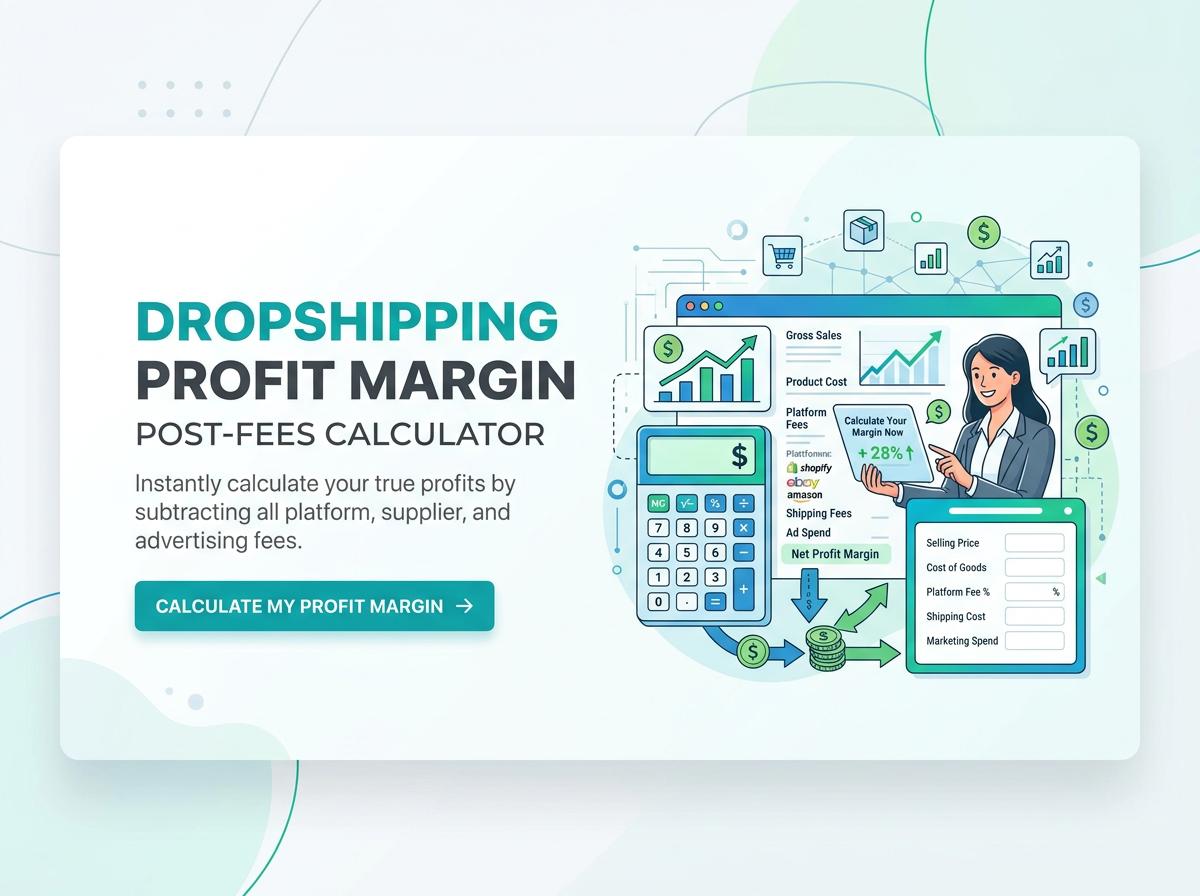

Calculate your true dropshipping profits with our post-fees margin calculator. Instantly factor in product costs, shipping, platform charges, and payment gateway fees to reveal your exact net profit. Stop guessing hidden costs and optimize your pricing strategy today.
Dropshipping Profit Calculator
What is considered a good net profit margin after all dropshipping fees?
In the dropshipping industry, net profit margins are generally lower than traditional retail due to higher variable costs. A "good" net profit margin falls within specific benchmarks:
- 10% to 15%: Average and sustainable.
- 15% to 20%: Good, representing a well-optimized and efficient store.
- 20% to 30%: Excellent, usually achieved through high-ticket dropshipping or organic (free) traffic sources.
While your gross margin (retail price minus supplier cost) might look highly attractive at 40% to 50%, operational expenses—like advertising, app subscriptions, and gateway fees—will quickly reduce your final take-home net profit.
How much do payment gateways like Stripe or PayPal take per transaction?
Payment gateways charge processing fees that directly reduce your revenue per sale. While rates vary slightly by country and volume, the standard fees for merchants are fairly uniform across major providers.
| Gateway | Domestic Fee | International/Cross-Border Fee |
|---|---|---|
| PayPal | 3.49% + $0.49 | Additional 1.50% |
| Stripe | 2.90% + $0.30 | Additional 1.00% to 1.50% |
| Shopify Payments | 2.90% + $0.30 (Basic) | Additional 1.00% |
These fixed cents per transaction significantly impact margins if you sell high-volume, low-ticket items.
Which e-commerce platform fees eat into the gross margin the most?
E-commerce platforms impact your margins through a combination of fixed and variable fees. The fees that eat into gross margins the most are:
- Transaction Fees: Platforms like Shopify charge up to 2% per transaction if you do not use their native payment gateway.
- This is in addition to your third-party payment gateway fee.
- Tiered Subscription Plans: Basic plans start around $29–$39/month, but scaling to advanced plans ($299+/month) cuts into margins if sales volume drops.
- Premium Themes & Add-ons: Upfront theme costs and ongoing maintenance fees act as sunk costs, delaying your initial profitability phase.
How do customer acquisition costs and ad spend reduce final profits?
Customer Acquisition Cost (CAC) is typically a dropshipper’s largest expense, often consuming 20% to 40% of total revenue. Because dropshippers rely heavily on paid social media ads (Facebook, TikTok) or search ads (Google), these costs directly slash gross profit.
For example:
- Retail Price: $50
- Product/Shipping Cost: $15 (Gross Margin = $35)
- Ad Spend to get one sale (CAC): $20
- Remaining Net Profit: $15
If advertising algorithms shift or ad fatigue sets in, your CAC rises. If the CAC exceeds your gross margin, your net profit becomes negative, resulting in a financial loss on every order.
Are there hidden handling or processing fees charged by the supplier?
Yes, dropshipping suppliers often have hidden fees that are not immediately apparent in the base product price. These can slowly chip away at your margins:
- Fulfillment Fees: Some sourcing agents charge a per-order picking and packing fee (e.g., $0.50 to $1.00 per package).
- Blind Dropshipping Fees: Removing supplier invoices and adding your custom branding or thank-you cards usually incurs a small premium.
- MOQ Surcharges: If you do not meet a Minimum Order Quantity, suppliers may apply a "small order" processing fee.
- Warehouse Storage: If buying in bulk to secure better product pricing, 3PL providers will charge ongoing monthly storage fees.
How dramatically do refunds and chargebacks impact the actual margin?
Refunds and chargebacks are devastating to dropshipping margins because you lose significantly more than just the value of the sale.
- Standard Refunds: You lose the product cost, the original shipping fee, and the advertising money spent to acquire the customer (CAC). High return shipping costs usually prevent economically recovering the physical item.
- Chargebacks: If a customer disputes a charge with their bank, you lose the funds and are penalized with a non-refundable chargeback fee (typically $15 to $20).
Furthermore, a chargeback rate over 1% can cause processors like Stripe to freeze your funds, destroying your cash flow.
What is the cost of currency conversion fees on cross-border orders?
When dropshipping globally, currency conversion fees act as a silent margin killer. These fees occur in two main areas:
- Receiving Payments: If a customer pays in Euros but your bank account is in USD, your payment processor will apply a currency conversion fee, typically 1% to 2% above the daily base exchange rate.
- Paying Suppliers: If you collect USD but must pay a Chinese supplier in CNY or an agent via international wire, you lose another 1% to 3% to your bank or a service like Wise.
Combined, poor currency management can quietly cost you 2% to 5% of your total revenue.
How do monthly app subscriptions affect the profit margin per item?
E-commerce apps for email marketing, reviews, upselling, and SEO represent fixed monthly operational expenses. To calculate their impact on your profit margin, these costs must be amortized over the number of items you sell.
For example, if you pay $100 a month for various store apps:
- Selling 10 items/month = Apps cost $10 per item.
- Selling 100 items/month = Apps cost $1 per item.
- Selling 1,000 items/month = Apps cost $0.10 per item.
For beginners with low sales volume, app subscriptions dramatically eat into the net profit margin per item. It is critical to strictly use essential apps until high volume is achieved.
Do sales taxes, customs duties, or VAT reduce the seller's bottom line?
Yes, taxes and duties significantly reduce your bottom line if you do not strategically factor them into your retail price and pass them on to the consumer.
For example, in the European Union, the Value Added Tax (VAT) ranges from 17% to 27%. If you sell a product for €50 and are required to remit 20% VAT, you owe €10. If you did not price the product at €60 to account for this tax, that €10 comes directly out of your net profit.
Similarly, unexpected customs duties upon arrival can lead to customers rejecting packages, resulting in expensive refunds.
How much do fluctuating shipping rates and surcharges lower net profits?
Fluctuating shipping rates can easily wipe out net profits, especially for sellers who offer "Free Shipping" and absorb the logistics costs. Shipping rates are highly volatile and affected by:
- Peak Season Surcharges: During Q4 (holiday season), international carriers often increase rates by 10% to 30%.
- Fuel Surcharges: Rising global oil prices directly increase courier fuel surcharges, changing your baseline shipping costs from week to week.
- Volumetric Weight: Suppliers may switch to larger packaging, unexpectedly triggering higher dimensional weight charges.
If your net profit per item is only $5, a sudden $3 increase in shipping costs eliminates 60% of your total margin.
Sources:
 Amazon FBA Storage & Fulfillment Fee Calculator