
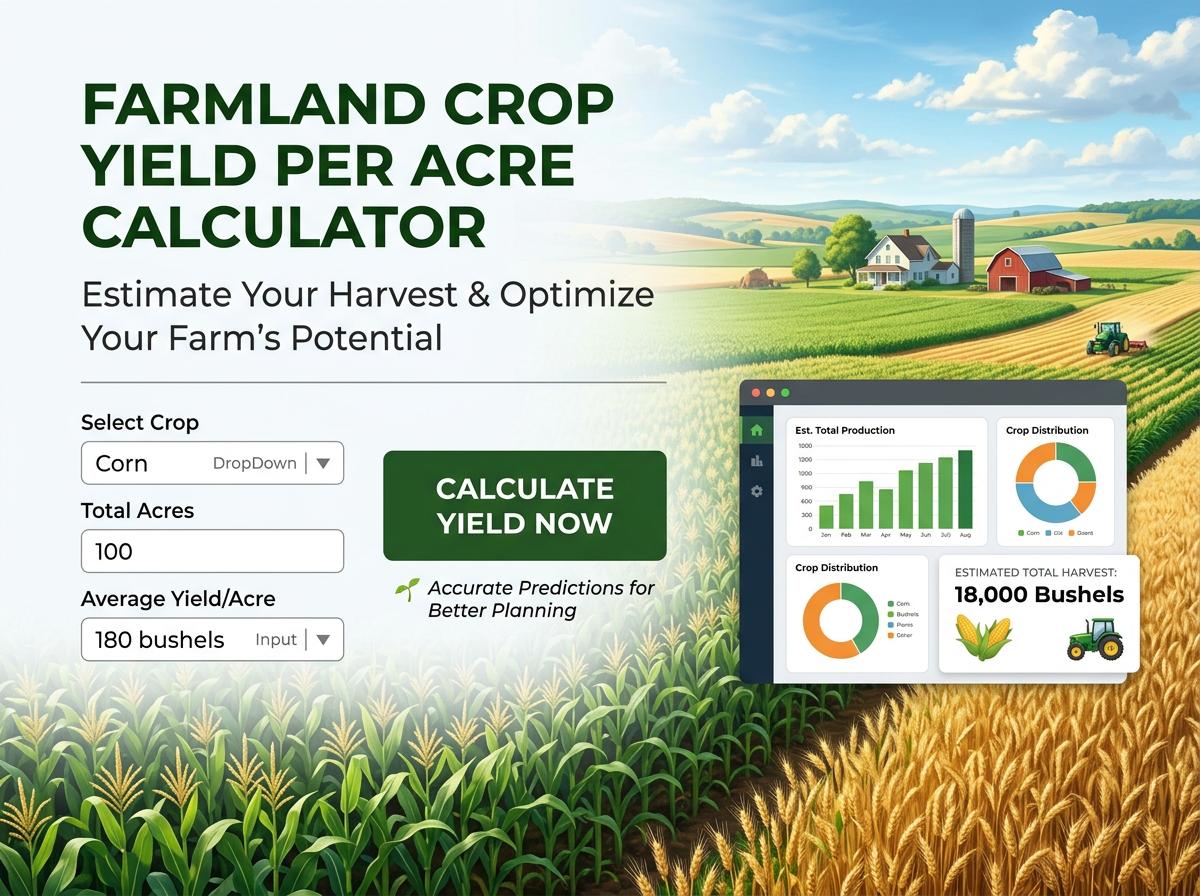

Maximize your harvest with our accurate Farmland Crop Yield per Acre Calculator. Instantly estimate total crop production, optimize your agricultural planning, and forecast farm profitability. A fast, free, and essential tool for farmers, agronomists, and landowners preparing for the growing season.
Crop Yield Calculator
How is crop yield per acre accurately calculated?
Crop yield per acre is calculated by dividing the total harvested production by the total harvested land area. The standard formula is:
- Yield = Total Production / Total Acres
Farmers first measure the total grain or biomass harvested, typically using weigh wagons, scale tickets, or combine yield monitors. This weight is then adjusted for moisture content to meet standard market requirements (for example, corn is usually standardized to 15.5% moisture). The standardized total weight is divided by the exact acreage harvested. Precision agriculture utilizes GPS-guided combine harvesters equipped with mass flow sensors to accurately calculate and map minute yield variations across specific square-foot grids within a single acre.
What soil conditions most directly impact crop yield?
Several critical soil conditions dictate the physical and chemical environment for root growth, directly impacting crop yields:
- Soil pH: Determines nutrient availability. Most major crops thrive in slightly acidic to neutral pH (6.0-7.0).
- Organic Matter: High organic matter improves water retention, soil structure, and beneficial microbial activity.
- Nutrient Levels: Adequate amounts of macronutrients (Nitrogen, Phosphorus, Potassium) and micronutrients are essential for healthy plant development.
- Soil Texture: Loam soils provide the best balance of aeration and moisture retention, whereas heavy clay can cause waterlogging and sand drains too quickly.
- Compaction: Compacted soil restricts root penetration and water infiltration, significantly stunting plant growth and reducing potential yield.
How does weather variability affect per-acre production?
Weather variability is one of the most unpredictable and influential factors determining per-acre production. Its impacts include:
- Temperature Extremes: Unusually high temperatures during pollination can cause sterile flowers, drastically dropping yields. Late spring frosts can kill seedlings, while early fall frosts can stop crop maturation.
- Precipitation: Droughts lead to water stress, stunted growth, and poor grain fill. Conversely, excessive rainfall causes waterlogging, promotes fungal diseases, and washes away essential nutrients.
- Severe Events: Hail, high winds (causing lodging), and storms can physically destroy entire fields overnight.
Consistent, moderate weather aligned with a crop's specific growth stages is vital for maximizing harvest totals.
Which farming technologies best maximize yield per acre?
Modern farming relies on advanced technologies to maximize output per acre:
- Precision Agriculture: Uses GPS and GIS to manage field variations. Variable Rate Technology (VRT) allows the targeted application of seeds, fertilizers, and water to optimize efficiency.
- Biotechnology: Genetically Modified Organisms (GMOs) and CRISPR gene-edited seeds provide resistance to pests, diseases, and herbicides while improving drought tolerance.
- IoT Sensors: Soil moisture and nutrient sensors provide real-time data, enabling highly precise irrigation and fertigation.
- Drones and Satellite Imagery: Aerial imaging helps detect early signs of plant stress, nutrient deficiencies, or pest infestations, allowing for rapid intervention.
- Automated Machinery: AI-driven tractors and robotic weeders increase operational efficiency and reduce accidental crop damage.
How do fertilizers and pesticides influence harvest totals?
Fertilizers and pesticides are agrochemicals that protect and enhance crop yields, though they act in different ways:
Fertilizers supply essential nutrients—primarily Nitrogen, Phosphorus, and Potassium (NPK)—that native soils may lack. Nitrogen drives vegetative growth, Phosphorus aids root development, and Potassium improves disease resistance. Proper application maximizes plant size, grain weight, and overall harvest totals per acre.
Pesticides (including herbicides, insecticides, and fungicides) do not increase yield potential; rather, they preserve it. Herbicides eliminate weeds that compete for water and nutrients. Insecticides prevent insects from consuming foliage and fruit, while fungicides stop diseases from destroying plant tissue. Together, these chemicals ensure the crop reaches its maximum genetic yield potential.
What role does crop rotation play in increasing yields?
Crop rotation—the practice of growing different types of crops in the same area across sequential seasons—boosts yields through several key mechanisms:
- Pest and Disease Disruption: Changing crops breaks the life cycles of soil-borne pathogens and pests that target specific plant species, naturally reducing crop damage.
- Nutrient Management: Different crops have distinct nutrient profiles. For example, planting legumes (like soybeans) fixes atmospheric nitrogen into the soil, leaving a nutrient-rich environment for the next crop (like corn), which demands high nitrogen.
- Weed Control: Rotating crops allows for different herbicide applications and canopy covers, suppressing resistant weed populations.
- Soil Structure: Alternating deep-rooted and shallow-rooted crops improves soil aeration, reduces compaction, and prevents soil erosion.
How significantly does irrigation improve per-acre output?
Irrigation has a massive impact on per-acre output, often increasing yields by 50% to over 100% compared to rainfed agriculture, depending on the region. Its significant benefits include:
- Drought Mitigation: It guarantees crop survival and growth during dry spells, preventing catastrophic yield losses.
- Optimized Growth Stages: Crops have critical moisture periods (e.g., corn silking). Irrigation ensures water is available precisely when it dictates final yield outcomes.
- Nutrient Uptake: Water is the carrier for soil nutrients; adequate moisture ensures plants can absorb applied fertilizers efficiently.
- Double Cropping: In some regions, reliable irrigation allows farmers to plant and harvest two different crops in a single year on the same acre.
What are the average yield expectations for major crops?
Average yield expectations vary widely based on geography, weather, and technology. Below are approximate recent averages for major crops in the United States (measured in bushels per acre):
| Crop | Average US Yield (Bushels/Acre) | Primary Determining Factors |
|---|---|---|
| Corn | 170 - 180 bu/acre | Nitrogen availability, summer rainfall, genetics |
| Soybeans | 50 - 55 bu/acre | Planting date, late-season moisture, weed control |
| Wheat | 45 - 50 bu/acre | Winter survival (winter wheat), disease management |
| Rice | 165 - 175 bu/acre | Water management, temperature control |
Note: Highly managed, irrigated fields routinely exceed these national averages.
How do pests and crop diseases reduce harvest outcomes?
Pests and diseases diminish harvest outcomes by attacking crops at various growth stages, resulting in estimated global yield losses of 20% to 40% annually. They reduce yields by:
- Defoliation: Insects like caterpillars consume leaves, reducing the plant's photosynthetic capacity, which starves the developing grain or fruit.
- Root and Stem Damage: Nematodes and root rots destroy the root system, preventing water and nutrient uptake. Borers weaken stems, causing plants to collapse (lodge) before harvest.
- Nutrient Siphoning: Aphids and fungal rusts extract vital nutrients directly from the plant's vascular system.
- Quality Degradation: Pathogens can infect the harvested product itself (e.g., ear rot in corn), producing mycotoxins that make the crop unsellable and effectively reducing the usable yield.
What historical trends show changes in per-acre yields?
Historically, per-acre crop yields remained relatively flat for centuries, seeing only marginal improvements through traditional selective breeding and crop rotation. However, the mid-20th century marked a drastic upward trend known as the Green Revolution.
Starting in the 1940s and 1950s, the widespread introduction of synthetic fertilizers, chemical pesticides, and high-yielding dwarf crop varieties caused yields to skyrocket. For example, average U.S. corn yields jumped from around 30 bushels per acre in 1930 to over 170 bushels per acre today. Since the 1990s, the adoption of genetically modified (GM) crops and precision agriculture technologies has sustained this upward trajectory. While the rate of exponential growth has slightly plateaued recently, ongoing innovations in biotechnology continue to push the ceiling of agricultural production.
 Vending Machine Route ROI Calculator