
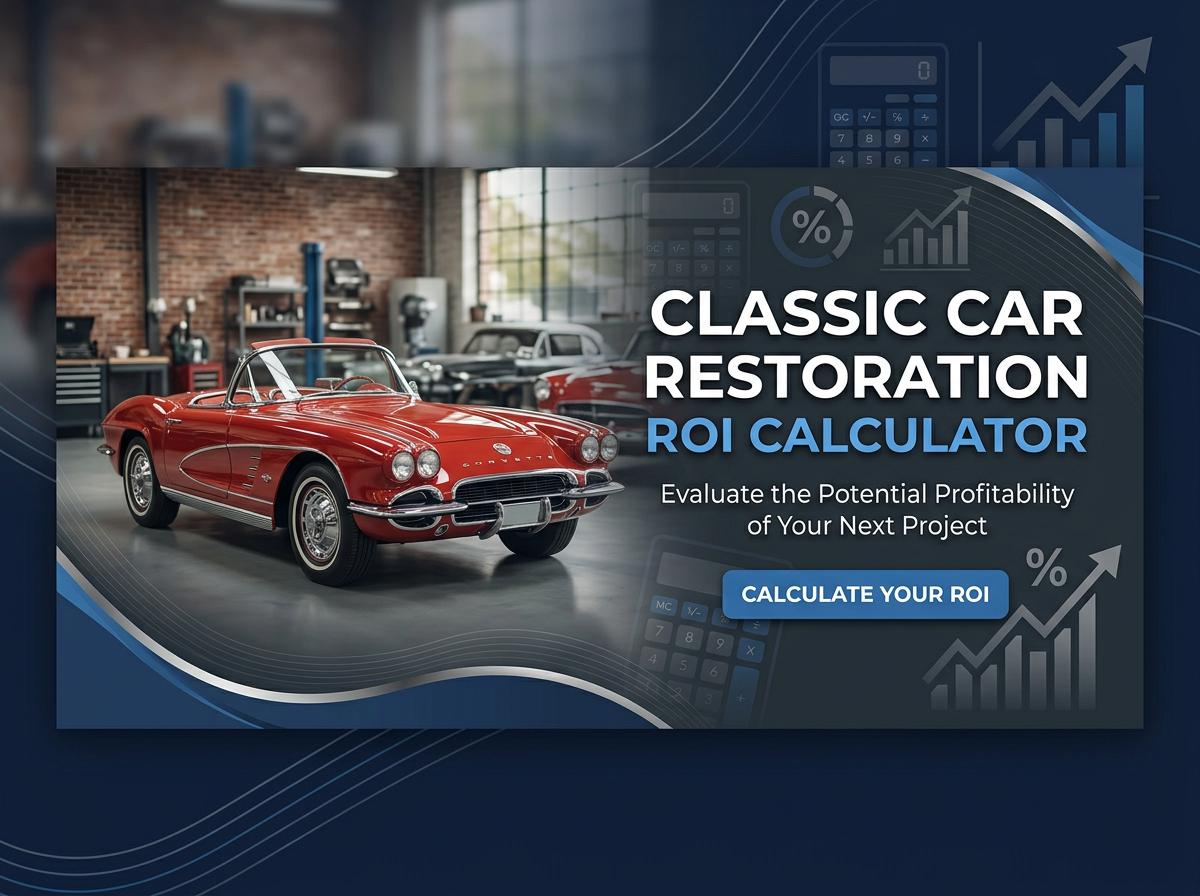

Maximize your investment with our Classic Car Restoration ROI Calculator. Estimate repair costs, forecast future market value, and discover your potential profit today.
Classic Car Restoration ROI
Which classic car models offer the highest ROI?
The classic car market fluctuates, but certain models consistently deliver high Returns on Investment (ROI) due to enduring popularity and limited supply.
| Car Category | Specific Models |
|---|---|
| Air-Cooled Porsches | 1970s-1990s Porsche 911s |
| Vintage SUVs | First-gen Ford Broncos, Chevy K5 Blazers, Toyota FJ40s |
| American Muscle | 1960s Ford Mustangs, Chevy Camaros, Dodge Chargers |
| European Exotics | Classic Ferraris, Mercedes-Benz Pagodas |
Currently, vintage SUVs and 1980s-1990s Japanese sports cars (like the Toyota Supra and Mazda RX-7) are seeing some of the fastest ROI growth as millennial collectors enter the market.
How do you calculate the true ROI of a restoration?
Calculating the true ROI requires accounting for every single expense, not just the vehicle's initial purchase and major parts. The standard formula is:
ROI = ((Final Sale Price - Total Investment) / Total Investment) × 100
To accurately determine your Total Investment, you must calculate:
- Initial Asset Cost: The base vehicle purchase price, including taxes and transport.
- Restoration Expenses: All parts, materials, and professional labor invoices.
- Holding Costs: Storage fees, insurance premiums, and maintenance during the build.
- Selling Costs: Auction entry fees, broker commissions, marketing, and transportation.
Failure to include holding and selling costs often leads to falsely inflated ROI calculations.
Do matching numbers significantly impact the final value?
Yes, "matching numbers" can drastically increase a classic car's final valuation, often acting as the deciding factor for top-tier collectors. This term means the vehicle still retains its factory-original major components (engine, transmission, and rear axle) stamped with serial numbers matching the chassis VIN.
- Value Premium: Matching numbers can boost a car's value by 20% to over 50% compared to a non-matching "period-correct" vehicle.
- Historical Authenticity: It guarantees the car has not been pieced together from multiple salvage yard vehicles.
- Investment Grade: Blue-chip classics (like Ferraris, Shelby Mustangs, and split-window Corvettes) absolutely require matching numbers to achieve top-tier auction results.
What hidden restoration costs destroy potential profits?
Many amateur restorers underestimate secondary expenses, leading to blown budgets. The most common profit-killing hidden costs include:
- Extensive Rust and Rot: Surface rust often hides severe structural rot. Fabricating custom sheet metal demands massive labor hours.
- Missing Proprietary Trim: Sourcing rare badges, chrome moldings, or original dashboard components for obscure models can cost thousands.
- Previous "Hack" Repairs: Undoing poor welding, cheap body filler, or spliced wiring harnesses takes more time than starting from scratch.
- Machine Shop Delays: Engine block machining often runs over budget and delays the timeline, indirectly increasing holding costs.
- Specialty Hardware: Buying period-correct, factory-style nuts, bolts, and fasteners can be shockingly expensive.
Does a restomod yield a better return than an original restoration?
It heavily depends on the specific vehicle's rarity and the target demographic. A "restomod" combines classic styling with modern performance upgrades like fuel injection, disc brakes, and modern suspension.
When Restomods Win: For mass-produced vehicles like the 1960s Chevy C10, first-generation Ford Mustang, or standard Chevrolet Camaro, high-quality restomods often yield a higher ROI. Modern buyers will pay a massive premium for vintage aesthetics paired with turn-key reliability.
When Originality Wins: For low-production, ultra-rare vehicles (e.g., Plymouth Hemi 'Cuda, Ferrari 275 GTB, or Shelby Cobra), modifying the car will drastically destroy its value. High-end collectors demand exacting, factory-original specifications.
How do professional labor costs affect the overall ROI?
Professional labor is almost always the single largest expense in a restoration, routinely destroying profit margins if not managed carefully. Top-tier restoration shops charge anywhere from $80 to $200+ per hour. A full concourse-level restoration can easily require 1,000 to 2,000+ hours of labor.
Because of these high rates, paying a shop to perform a 100% turnkey restoration rarely results in a positive ROI unless the base vehicle is an extremely high-value blue-chip classic.
To maintain profitability, investors usually rely on "sweat equity"—performing teardowns, reassembly, and sourcing parts themselves, while only outsourcing highly specialized tasks like media blasting, engine machining, and final paintwork.
Is a full frame-off restoration worth the investment?
A full frame-off restoration—where the body is completely removed from the chassis to meticulously rebuild every nut and bolt—is only financially worthwhile for high-tier, investment-grade vehicles.
Because it requires massive labor hours, a frame-off restoration can easily cost $50,000 to $150,000+. If the car's ultimate market ceiling is only $60,000, you will lose a significant amount of money.
For mid-tier or mass-produced classics, a "sympathetic" or frame-on restoration (focusing on fresh paint, a clean interior, and mechanical reliability while leaving the chassis intact) yields a far better ROI. Frame-off restorations should be strictly reserved for cars where concourse-level perfection dictates the final auction premium.
How do storage and insurance costs factor into the net ROI?
Storage and insurance are the "silent killers" of classic car ROI. Because restorations often take years to complete, these holding costs compound significantly over time, eroding your net profit.
- Storage: Climate-controlled storage is essential to prevent rust during a multi-year build. Renting a specialized garage space can cost $200 to $500+ monthly. Over a three-year build, that is $7,200 to $18,000 lost.
- Insurance: You must carry "builder's risk" or comprehensive classic car insurance to protect the appreciating asset against fire, theft, or shop damage, adding hundreds annually.
To maximize ROI, the restoration turnaround time must be as tight as possible. Every extra month the car sits unfinished directly subtracts from the final margin.
Does the quality of replacement parts affect the resale price?
Absolutely. The caliber of parts used acts as a direct indicator of the restoration's overall quality, heavily influencing educated buyers and appraisers.
- NOS (New Old Stock): These are original factory parts that were manufactured decades ago but never used. They fit perfectly, retain strict authenticity, and command the highest resale premiums from purists.
- OEM Quality Reproductions: High-end aftermarket parts authorized by the original manufacturer. They maintain good value and are acceptable for most mid-tier builds.
- Cheap Aftermarket Parts: Low-budget, poorly fitted reproduction parts instantly devalue a classic. Buyers can easily spot wavy chrome or cheap interior vinyl, which signals that mechanical corners were likely cut as well.
How long does it typically take to realize a return on investment?
Realizing an ROI on a classic car restoration is rarely a quick flip; it is a medium-to-long-term investment. The timeline generally spans 2 to 5 years, broken down into two phases:
- The Build Phase (1 to 3 Years): Sourcing the car, ordering parts, and managing labor is notoriously slow. Machine shop queues, custom fabrication, and paint curing times simply cannot be rushed.
- The Market Phase (6 Months to 2 Years): Finding the right buyer for a niche asset takes time. Waiting for the optimal spring selling season or a premier auction event ensures maximum returns.
Investors relying strictly on market appreciation (without restoring) typically hold vehicles for 5 to 10 years to see substantial ROI.
 Self-Storage Facility Unit Mix Calculator