
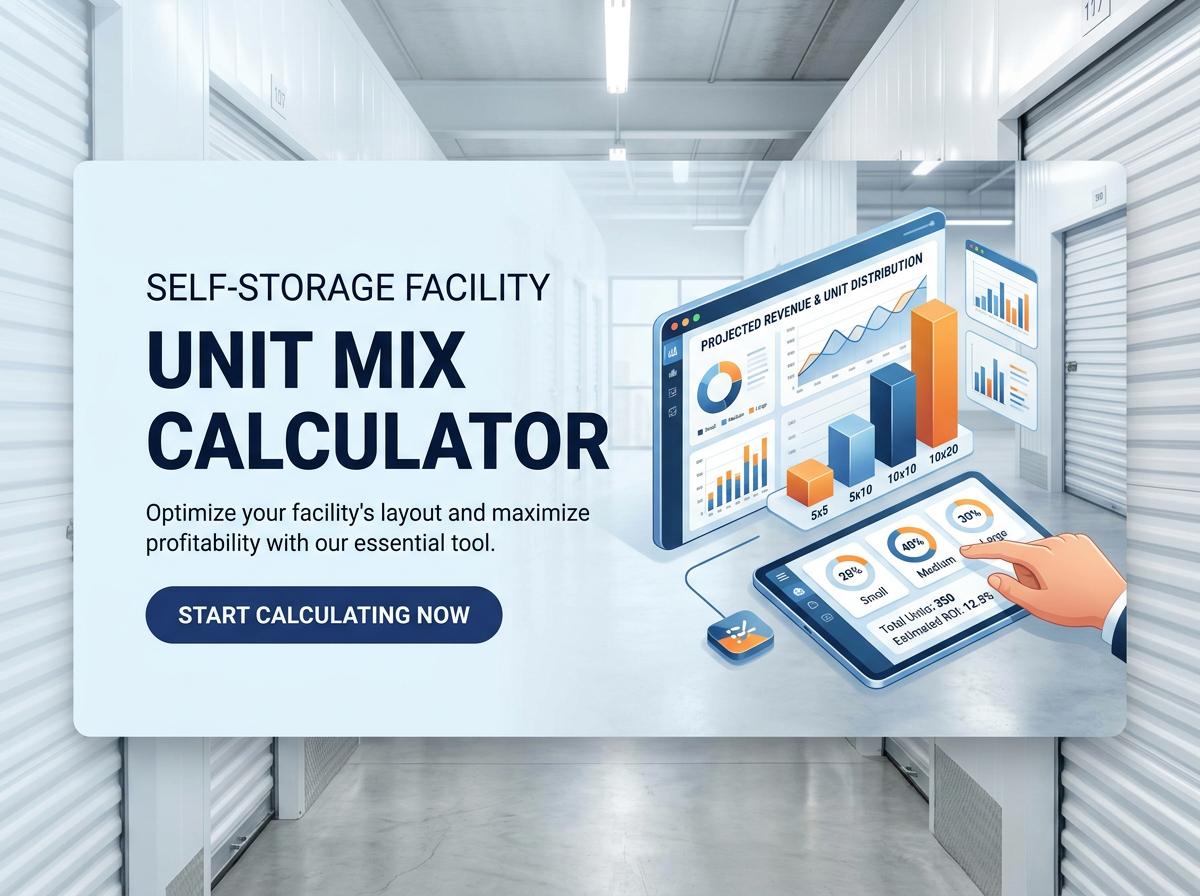

Maximize your facility's revenue with our Self-Storage Unit Mix Calculator. Easily determine the most profitable combination of unit sizes, calculate rentable square footage, and optimize your layout based on local market demand. Plan your perfect storage development and maximize ROI today!
Self-Storage Unit Mix Calculator
| Unit Size (W × L) | Quantity | Rent/Mo ($) | Total SqFt | Monthly Rev | % of Area |
|---|
How do local demographics and housing trends dictate the ideal unit sizes?
Local demographics and housing patterns serve as the primary baseline for determining a self-storage facility's optimal unit mix. Developers must analyze the community profile to anticipate storage volume needs:
- High-Density Urban/Apartments: Residents lack closets and basements. This creates high demand for smaller units (5x5, 5x10) to store seasonal clothing, bicycles, or boxes.
- Single-Family Suburbs: Homeowners accumulate furniture, appliances, and lawn equipment, driving demand for larger units (10x15, 10x20).
- College Towns: Generates highly seasonal demand for small-to-medium units as students store dorm contents over the summer.
- Aging Populations: Retirees downsizing from large homes to smaller condos require medium-to-large units for long-term storage of family heirlooms and excess furniture.
Which unit sizes historically yield the highest revenue per square foot?
Historically, smaller storage units yield significantly higher Revenue Per Square Foot (RPSF) than larger units. While a large unit brings in more total gross rent, breaking that same footprint down into multiple smaller units commands a premium price.
| Unit Size | Square Feet | Hypothetical Rent | RPSF |
|---|---|---|---|
| 5x5 | 25 sq ft | $60 | $2.40 |
| 5x10 | 50 sq ft | $90 | $1.80 |
| 10x10 | 100 sq ft | $140 | $1.40 |
| 10x20 | 200 sq ft | $220 | $1.10 |
Facility owners must balance this higher yield against the higher construction costs (more doors, more partitions) and higher vacancy risk associated with smaller units. An optimal mix maximizes RPSF while matching local demand.
What percentage of the mix should be climate-controlled versus standard drive-up?
The optimal ratio of climate-controlled (CC) to standard drive-up units depends on the intersection of regional weather, target demographics, and local supply.
- Regional Climate:
- Extreme Weather: Areas with high humidity or freezing winters may demand 70-100% CC units to protect furniture and electronics from mold and cracking.
- Mild Weather: Temperate zones can support a larger mix of standard drive-ups.
- Demographics & Items Stored: Higher-income areas or business clients storing inventory strongly prefer CC. Standard drive-up is favored by contractors or those storing tools.
Nationally, multi-story urban facilities lean heavily toward 100% CC due to building footprints, while sprawling suburban/rural facilities may maintain a 30% CC to 70% drive-up ratio.
What unit sizes are currently oversupplied or undersupplied by local competitors?
Identifying supply gaps in a 3 to 5-mile trade area requires a thorough competitor analysis. Developers can discover oversupplied and undersupplied units through several methods:
- Mystery Shopping: Calling competitors or checking their websites to see which unit sizes are waitlisted or sold out (indicating undersupply).
- Price Reductions: Tracking aggressive move-in specials. A facility offering heavy discounts on 10x15 units is likely oversupplied in that size.
- Market Feasibility Studies: Utilizing data firms to aggregate local supply per capita by unit size.
If competitors are entirely sold out of 10x20s but have fifty 5x5s available, a developer should bias their initial unit mix toward larger sizes to capture the unmet market demand.
How does the facility's physical layout and topography restrict the possible unit mix?
The physical constraints of a parcel strictly govern the architectural layout and subsequent unit mix. Key restrictive factors include:
- Parcel Shape: Irregular or narrow lots may force the creation of non-standard hallway layouts, leading to a higher percentage of smaller or odd-sized units (e.g., 5x7s) to maximize rentable space.
- Topography: Sloped terrain often requires multi-level construction built into a hill. This usually dedicates the bottom grade to large drive-up units and the interior upper levels to smaller, climate-controlled units.
- Drive Aisles & Fire Codes: Municipal requirements for 25- to 30-foot drive aisles limit the number of buildings that can fit. If building depth is constrained to 30 feet, creating massive 15x30 units becomes architecturally impractical.
Is there enough local demand to justify allocating space for RV or boat parking?
Allocating acreage for RV and boat parking requires specific local demand drivers, as vehicle storage yields a much lower revenue per square foot compared to traditional enclosed units. Consider the following indicators:
- Recreational Proximity: Is the facility within 10-15 miles of major lakes, coastal marinas, national parks, or campgrounds?
- HOA Restrictions: Neighborhoods with strict Homeowner Association (HOA) rules prohibiting street or driveway parking of RVs and boats naturally generate high demand for off-site storage.
- Disposable Income: Target trade areas must have a demographic with high enough disposable income to own large recreational vehicles.
If these factors align, covered or fully enclosed RV parking can be a powerful anchor to attract long-term, high-paying tenants.
How easily can the unit mix be reconfigured later using movable partition walls?
Reconfiguring a unit mix post-construction is highly feasible, relatively inexpensive, and crucial for adapting to shifting market demands—provided the facility is designed with flexibility in mind.
Most modern self-storage facilities utilize standardized steel roll-up doors and corrugated metal partition walls bolted into a modular grid system (typically 10x10 grids). If a facility has an oversupply of 10x10 units but a waitlist for 10x20s, management can easily unbolt and remove the dividing partition between two adjacent 10x10s to create a single 10x20.
Conversely, splitting a large unit into smaller ones is costlier, requiring new hallway framing, extra roll-up doors, and updated fire sprinkler coverage. Therefore, initially designing the facility with extra doors (smaller units) allows for easier downward removal of partitions later.
How does an urban versus rural location influence the ratio of small to large units?
The geographic setting of a facility directly dictates the living space available to its customers, creating distinct unit mix profiles for urban and rural markets.
| Setting | Housing Type | Dominant Unit Mix Demand |
|---|---|---|
| Urban | Dense apartments, minimal closets, no garages. | Heavily skewed toward small units (5x5, 5x10). Renters use them as off-site closets. |
| Rural | Large properties, garages, barns, open land. | Dominated by large units (10x20, 10x30). Customers store large machinery, vehicles, or whole-house contents. |
Furthermore, high land costs in urban areas necessitate multi-story buildings where smaller units yield the high RPSF needed to offset expensive real estate. Cheaper rural land supports sprawling, single-story buildings suited for larger units.
What are the expected turnover rates and average length of stay for each unit size?
Turnover rates and the average length of stay in the self-storage industry correlate strongly with unit size and the life events prompting the storage need.
- Small Units (5x5, 5x10): Experience the highest turnover and shortest length of stay (averaging 3 to 6 months). They are typically rented for transitional life events: college summer breaks, minor apartment moves, or temporary decluttering.
- Medium Units (10x10, 10x15): Have a moderate turnover. These average a 9 to 14-month stay, usually tied to home staging, major renovations, or longer relocation processes.
- Large Units (10x20+): Experience the lowest turnover and longest length of stay (often exceeding 24 months). Tenants use these for long-term storage of vehicles, business inventory, or heirlooms.
How should the unit mix be adjusted during phased construction based on early lease-up data?
Phased construction allows developers to mitigate risk by using Phase 1 as a real-world feasibility study for subsequent phases. Early lease-up data provides actionable intelligence to optimize the final unit mix.
- Analyze Velocity: Track how fast specific unit sizes rent. If 10x10s reach 90% occupancy within three months while 5x5s languish at 30%, Phase 2 blueprints must be altered to eliminate smaller units.
- Track Waitlists: Management software should meticulously log every customer turned away due to unavailable sizes. These lost leads dictate exactly what to build next.
- Adjust Pricing Dynamics: If early demand for climate-controlled units allows you to push street rates far higher than standard units without losing occupancy, Phase 2 should heavily increase the climate-controlled allocation.
Sources:
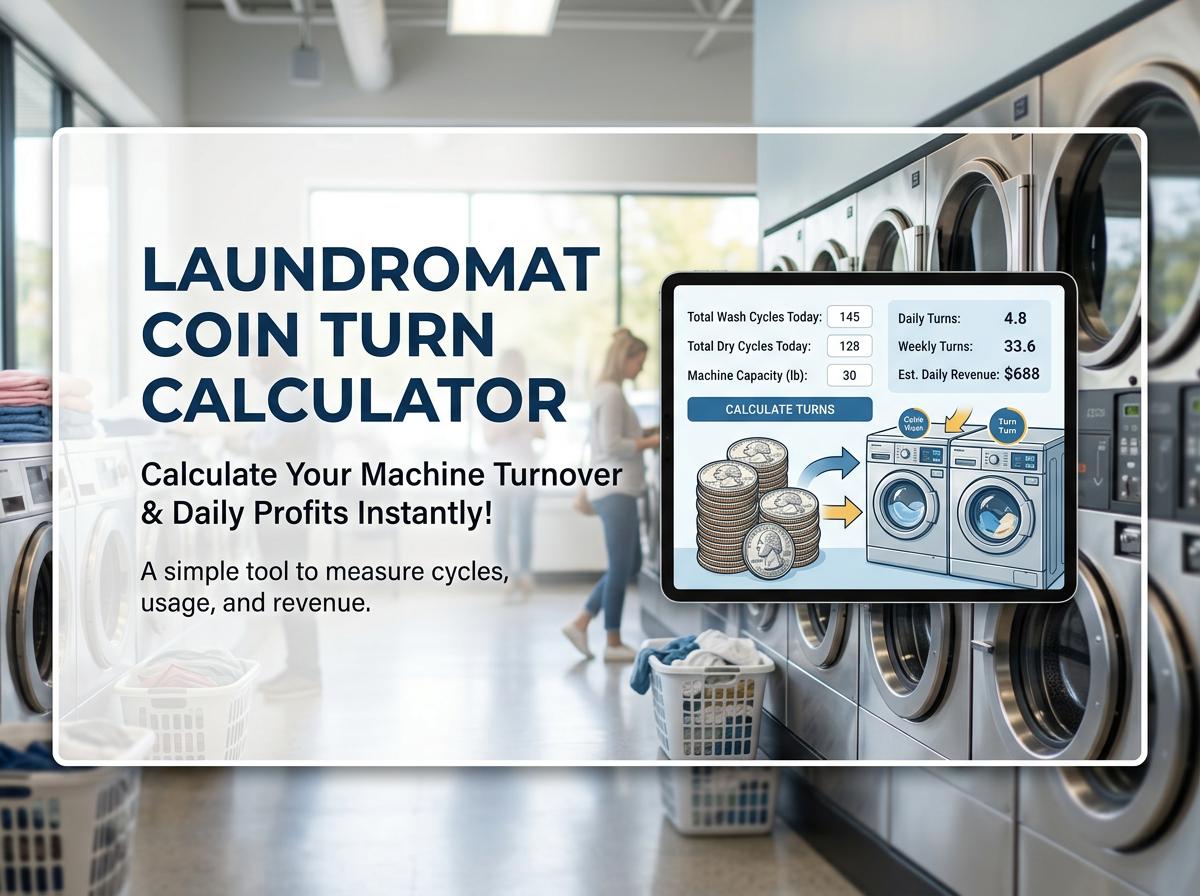 Laundromat Coin Turn Calculator