
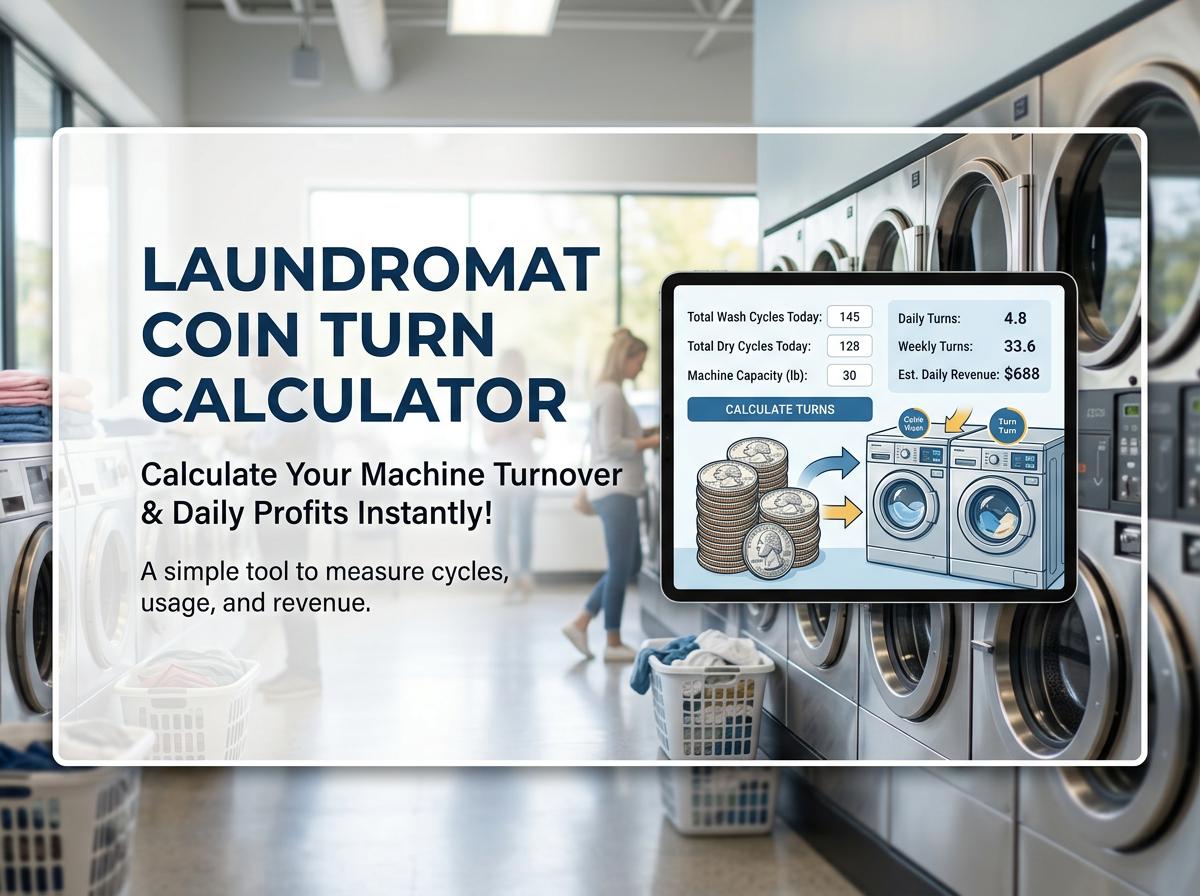

Maximize your laundromat's profits with our free Coin Turn Calculator. Easily calculate daily machine turns (TPD) to estimate daily revenue, track washer and dryer performance, and optimize your business operations. Perfect for laundromat owners and investors looking to project earnings accurately.
Laundromat Coin Turn Calculator
How does a laundromat coin turn mechanism actually work?
A coin slide (or coin turn) mechanism uses a series of mechanical physical checks to validate currency. When coins are inserted into the slots, the mechanism measures three main factors: diameter, thickness, and sometimes weight. As the user pushes the slide forward, spring-loaded sizing dogs or pins drop down.
If the correct coins are present, they physically lift these locking pins, allowing the slide to push all the way in. If a slot is empty or contains an incorrect coin (like a slug or a penny), the pin drops into a notch, physically jamming the slide to prevent operation. Once fully pushed, the back of the mechanism triggers a microswitch or mechanical linkage to start the washing machine, and the coins drop into the secure vault.
What is the best way to safely fix a jammed coin slide?
Safely fixing a jammed coin slide requires patience to avoid damaging the internal sizing pins. Follow these steps:
- Do not force it: Never use a hammer, kicking, or extreme force, which will permanently bend the sizing dogs.
- Remove the mechanism: Use your service key to open the access door and unbolt the coin slide assembly from the machine.
- Inspect the slots: Look for bent coins, foreign objects, or sticky residue (like candy or gum) blocking the path.
- Use a pick tool: Gently dislodge the jammed item using a thin metal pick or tweezers.
- Test smoothly: Insert the correct coins and manually test the slide mechanism several times before reinstalling it into the machine.
How do you change the price setting on a mechanical coin turn?
Changing the price on a mechanical coin slide involves modifying how many slots require a coin versus how many are blocked off or bypassed.
- Remove the slide: Take the coin mechanism out of the washing machine or dryer.
- Locate the sizing dogs: Flip the mechanism over to access the bottom plate and the sizing pins.
- Adjust block-out blanks: To increase the price, remove a plastic or metal "blank" (block-out insert) from a coin slot and activate its corresponding sizing pin so a coin is now required. To decrease the price, insert a blank into a slot and disable/remove its sizing pin so the slot no longer requires a coin to pass.
- Reassemble and test: Secure the bottom plate and test with the new exact change amount.
Why do coin turns suddenly get stuck or refuse to push in?
Coin turns typically get stuck due to user error, vandalism, or lack of routine maintenance. Common culprits include:
- Incorrect Currency: Slugs, foreign coins, or play money fail the thickness/diameter test, triggering the locking pins.
- Damaged Coins: Bent, sticky, or heavily corroded coins will catch on the internal metal tracks.
- Debris and Lint: Laundromats are highly dusty environments. Lint mixed with detergent residue can turn into a thick paste that seizes the moving parts.
- Broken Springs: The tiny tension springs that control the sizing dogs can snap over time, leaving a pin permanently engaged in the locked position.
- Wear and Tear: The brass or metal slide track simply wears down from thousands of uses, creating friction and misalignment.
How often should you clean and lubricate the coin slides?
You should implement a routine maintenance schedule for your coin slides depending on the traffic volume of your laundromat:
- High-volume stores: Clean every 3 to 6 months.
- Low-volume stores: Clean annually.
Important Cleaning Rules: Never use wet lubricants like WD-40, grease, or oil! Wet lubricants attract lint, dust, and detergent powder, quickly forming a sticky sludge that will jam the mechanism. Instead, wash the disassembled slide in warm soapy water, dry it completely, and apply a dry lubricant. Powdered graphite or Teflon powder are the industry standards for keeping slides moving freely without attracting debris.
Can you configure a standard coin turn to accept custom tokens?
Yes, standard coin turns can be configured to accept custom tokens, which is a popular strategy to prevent theft and encourage customer loyalty. However, it usually requires modifying or swapping out the internal sizing dogs (the pins that measure the coin).
Because tokens typically have different diameters and thicknesses than standard quarters, you must purchase a coin slide specifically calibrated for your token's exact dimensions, or buy a conversion kit for your existing slides. Once the slides are converted to accept your specific token, they will physically reject regular quarters. It is crucial to use high-quality, consistently minted tokens, as cheap tokens with irregular thicknesses will cause frequent jams.
What are the signs that a coin mechanism needs to be entirely replaced?
While most coin mechanisms can be rebuilt with replacement springs and pins, eventually, total replacement is the most cost-effective option. Signs you need a completely new unit include:
- Severe Track Wear: If the metal channels where the slide glides are heavily grooved or worn down, the slide will wiggle and jam constantly.
- Cracked Housings: Any physical cracks in the main casting (often from attempted theft or vandalism) compromise the mechanism's security.
- Chronic Jamming: If a slide continues to jam or reject correct coins immediately after a thorough cleaning and rebuild.
- Parts Unavailability: When dealing with very old models where replacement sizing dogs and springs are no longer manufactured.
- Rust and Corrosion: Deep pitting rust that cannot be buffed out and creates permanent friction.
Are vertical coin drop systems more reliable than traditional horizontal coin pushes?
Yes, vertical coin drops are generally considered more reliable than traditional horizontal coin push slides. Here is a quick comparison:
| Feature | Vertical Coin Drop | Horizontal Coin Slide |
|---|---|---|
| Gravity Assistance | Debris falls right through, reducing jams. | Debris sits in the track, causing build-up. |
| Moving Parts | Fewer mechanical parts; uses optical/electronic sensors. | Many springs, pins, and metal slides. |
| User Effort | Simply drop the coin in. | Requires physical pushing force. |
| Pricing Changes | Often changed electronically in seconds. | Requires manual disassembly and blanking. |
Because vertical drops rely on gravity and electronic validation rather than brute mechanical force, they experience significantly less physical wear and tear.
How easy is it to upgrade a coin turn machine to a digital card reader?
Upgrading a commercial washer or dryer to a digital card reader (or app-based payment system) is surprisingly straightforward, especially for modern electronic machines. Many payment system companies provide plug-and-play retrofit kits.
- Remove the Coin Mech: Take out the existing mechanical coin slide and vault.
- Install the Bezel: Place the new card reader or Bluetooth module into the empty coin slot space. Custom faceplates are usually provided to cover the gap.
- Connect Harness: Plug the reader into the machine's control board. Most kits come with specific wiring harnesses that match major laundry brands.
- Configure: Connect the device to your store's WiFi or cellular network and set up the pricing via an online dashboard.
For older mechanical-timer machines, installation requires a pulse-kit relay to simulate a physical coin drop.
What is the most secure procedure for collecting coins from the drop boxes?
Establishing a strict, secure coin collection protocol protects your profits from both external theft and internal skimming. Best practices include:
- Vary Your Schedule: Never collect coins on the exact same day and time. Unpredictability deters targeted robberies.
- Dual Key Systems: The key to open the machine's service panel should be different from the key to the coin vault.
- Use Lockable Coin Boxes: Invest in self-locking coin boxes that automatically snap shut when pulled from the machine, preventing the collector from touching the actual coins.
- Conduct Audits: Cross-reference the weight/amount of the coins collected against the cycle counters on the machines' electronic control boards.
- Secure Transport: Empty coins directly into a heavy-duty, locked transport cart rather than carrying open buckets around the store.
Source Data: