
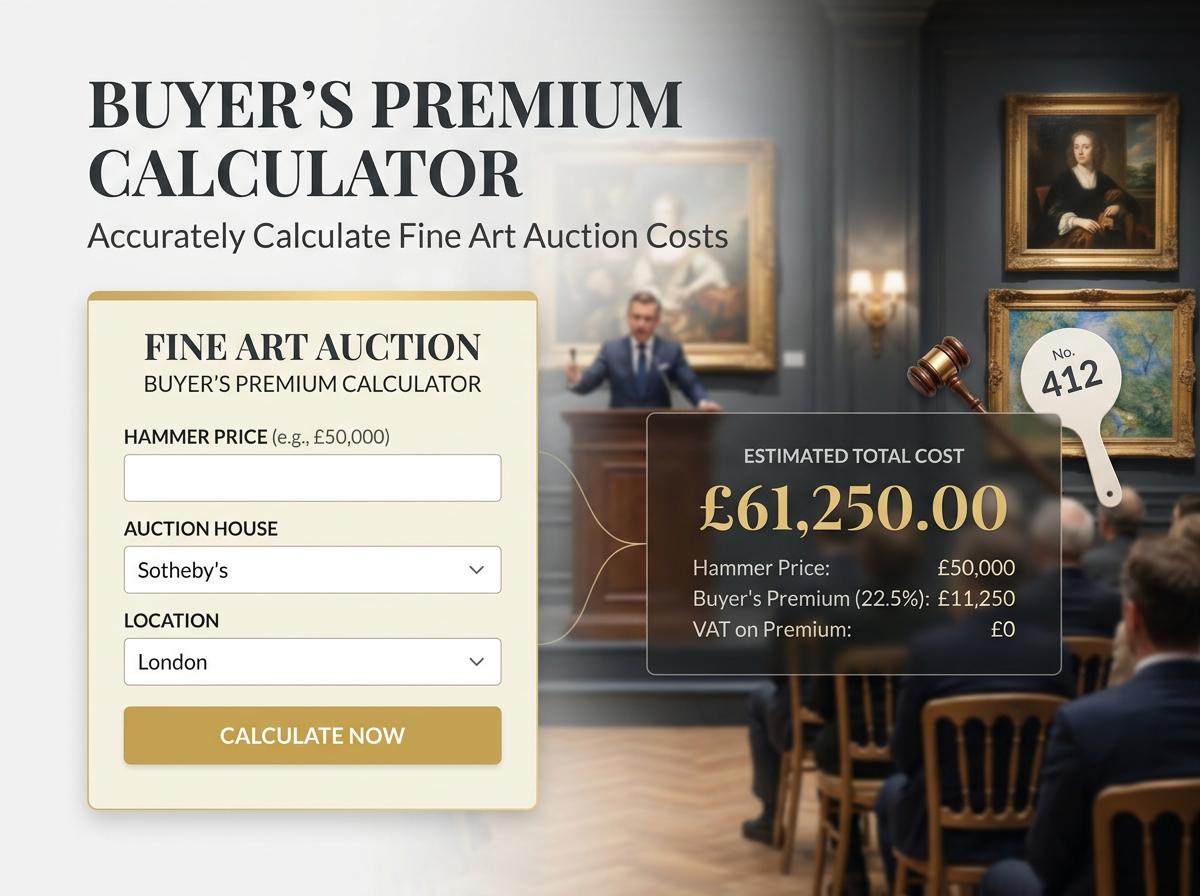

Easily calculate your total auction costs with our Fine Art Auction Buyer's Premium Calculator. Instantly factor in auction house fees, premiums, and taxes before you bid to know your exact final price. Perfect for art collectors and investors making informed bidding decisions.
Buyer's Premium Calculator
What exactly is a buyer's premium in an art auction?
A buyer's premium is an additional, non-negotiable charge that the winning bidder must pay on top of the hammer price (the winning bid) at an auction. It acts as an administrative fee that goes directly to the auction house to cover their operational costs. These costs include cataloging, marketing, insurance, facility maintenance, and expert appraisals. The implementation of the buyer's premium ensures that the auction house remains profitable and covers its overhead regardless of the final sale prices achieved by the sellers.
Is the buyer's premium included in the final hammer price?
No, the buyer's premium is not included in the final hammer price. The hammer price refers exclusively to the winning bid amount at which the auctioneer drops the gavel. The buyer's premium is an additional percentage calculated strictly on top of this hammer price. When you receive your final invoice, the auction house will list the hammer price, the buyer's premium, and any applicable taxes as completely separate line items. The sum of all these components makes up the total final purchase price.
How is the buyer's premium calculated on the winning bid?
The buyer's premium is calculated as a specific percentage of the winning bid. For lower-priced items, it is often a flat percentage. Here is a basic example calculation for a 25% premium:
| Component | Amount |
|---|---|
| Hammer Price (Winning Bid) | $10,000 |
| Buyer's Premium (25%) | $2,500 |
| Total Price (Before Tax) | $12,500 |
For more expensive items, major auction houses use a tiered calculation. The percentage decreases as portions of the hammer price cross specific financial thresholds.
Do buyer's premium percentages vary between different auction houses?
Yes, buyer's premium percentages vary significantly across the industry depending on the size and prestige of the auction house:
- Major International Houses (e.g., Christie's, Sotheby's): Usually charge around 25% to 26% for lower tiers, scaling down to about 13.9% to 15% for multi-million-dollar bids.
- Mid-Size and Regional Houses: Typically charge a flat rate between 20% and 25%.
- Small or Local Auctions: May charge lower flat rates, generally ranging from 10% to 18%.
Because there is no standard industry rate, bidders must always review a specific auction house's Terms and Conditions before participating.
Are local sales taxes applied to the buyer's premium fee?
Yes, local sales taxes are almost always applied to both the hammer price and the buyer's premium. Tax authorities generally view the buyer's premium as an integral part of the total taxable purchase price of the item. Depending on the jurisdiction of the auction house or the final shipping destination, buyers may be liable for:
- State and local sales tax (in the United States).
- Value Added Tax (VAT) (in the UK and Europe).
Tax exemptions usually only apply if the buyer presents a valid resale certificate or if the artwork is being shipped directly to a tax-exempt state or country.
Does the auction house or the seller keep the buyer's premium?
The auction house retains the entirety of the buyer's premium. It serves as the primary source of revenue for the auctioneer, compensating them for the extensive costs of researching, cataloging, marketing, and hosting the sale. The seller does not receive any portion of the buyer's premium. Instead, the seller receives the hammer price minus a separate fee known as the "seller's commission." By charging both parties, the auction house profits from both the buyer and the seller in a single transaction.
Is it ever possible to negotiate the buyer's premium?
Generally, the buyer's premium is strictly non-negotiable for the vast majority of bidders. Auction houses rely on these standardized fees to maintain their profit margins, and the rates are legally bound by the auction's published conditions of sale. However, exceptions do occasionally occur for highly sought-after buyers or massive institutional clients (like major museums) who guarantee a high volume of spending. In these rare, high-leverage situations, special terms might be quietly arranged, but for the average collector, the published premium is final.
Do online bidding platforms charge extra fees on top of the premium?
Yes, bidding through third-party online aggregator platforms (such as LiveAuctioneers, Invaluable, or Artsy) often incurs an additional "online bidding fee." This surcharge is typically an extra 1% to 5% added directly to the standard buyer's premium. For example, if an auction house charges a 20% premium and the platform charges a 5% fee, your total premium jumps to 25%. You can usually avoid this extra third-party surcharge by registering and bidding directly through an auction house's proprietary online bidding system or via telephone.
Does the premium percentage change based on hammer price tiers?
Yes, major auction houses utilize a sliding scale or tiered structure for buyer's premiums, where the percentage drops as the hammer price reaches higher thresholds. A common structure operates like tax brackets:
- Up to $500,000: 25% premium
- $500,001 to $4,000,000: 20% premium
- Above $4,000,000: 13.9% premium
If a bid crosses into a higher tier, the premium is calculated cumulatively. For instance, on a $1,000,000 bid, the buyer pays 25% on the first $500,000, and 20% on the remaining $500,000.
Is the buyer's premium refundable if the artwork is returned?
The buyer's premium is generally only refundable under very strict, specific circumstances—most notably if the artwork is proven to be a forgery. Major auction houses offer an "authenticity guarantee." If a buyer successfully invokes this guarantee by proving the work is not authentic within a specified timeframe (usually 3 to 5 years), the auction house will cancel the sale and refund the full purchase price, including the buyer's premium. For ordinary returns, such as buyer's remorse, sales are considered final and no refunds are issued.
Sources:
 Collectibles Grading ROI Calculator