
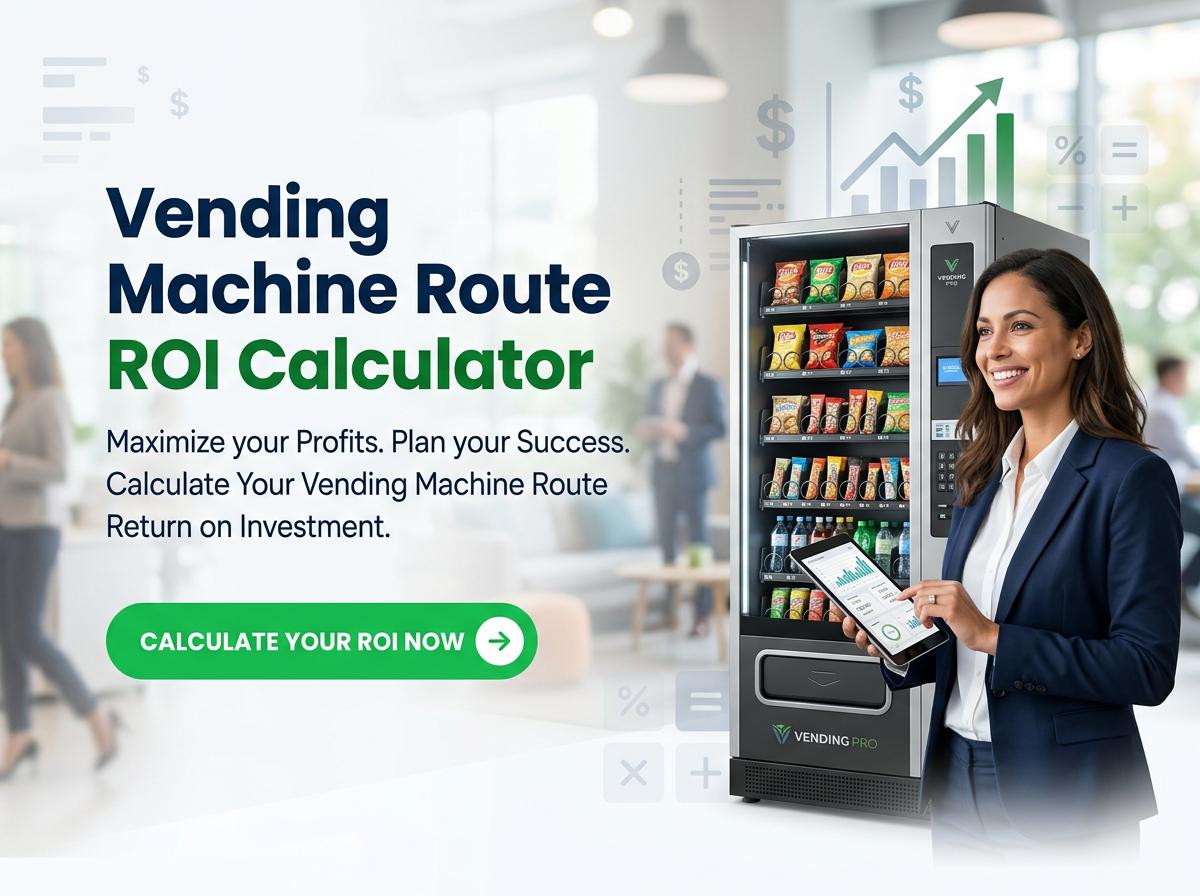

Calculate the profitability of your vending business with our free Vending Machine Route ROI Calculator. Input your costs and estimated sales to instantly project your revenue, margins, and return on investment. Make smarter business decisions and maximize your profits today!
Vending Route ROI Calculator
What is the average initial cost to start or buy a vending route?
The initial cost heavily depends on whether you are building a route from scratch with new/used machines or purchasing an established, cash-flowing business. Buying an existing route generally costs between 70% and 120% of its gross annual sales.
| Business Strategy | Estimated Cost Range |
|---|---|
| Starting New (1-3 Used Machines) | $1,500 - $5,000 |
| Starting New (1-3 New Machines) | $5,000 - $15,000 |
| Buying Small Established Route | $20,000 - $60,000 |
| Buying Large Full-Time Route | $100,000 - $300,000+ |
How long does it typically take to break even on the investment?
The break-even point for a vending route typically ranges from 12 to 24 months, though this can vary based on your initial capital outlay and location performance.
- New Routes: If you buy inexpensive, refurbished machines and place them in high-traffic locations, you can break even in under a year.
- Purchased Routes: Buying an established route requires a higher upfront cost, meaning it generally takes 1.5 to 2 years to recoup the initial investment, despite having immediate cash flow.
What is the average profit margin on typical vending machine products?
Gross profit margins in the vending industry are remarkably high, usually ranging from 50% to 80%. However, after factoring in fuel, maintenance, taxes, and commissions, the net profit margin generally settles between 10% and 20%.
| Product Category | Average Wholesale Cost | Average Vend Price | Gross Margin |
|---|---|---|---|
| Canned Soda | $0.30 - $0.40 | $1.00 - $1.50 | 60% - 75% |
| Chips & Snacks | $0.25 - $0.50 | $1.25 - $2.00 | 65% - 80% |
| Bottled Beverages | $0.50 - $0.80 | $2.00 - $3.00 | 65% - 75% |
How much of the gross revenue usually goes to location commissions?
Location commissions typically consume 5% to 20% of a machine's gross revenue. The exact percentage depends on the location's foot traffic, exclusivity, and negotiating leverage.
- 0% Commission: Common for small offices or breakrooms where the machine is placed purely as an employee amenity.
- 5% - 10% Commission: Standard for medium-sized businesses, warehouses, and apartment complexes.
- 15% - 20%+ Commission: Reserved for premium, high-volume locations like large hotels, hospitals, and busy schools.
What are the hidden maintenance and repair costs for the machines?
Beyond the cost of inventory, vending operators must budget for several hidden maintenance and operational expenses that can quietly eat into profits:
- Payment Readers: Monthly telemetry fees ($8-$15/machine) plus transaction fees (approx. 5-6% per swipe).
- Cooling Systems: Compressor repairs or replacements for refrigerated machines ($200 to $500+).
- Cash Mechanisms: Fixing or replacing jammed coin mechanisms and bill validators ($100 to $300).
- Cosmetic Repairs: Replacing broken buttons, burnt-out LED lights, or vandalized plexiglass.
On average, budget $50 to $100 per machine annually for routine maintenance.
How does route density affect your daily fuel and labor expenses?
Route density—the geographic closeness of your machines—is the most critical factor in controlling operational costs. A highly dense route maximizes profitability through:
- Reduced Fuel Consumption: Driving fewer miles directly lowers daily gas expenses, protecting your bottom line from fuel price spikes.
- Labor Optimization: Less "windshield time" means you or your employees can service more machines per hour, lowering the labor cost per vend.
- Vehicle Longevity: Fewer miles driven reduces wear and tear, delaying costly vehicle maintenance and depreciation.
Conversely, a spread-out route can render otherwise profitable machines completely unprofitable due to the travel costs required to service them.
How much do product spoilage and vandalism impact overall profitability?
Spoilage and vandalism are two distinct threats that, combined, can reduce a route's net profits by 5% to 10% if not strictly managed.
Spoilage: Typically accounts for 2% to 5% of gross revenue. It is heavily influenced by poor inventory rotation and overstocking perishable items (like pastries or dairy) in low-traffic machines.
Vandalism: Impact varies by location. While generally rare in secure corporate environments, machines in public or outdoor spaces may suffer frequent break-ins. Replacing broken glass ($100+), stolen cash, and destroyed bill validators ($300+) can wipe out months of a single machine's profit.
Do cashless payment readers significantly increase sales and ROI?
Yes, installing cashless card and mobile payment readers drastically improves both sales and overall Return on Investment (ROI). Consumers carry less cash today, making card readers essential.
- Increased Revenue: Operators typically see a 20% to 30% increase in overall sales after installing a reader.
- Higher Ticket Averages: Customers are less constrained by pocket change, leading to multiple item purchases in a single transaction.
- Remote Monitoring: Card readers provide telemetry data, allowing operators to track inventory remotely. This eliminates unnecessary trips to half-full machines, saving fuel and labor.
How do you accurately calculate the valuation of an existing route for sale?
Valuing a vending route requires analyzing both the physical assets and the historical cash flow. Most buyers and sellers use a combination of these three methods:
- Percentage of Gross Sales: The most common rule of thumb. A healthy route typically sells for 70% to 100% of its gross annual revenue.
- Multiple of Net Income (SDE): Calculated by taking the Seller’s Discretionary Earnings (net profit plus owner benefits) and applying a multiple, usually between 1.5x and 2.5x.
- Asset Valuation: Calculating the fair market value of the machines, vehicles, and current inventory, plus a premium for the secured location contracts.
What is the expected average monthly net profit per machine?
The average monthly net profit per vending machine varies wildly based on foot traffic, pricing strategy, and the type of products sold. Across the industry, the average machine generates roughly $50 to $100 per month in net profit.
| Location Performance | Expected Monthly Net Profit |
|---|---|
| Low-Traffic / Poor Location | $10 - $30 |
| Average Location | $50 - $100 |
| High-Traffic / Premium Location | $200 - $500+ |
 ATM Placement Surcharge Profit Calculator