
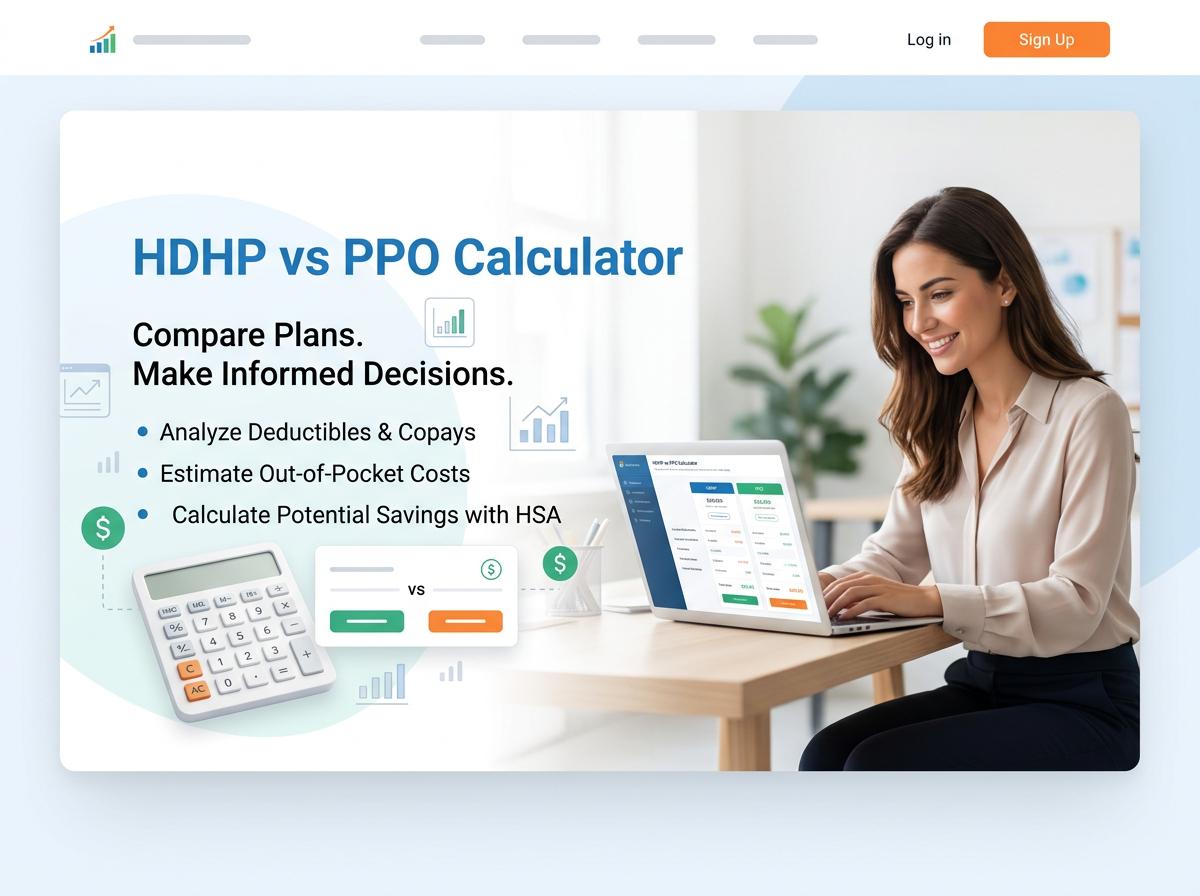

Use our HDHP vs. PPO Calculator to easily compare health insurance plans. Estimate monthly premiums, out-of-pocket costs, deductibles, and HSA tax savings to find the most cost-effective coverage for your healthcare needs and budget.
HDHP vs. PPO Calculator
HDHP
PPO
What are the monthly premium differences between an HDHP and a PPO
The primary difference in monthly premiums comes down to upfront costs versus coverage guarantees:
- HDHP (High Deductible Health Plan): Features significantly lower monthly premiums. This makes it an attractive option for healthy individuals looking to save on fixed monthly expenses.
- PPO (Preferred Provider Organization): Features higher monthly premiums. In exchange for paying more each month, you receive more immediate cost-sharing benefits and predictable copayments.
How do the annual deductibles compare before insurance starts paying
Annual deductibles represent the amount you must pay out-of-pocket before standard insurance coverage begins.
| Feature | HDHP | PPO |
|---|---|---|
| Deductible Amount | High (The IRS mandates minimums, often $1,600+ for individuals). | Typically lower (often ranging between $500 and $1,500). |
| Pre-Deductible Coverage | You pay 100% of medical costs until the deductible is met (except preventative care). | Insurance often subsidizes costs via copays before the deductible is fully met. |
Which plan makes me eligible to open a Health Savings Account
Only a qualifying High Deductible Health Plan (HDHP) makes you eligible to open and contribute to a Health Savings Account (HSA). An HSA is a powerful tax-advantaged savings account that allows you to set aside pre-tax money to pay for qualified medical expenses, and the funds roll over year after year.
Traditional PPOs do not qualify for an HSA. However, if you have a traditional PPO, you may be eligible for a Flexible Spending Account (FSA), which also uses pre-tax dollars but typically requires you to spend the funds by the end of the plan year.
Are there differences in the size and flexibility of the provider networks
Generally, network size and flexibility depend on the network type rather than the deductible size. An HDHP is a financial structure, not a network type; it can be structured as a PPO, EPO, or HMO.
- If the HDHP is also a PPO: Both plans will have similar flexibility, allowing you to see in-network and out-of-network providers.
- If the HDHP is an HMO: The traditional PPO will offer a larger, more flexible network with out-of-network coverage, while the HMO-based HDHP will restrict you to in-network providers only.
How do out-of-pocket maximums differ between the two plans
The out-of-pocket maximum is the absolute most you will pay in a single year for covered healthcare services.
- HDHP: The IRS strictly limits the maximum out-of-pocket costs for HSA-eligible HDHPs. Because of these federal limits, the absolute cap can sometimes be lower than a traditional plan, strongly protecting you from catastrophic expenses.
- PPO: Out-of-pocket maximums can vary widely and are often quite high. Because you pay lower deductibles and rely on copays throughout the year, it typically takes much longer to reach this maximum ceiling.
Do I need a referral from a primary care doctor to see a specialist
Whether you need a referral depends entirely on the plan's network structure, not its deductible:
- Traditional PPO: You do not need a referral to see a specialist. You have the flexibility to book appointments directly with specialized doctors.
- HDHP: If your HDHP utilizes a PPO network, you will not need a referral. However, if your employer's HDHP operates on an HMO or POS network, you will be required to choose a primary care physician (PCP) and obtain referrals before seeing any specialists.
How does the payment structure for copayments and coinsurance vary
Payment structures differ significantly in how costs are shared before the deductible is met.
| Plan | Copayments (Flat Fee) | Coinsurance (Percentage) |
|---|---|---|
| PPO | Common for routine doctor visits and drugs, applicable immediately. | Kicks in for major procedures or hospitalizations after the deductible is met. |
| HDHP | Rarely used before the deductible is met. | You pay 100% of the negotiated rate until the deductible is hit; then coinsurance kicks in. |
Which plan is more cost-effective for someone with chronic medical needs
For individuals with chronic medical needs, a traditional PPO is generally more cost-effective and easier to budget for.
Because chronic conditions require frequent doctor visits, ongoing therapies, and regular prescriptions, a PPO allows you to pay predictable, flat-rate copays immediately. Conversely, an HDHP requires you to pay the full out-of-pocket cost for these services until you reach your high deductible. While an HDHP's Health Savings Account (HSA) offers tax benefits, the severe upfront financial burden usually makes PPOs the safer, more manageable choice for heavy medical users.
How are prescription drug costs handled under an HDHP versus a PPO
Prescription drug coverage handles out-of-pocket costs very differently depending on the plan type:
- Traditional PPO:
- Utilizes a tiered copay system (e.g., $10 for generic, $40 for brand-name).
- These flat-fee copays apply immediately, even if the medical deductible isn't met yet.
- HDHP:
- You pay the full negotiated price of the medication until you reach your high annual deductible.
- After the deductible is met, coinsurance or copayments apply.
- Exception: Certain preventive medications mandated by law may be covered at 100% before the deductible is met.
Does my employer provide different financial contributions for either plan
Employer contributions vary by company, but they typically structure financial incentives differently based on the plan you choose:
- Premium Subsidies: Employers generally subsidize a significant portion of the monthly premiums for both plans. Because HDHPs are fundamentally cheaper, the total premium cost to the employer is lower.
- HSA Seed Money: To encourage employees to choose the cheaper HDHP, many employers deposit "seed money" (e.g., $500 to $1,000 annually) directly into the employee's Health Savings Account (HSA). Employees on traditional PPOs do not receive this cash contribution.
 Renter's Insurance Actual Cash Value vs. Replacement Cost Calculator