
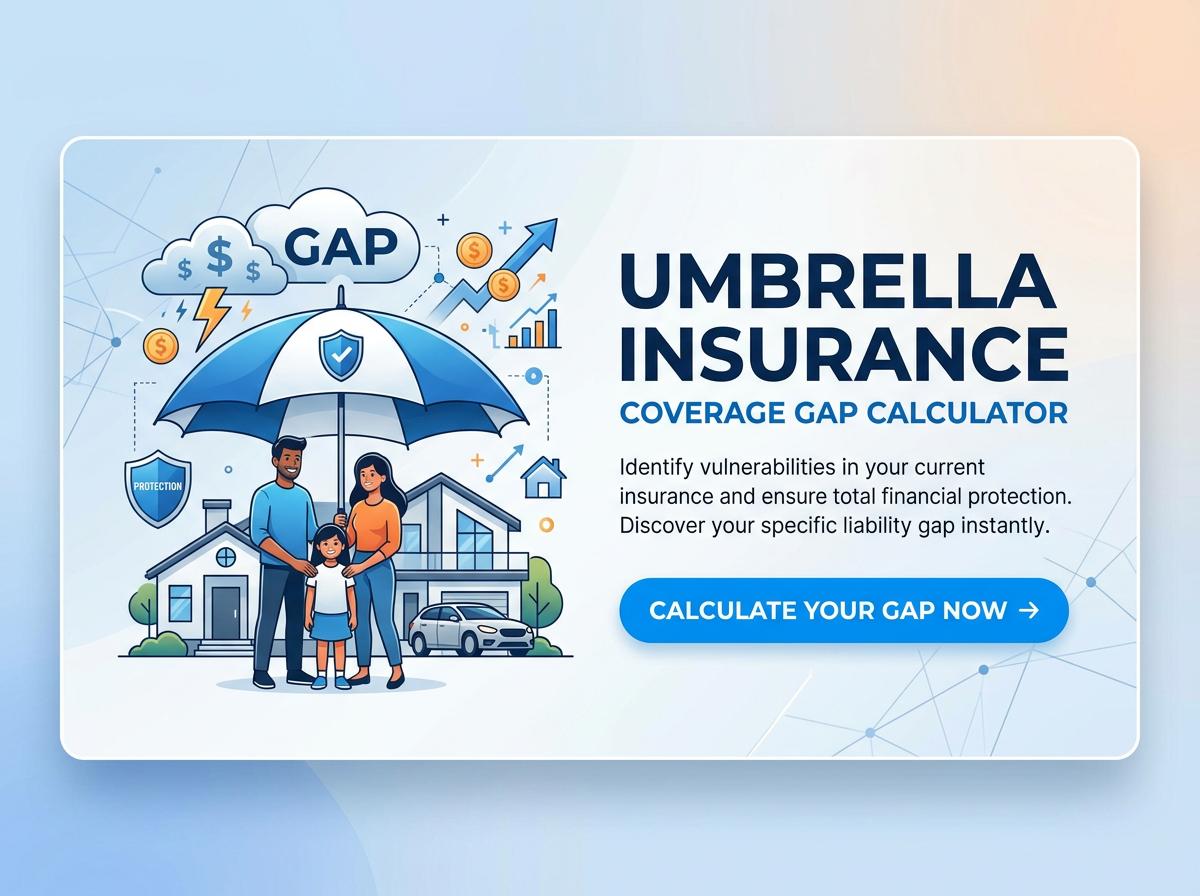

Protect your hard-earned assets with our free Umbrella Insurance Coverage Gap Calculator. Quickly identify vulnerabilities in your current liability policies, assess your financial risks, and determine exactly how much extra coverage you need for total peace of mind. Calculate your coverage gap today!
Umbrella Coverage Gap Calculator
What is an umbrella insurance coverage gap?
An umbrella insurance coverage gap occurs when there is a discrepancy between the maximum payout of your primary insurance policies (like auto or homeowners) and the point at which your umbrella insurance begins to pay.
Umbrella policies are designed to kick in only after the underlying policy limits are entirely exhausted. A gap typically arises due to:
- Lowering primary liability limits below the umbrella policy's strict requirements.
- A lapse or cancellation of the primary policy.
When this coverage gap exists, the policyholder becomes financially responsible for paying out-of-pocket until the umbrella coverage threshold is officially met.
How do underlying policy limits cause a coverage gap?
Underlying policy limits cause a coverage gap when they do not meet the minimum liability thresholds required by your umbrella insurance provider. Umbrella insurance functions strictly as secondary coverage, meaning it has a hard starting point (attachment point).
For example:
- Umbrella Requirement: $250,000 auto liability limit.
- Actual Auto Policy: $100,000 auto liability limit.
- The Gap: $150,000.
If you face a $500,000 lawsuit in this scenario, your auto insurance pays the first $100,000. Because the umbrella policy expects the primary insurance to cover up to $250,000, it will not cover the missing $150,000. You must pay this difference out-of-pocket before the umbrella policy covers the remaining $250,000.
What are the minimum required liability limits for primary policies?
Minimum required liability limits for primary policies vary by insurance company, but insurers typically require standard, higher-than-average thresholds before issuing an umbrella policy. Common minimum requirements include:
| Policy Type | Typical Minimum Required Limit |
|---|---|
| Auto Insurance | $250,000 per person / $500,000 per accident for bodily injury; $100,000 for property damage. |
| Homeowners Insurance | $300,000 for personal liability. |
| Watercraft Insurance | $300,000 to $500,000 for liability. |
Failing to maintain these exact minimums on your primary policies immediately creates a coverage gap.
Who pays the difference if a coverage gap occurs?
If a coverage gap occurs, the policyholder is legally and financially responsible for paying the difference. Neither the primary insurer nor the umbrella insurer will cover the shortfall.
Here is how the financial burden plays out in a gap scenario:
- The primary insurer pays up to the actual limit of your active primary policy.
- You must pay out-of-pocket for any remaining damages until the amount reaches the required starting threshold of your umbrella policy.
- The umbrella insurer pays the rest, up to its own policy limit.
Consequently, a coverage gap forces you to liquidate savings, sell assets, or face wage garnishment to satisfy a legal judgment.
How does a lapse in primary insurance affect your umbrella coverage?
A lapse in primary insurance has severe consequences for your umbrella coverage, effectively creating a massive coverage gap. Umbrella insurance strictly requires continuous, active underlying coverage to function properly.
If your primary auto or home insurance lapses due to missed payments or cancellation, and you face a liability claim:
- Your umbrella policy will not step in to act as primary insurance.
- You will be personally responsible for 100% of the costs up to the minimum limits the umbrella policy required you to have.
- The umbrella policy will only pay the amount that exceeds those required, but now non-existent, underlying limits.
Essentially, a lapse turns the required primary limit into a massive self-insured penalty.
Can changing home or auto insurers create an unexpected liability gap?
Yes, changing home or auto insurers is a common way unexpected liability gaps are created. This usually happens for two reasons:
- Mismatched Limits: When switching to a new, cheaper primary policy, the new liability limits might inadvertently be set lower than what your existing umbrella policy strictly requires.
- Timing Lapses: If the effective date of the new policy does not perfectly align with the cancellation date of the old policy, even a one-day lapse in primary coverage creates a total gap if an accident occurs on that day.
To avoid this, you must explicitly inform your insurance agent about your umbrella policy when switching primary insurers.
What is a self-insured retention and how does it act as a gap?
A Self-Insured Retention (SIR) functions similarly to a deductible for your umbrella insurance. It applies primarily in "drop-down" scenarios—when an umbrella policy covers a liability claim that is completely excluded by your primary underlying insurance (such as claims for libel, slander, or false arrest).
Because there is no primary insurance to pay first, the SIR acts as a small, planned coverage gap. Before the umbrella policy begins to pay for these specific claims, you must pay the SIR out-of-pocket.
Typical SIR amounts are relatively low, usually ranging from $250 to $1,000. It represents the amount of risk you "retain" yourself before broad coverage takes over.
Which specific liability scenarios are excluded entirely from umbrella policies?
While umbrella insurance offers broad protection, it does not cover everything. Certain liability scenarios are completely excluded, leaving a total coverage gap if you are sued. Common exclusions include:
- Intentional or malicious acts: Harm or damage you purposely cause to others.
- Business or professional liability: Liabilities arising from your business, profession, or a home-based business (these require commercial insurance).
- Breach of contract: Financial disputes arising from written or oral agreements.
- Damage to your own property: Umbrella is strictly for liability to others, not your own belongings.
- Unlisted recreational vehicles: Operating certain watercraft or off-road vehicles not explicitly acknowledged in the policy.
What happens if your underlying limits are lowered accidentally?
If your underlying limits are lowered accidentally—perhaps during an annual policy renewal or while trying to lower premium costs online—you instantly create a coverage gap. Your umbrella insurer expects the required minimum limits to be maintained at all times.
In the event of a severe claim, the umbrella insurance company will act as though the required limits are still in place. They will strictly calculate their payout starting only from their required threshold.
You will be held fully responsible for paying the financial difference between your accidentally lowered limit and the umbrella’s starting point. Insurance companies do not forgive these gaps, even for honest mistakes.
How often should policy limits be reviewed to prevent coverage gaps?
To prevent devastating coverage gaps, you should review your policy limits at least annually. The best time to do this is prior to the renewal dates of your home, auto, and umbrella policies.
Additionally, you must immediately review and coordinate your limits during the following trigger events:
- Switching primary insurance carriers to ensure new limits meet umbrella requirements.
- Purchasing a new asset, such as a boat, RV, or secondary home, which requires its own underlying liability minimums.
- Adding a new teenage driver to your auto policy.
Working with a single insurance agent or bundling your policies with one carrier ensures limits are automatically aligned.
Sources:
 Auto Insurance Deductible Breakeven Calculator