
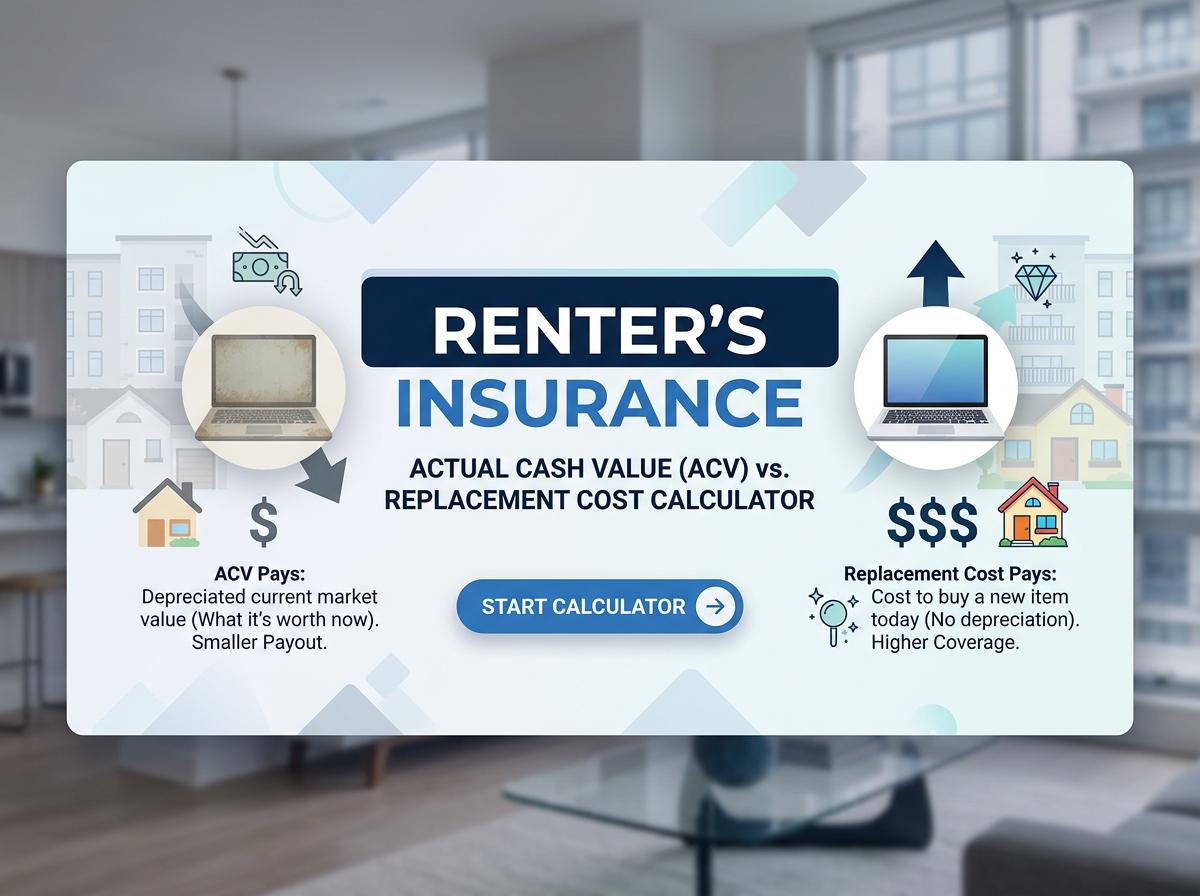

Compare renter's insurance payouts instantly with our Actual Cash Value vs. Replacement Cost Calculator. Discover the exact financial difference between ACV and replacement cost coverage so you can choose the right protection for your personal belongings. Calculate your potential claim today to ensure you are fully covered!
Renter's Insurance Calculator
RC is what your policy pays to buy a brand new item. ACV pays only what the used item was currently worth.
What is the main difference between Actual Cash Value and Replacement Cost?
The main difference lies in how a payout is calculated after an item is damaged or stolen:
- Actual Cash Value (ACV): Pays out the current market value of the item, which accounts for depreciation based on age and wear.
- Replacement Cost Value (RCV): Pays the amount needed to buy a brand new, equivalent item at today's retail prices, without any deductions for depreciation.
How does depreciation impact an Actual Cash Value claim?
Depreciation significantly reduces the final payout amount in an Actual Cash Value claim. As an item ages or experiences wear and tear, its value decreases. Insurance companies apply a depreciation rate based on the item's expected lifespan.
| Original Price (5-Year Lifespan) | Age at Loss | Depreciation Deducted | Final ACV Payout |
|---|---|---|---|
| $1,000 Laptop | 2 Years | $400 (40%) | $600 |
Therefore, depreciation guarantees you will receive less than what you originally paid or what it costs to buy a new replacement.
Will Replacement Cost pay for a brand new version of my damaged item?
Yes, Replacement Cost coverage will pay to replace your damaged item with a brand new version. However, the policy restricts this to an item of similar kind and quality.
- It covers the current retail price to replace the item today.
- It does not pay for a significant upgrade (e.g., replacing a basic television with a high-end home theater).
If your exact model is discontinued, the insurer will pay for the closest modern equivalent currently available on the market.
Which coverage type requires a higher monthly premium?
Replacement Cost requires a higher monthly premium. Because the insurance company takes on a significantly greater financial risk by paying for brand new items without deducting for depreciation, they charge more for this coverage.
On average, opting for Replacement Cost over Actual Cash Value can increase your premium by about 10% to 15%. However, many policyholders find the higher premium worthwhile because it prevents massive out-of-pocket expenses during a major loss.
How do insurance companies calculate the Actual Cash Value of an item?
Insurers typically calculate Actual Cash Value using a straightforward formula:
Actual Cash Value = Replacement Cost - Depreciation
To determine the depreciation amount, they consider three primary factors:
- Expected Lifespan: How long the item usually lasts (e.g., a refrigerator may have a 10-year lifespan).
- Current Age: How old the item was at the exact time of the loss.
- Condition: The physical state of the item before it was damaged.
Do I need to buy the replacement item first to get full Replacement Cost reimbursement?
Yes, in most cases, you must buy the replacement item first. The reimbursement process generally works in stages:
- The insurer issues an initial check for the Actual Cash Value (ACV) of the item.
- You purchase the replacement item out-of-pocket.
- You submit the new purchase receipt to your insurance adjuster.
- The insurer sends a second check for the remaining balance (known as Recoverable Depreciation) up to the replacement cost.
This ensures the funds are actually used to replace the lost items.
Why might a renter choose Actual Cash Value instead of Replacement Cost?
A renter might choose Actual Cash Value primarily to save money on their monthly premiums, as ACV policies are noticeably cheaper. This choice makes practical sense for a renter who:
- Is on a strict, limited monthly budget.
- Owns mostly older, second-hand, or inexpensive furniture and clothing.
- Does not plan on replacing damaged items immediately.
If their belongings have already heavily depreciated, the higher premium for Replacement Cost might not offer a worthwhile return on investment.
Are there specific category limits for high-value items under either coverage type?
Yes, both coverage types feature specific category limits (sub-limits) for high-value items. Standard policies cap payouts for categories prone to theft, regardless of your overarching coverage type.
| Item Category | Typical Policy Sub-Limit |
|---|---|
| Jewelry & Watches | $1,000 - $1,500 |
| Firearms | $2,000 - $2,500 |
| Cash & Coins | $200 - $500 |
To fully protect these items at their true Replacement Cost, you must purchase a scheduled personal property endorsement or a "rider."
How do original receipts factor into a Replacement Cost claim?
Original receipts are highly valuable in a Replacement Cost claim because they streamline the entire process. They provide three crucial pieces of information:
- Proof of Ownership: They definitively prove you owned the item.
- Date of Purchase: They establish the item's age, which is necessary for the initial Actual Cash Value calculation.
- Exact Specifications: They show the exact make, model, and purchase price, ensuring the insurer accurately prices out a true "similar kind and quality" replacement.
Can I easily switch my existing policy from Actual Cash Value to Replacement Cost?
Yes, you can typically switch your personal property coverage from Actual Cash Value to Replacement Cost very easily.
You simply need to contact your insurance agent or log into your online portal to request a policy update. Because Replacement Cost offers broader coverage, the insurer will recalculate your premium, resulting in a slightly higher bill.
Remember, you must make this change before a loss occurs; you cannot upgrade your coverage retroactively for an already damaged item.