
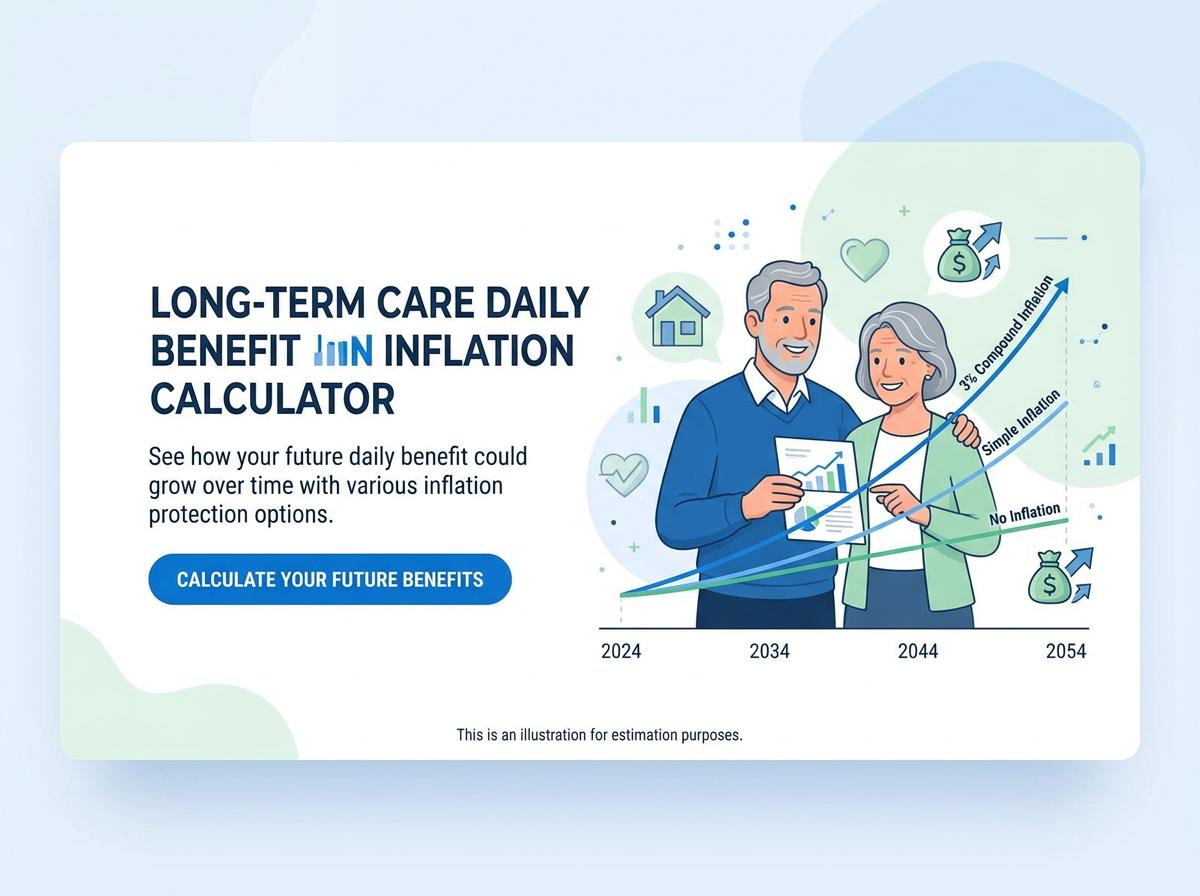

Plan for the future with our Long-Term Care Daily Benefit Inflation Calculator. Easily estimate how rising costs will impact your coverage over time, calculate the exact daily benefit you need, and ensure your assets remain protected. Try it today to secure your financial future!
LTC Daily Benefit Calculator
What is a long-term care daily benefit inflation rider?
A long-term care (LTC) daily benefit inflation rider is an optional policy add-on designed to periodically increase your coverage amount over time. When you purchase an LTC policy, you select a specific daily benefit (e.g., $150 per day). However, because you likely won't need care for decades, the cost of that care will increase.
This rider ensures your daily benefit automatically grows annually, helping to bridge the gap between your original benefit amount and the actual future cost of long-term care facilities or home health aides.
Why is inflation protection necessary for long-term care insurance?
Inflation protection is critical because the cost of healthcare usually outpaces general economic inflation. If you buy a policy at age 50, you may not file a claim until age 80. Without inflation protection, your benefits will severely lose their purchasing power.
- Rising Costs: Nursing home and assisted living costs historically increase by 3% to 5% annually.
- Wealth Protection: A stagnant benefit forces you to cover the pricing shortfall out-of-pocket, draining the retirement savings the policy was meant to protect.
What is the difference between simple and compound inflation growth?
The core difference lies in the mathematical formula used for the annual increase:
| Feature | Simple Inflation | Compound Inflation |
|---|---|---|
| Calculation | Based solely on the original daily benefit amount. | Based on the previous year's inflated benefit amount. |
| Growth Style | Grows by a fixed, flat dollar amount annually. | Grows exponentially, accelerating over time. |
| Best For | Older buyers (65+) who may need care sooner. | Younger buyers (under 60) who won't need care for decades. |
How does adding an inflation rider impact my overall premium cost?
Adding an inflation rider significantly increases your initial premium cost. Depending on your age and the specific rate of inflation chosen (e.g., 3% vs. 5%), an inflation rider can increase your base premium by 40% to over 100%.
While the initial cost is much higher than a policy without protection, automatic inflation riders are generally priced so that your premium remains level over time. The younger you are when purchasing the policy, the more expensive the rider will be relative to the base premium, because the insurer must fund decades of compounded growth.
What percentage rate of inflation protection is typically recommended?
Financial advisors generally recommend an inflation protection rate between 3% and 5% compound interest.
- 3% Compound: This is currently the industry standard. It balances a realistic projection of long-term care cost increases with a more affordable premium.
- 5% Compound: Historically the gold standard, offering the highest security. However, due to the current low-interest-rate environment for insurers, 5% compound riders have become prohibitively expensive for most consumers.
Your exact need depends on your current age, available retirement assets to co-fund care, and local healthcare costs.
How does a future purchase option differ from automatic inflation growth?
These are two entirely different mechanisms for increasing coverage over time:
- Automatic Inflation Growth: Your daily benefit increases automatically every year by a set percentage. Your premium is locked in based on your age at the original issue date, meaning it generally stays level over the life of the policy.
- Future Purchase Option (FPO): The insurer periodically offers you the right to buy additional coverage (e.g., every 2–3 years) without new medical underwriting. However, the premium for each new block of coverage is priced at your attained age, making these additions increasingly expensive as you get older.
Does the daily benefit inflation protection ever cap out or stop growing?
It depends entirely on the specific terms of the insurance policy. While some older policies offer uncapped lifetime inflation growth, many modern policies include a "cap" to help keep premiums affordable. Common limitations include:
- Maximum Benefit Multiplier: Growth stops once the daily benefit reaches exactly 2x or 3x the original amount.
- Duration Limits: Growth stops after a set number of years, such as 10 or 20 years from the policy issue date.
- Age Limits: Growth ceases when the policyholder reaches a specific age, such as age 75 or 85.
How does inflation protection affect state partnership program eligibility?
To qualify for a State Long-Term Care Partnership Program—which protects your personal assets from Medicaid spend-down rules—your policy must include specific inflation protection. Federal law mandates age-based inflation requirements for Partnership qualification:
| Age at Purchase | Inflation Requirement |
|---|---|
| Under Age 61 | Must include compound annual inflation protection. |
| Age 61 to 75 | Must include some level of inflation protection (simple or compound). |
| Age 76 and Older | Inflation protection is usually optional, but specific state rules apply. |
Can I reduce or drop the inflation coverage later if premiums become too expensive?
Yes, you can almost always reduce or drop your inflation rider later. In fact, doing so is a very common strategy to manage premium rate increases.
If your insurer raises rates and the policy becomes unaffordable, you can remove the inflation rider. If you do this, you will not lose the growth your policy has already accrued. Your daily benefit will simply be "frozen" at its newly inflated, current amount, and your premium will decrease significantly moving forward. You can also often step down the percentage, such as dropping from a 5% to a 3% rate.
Will the policy's inflation rate accurately keep pace with actual future healthcare costs?
Not necessarily. A fixed inflation rider is a predictive tool, but it is not directly pegged to the actual Consumer Price Index (CPI) or real-time regional healthcare costs.
If you purchase a 3% compound rider, but the actual cost of nursing home care inflates by 5% annually for the next 20 years, your daily benefit will fall short of the actual cost of care, creating an out-of-pocket gap. Conversely, if healthcare inflation slows down, your benefit might temporarily outpace costs. While it rarely perfectly matches reality, it provides a vital financial buffer.
 Life Insurance Human Life Value Calculator