

Planning a move? Use our free State Income Tax Relocation Savings Calculator to compare tax rates between states. Enter your income, current state, and destination to instantly see how moving will impact your take-home pay and discover your potential tax savings.
State Tax Relocation Calculator
Current State Tax (Est.):
New State Tax (Est.):
Net Annual Savings:
*Estimates are based on approximate top marginal/flat state income tax rates for simplicity. Excludes federal taxes, local city/county taxes, and detailed progressive tax brackets.
What is the difference between domicile and statutory residency?
Domicile refers to your true, fixed, and permanent home. You can legally have only one domicile at a time. It is based on your intent to return and remains your domicile until you actively establish a new one.
Statutory residency is based strictly on day-counting. Even if your domicile is in another state, you can be classified as a statutory resident if you spend a certain number of days (usually 183 days or more) physically present in a state.
- Domicile: Subjective; based on permanent ties, primary residence, and intent.
- Statutory Residency: Objective; triggered automatically by crossing a physical presence threshold.
How many days must I physically spend in the new state?
There is no universal federal rule, but the widely accepted threshold is the 183-day rule (more than half the year).
- Defensive strategy: You must spend less than 183 days in your former state to avoid triggering their statutory residency laws.
- Offensive strategy: You should spend more than 183 days in your new state to solidify your claim of domicile there.
If you split time among multiple states, ensure you spend the plurality of your days (more days than in any other single state) in your newly chosen domicile. Always keep a meticulous day-count log.
What steps legally sever tax ties with my former state?
Severing ties requires showing you have abandoned your old state and moved your "center of gravity" to the new one. Key steps include:
- Housing: Sell your old primary residence or reclassify it as a vacation/rental home.
- Legal: Obtain a new driver’s license, register vehicles, and update voter registration immediately.
- Financial: Move bank accounts, safe deposit boxes, and active financial management to local branches in the new state.
- Professional/Social: Establish care with local doctors, dentists, and CPAs. Move club, gym, and religious memberships.
Auditors look at the "teddy bear test"—where you keep your most prized personal possessions.
Will my old state audit my move to challenge my new residency?
Yes, if you are moving from a high-tax state (like California, New York, or Illinois) to a no-income-tax state (like Florida, Texas, or Nevada), a residency audit is highly likely—especially for high-income earners.
Tax agencies aggressively try to prove you never actually changed your domicile. During an audit, investigators will scrutinize:
- Cell phone records and tower pings.
- Credit card transaction locations.
- Flight logs and travel itineraries.
- Utility usage (e.g., water and electricity spikes at the old house).
The burden of proof lies entirely on you to prove you have left.
Do higher property and sales taxes offset the income tax savings?
They can, depending on your lifestyle, spending habits, and housing choices. States without a state income tax must generate revenue through other avenues.
| State | Income Tax | Offsetting Revenue Focus |
|---|---|---|
| Texas | 0% | Very high property taxes. |
| Florida | 0% | Average property taxes, high insurance. |
| Tennessee | 0% | High combined state/local sales taxes. |
For ultra-high-earners, the income tax savings almost always eclipse higher local taxes. However, retirees or middle-income earners buying large homes may find their total tax burden remains similar.
Will my former state still tax my deferred compensation or stock options?
Usually, yes. Your former state retains the right to tax income that was earned or sourced while you were a resident, even if it pays out after you leave.
- Stock Options: Typically taxed by the old state based on an allocation formula (days worked in the state between the grant date and vesting date).
- Deferred Compensation: Non-qualified deferred compensation is generally taxable by your old state.
Exception: Under federal law, if non-qualified deferred compensation pays out evenly over 10 or more years, the former state cannot tax it. Qualified retirement accounts (like 401ks) are also protected.
How is my business or rental income sourced and taxed after I move?
Income is generally taxed based on where it is physically sourced, regardless of your new state of residency.
- Rental Income: Income from real estate is taxed by the state where the physical property is located. You will need to file a non-resident return in the old state.
- Business Income: If your business has physical operations, property, or employees in the old state, that specific portion of income is apportioned to the old state.
- Pass-Through Entities: K-1 income is taxed based on where the underlying business activity takes place.
What documents prove my genuine intent to stay in the new state permanently?
To survive a residency audit, you need substantial documentary evidence proving your intent to make the new state your permanent home. Critical documents include:
- Real Estate Docs: Closing paperwork on a new primary residence, or a long-term lease agreement.
- Declaration of Domicile: A formal legal document filed with the county court (available in states like Florida).
- Logistics: Moving company invoices and transit insurance showing the relocation of furniture and valuables.
- Personal Records: Veterinary records for family pets relocated to the new state.
- Legal Docs: Updated estate plans (wills, trusts) governed by the laws of the new state.
How do I file part-year resident returns for the year I relocate?
In the year of your move, you will file part-year resident tax returns in both your old and new states (if both levy income taxes).
- Determine Move Date: Pinpoint the exact day you established your new domicile.
- Split the Income: Income earned before the move date is reported to the old state. Income earned after the move date is reported to the new state.
- Report Sourced Income: Any income generated physically in the old state after your move must still be reported on the old state's part-year return.
Maintain precise payroll records to justify this income split to auditors.
Does the new state tax retirement accounts and pensions differently?
Yes, taxation of retirement income depends entirely on your new state's laws. Thanks to a federal law (4 U.S.C. § 114), your former state cannot tax your qualified pension or retirement distributions once you move.
| Tax Treatment | State Examples |
|---|---|
| No Income Tax | Florida, Texas, Nevada, Washington |
| Exempts All Pensions | Pennsylvania, Illinois, Mississippi |
| Fully Taxes Retirement | California, Vermont |
Always review your destination state's specific rules, as some exempt Social Security but tax IRA distributions, or offer specific age-based deductions.
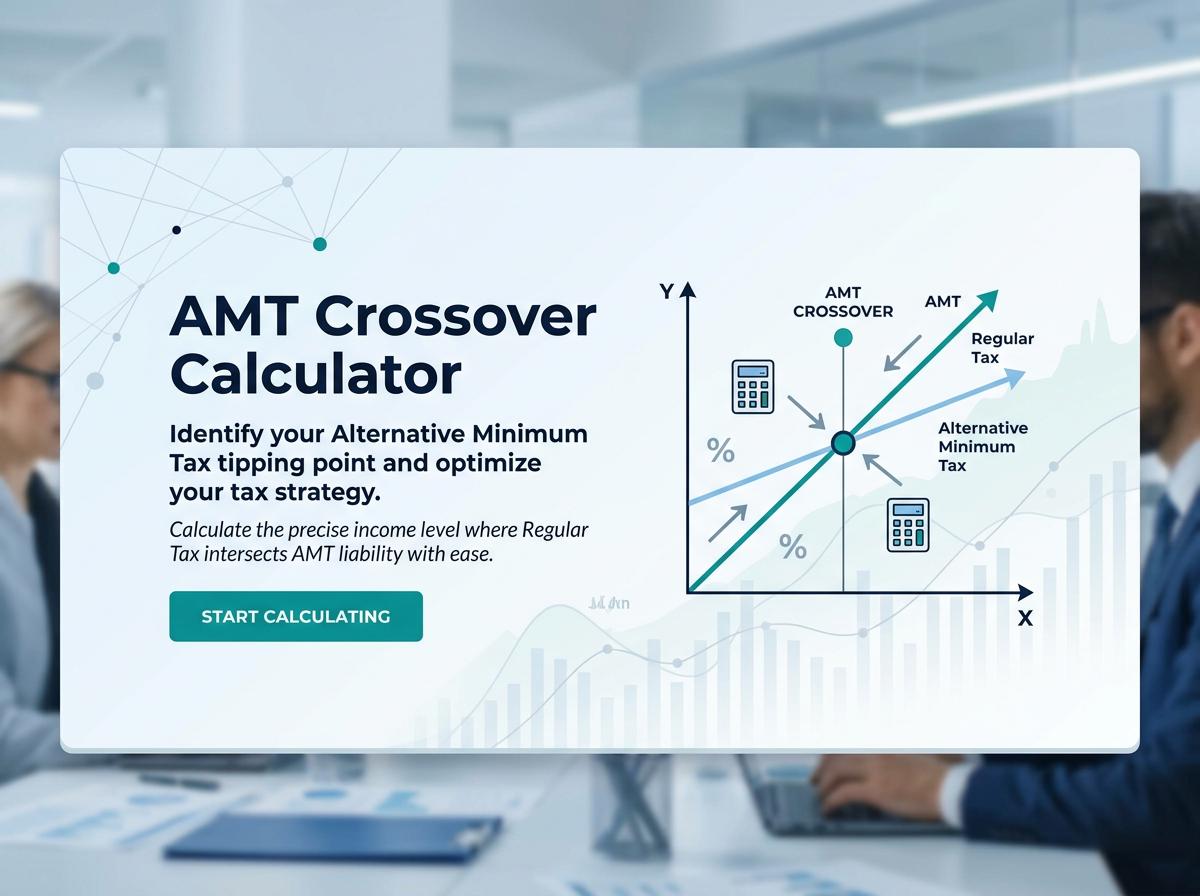 AMT (Alternative Minimum Tax) Crossover Calculator