
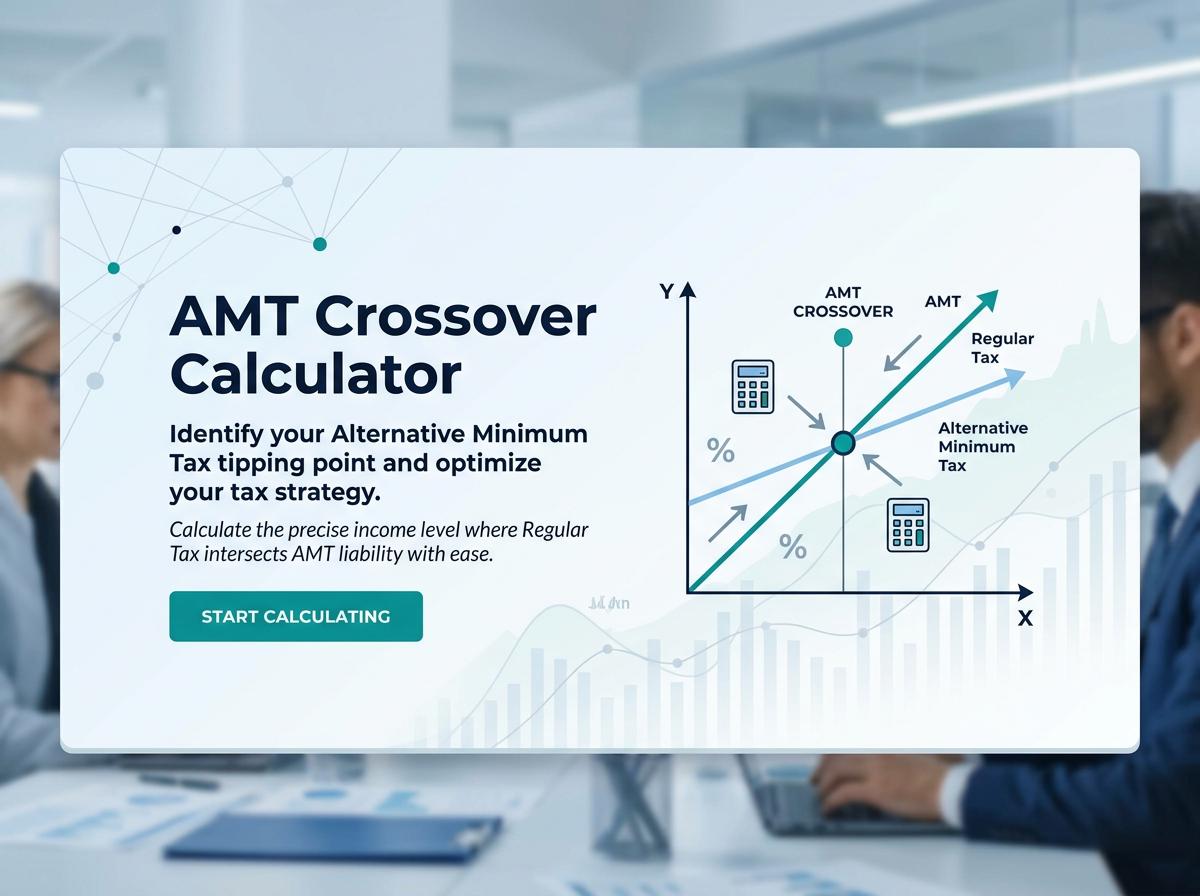

Calculate your exact Alternative Minimum Tax liability with our AMT Crossover Calculator. Determine the precise income threshold where AMT applies, optimize your Incentive Stock Option (ISO) exercises, minimize your tax burden, and make smarter financial planning decisions to avoid surprise IRS bills. Try it now!
AMT Crossover Calculator (2024)
What exactly is the AMT crossover point?
The Alternative Minimum Tax (AMT) crossover point is the specific financial threshold where a taxpayer's calculated tentative minimum tax exceeds their regular income tax liability.
Under US tax law, you are required to calculate your taxes twice: once under standard rules and once under AMT rules. The AMT ignores many common deductions and applies a flat, two-tiered rate (usually 26% and 28%). The crossover point occurs when your disallowed deductions or specific income types (like ISOs) push your AMT calculation higher than your regular tax. At this exact intersection, you transition from paying regular taxes to being subject to the AMT, meaning you are legally required to pay the higher amount.
How is the AMT crossover threshold calculated?
The AMT crossover threshold isn't a single, fixed number; it is calculated uniquely for each taxpayer by comparing two separate tax formulas:
- Calculate Regular Tax: Gross income minus standard or itemized deductions, applying the standard progressive tax brackets.
- Calculate Tentative Minimum Tax (TMT):
- Start with regular taxable income.
- Add back disallowed deductions (e.g., SALT) and preference items (e.g., ISO spread) to find your Alternative Minimum Taxable Income (AMTI).
- Subtract the AMT exemption amount based on your filing status.
- Apply the AMT rates of 26% and 28%.
The crossover threshold is reached exactly when your TMT calculation surpasses your regular tax calculation. Tax software automatically runs both calculations to identify if you have crossed this line.
What specific tax deductions push you toward the AMT crossover?
Certain standard tax deductions are entirely disallowed under AMT rules. Claiming high amounts of these deductions lowers your regular tax but increases your Alternative Minimum Taxable Income (AMTI), pushing you closer to the crossover point. Key deductions include:
- State and Local Taxes (SALT): Income, sales, and property taxes are entirely added back to your AMTI.
- Interest on Secondary Mortgages: Home equity loan interest that is not explicitly used to buy, build, or substantially improve your home.
- Private Activity Bond Interest: Tax-exempt interest from certain municipal bonds.
- Accelerated Depreciation: The difference between regular and straight-line depreciation on certain assets.
How do Incentive Stock Option exercises trigger the AMT crossover?
Exercising Incentive Stock Options (ISOs) is one of the most common triggers for hitting the AMT crossover point. The mechanism works through the "bargain element" or "spread."
When you exercise an ISO, you buy shares at a strike price that is usually lower than the current Fair Market Value (FMV). Under regular tax rules, this spread is not recognized as taxable income until you eventually sell the shares.
However, under AMT rules, the spread between the strike price and the FMV on the exercise date is treated as recognizable income in the year of exercise. If the spread is substantial, it dramatically inflates your AMTI without increasing your regular taxable income, rapidly forcing you past the crossover point.
What income levels are most likely to hit the AMT crossover?
Following the Tax Cuts and Jobs Act (TCJA) of 2017, the AMT exemption amounts and phase-out thresholds were significantly increased. Consequently, the income levels most likely to hit the AMT crossover point shifted to higher-earning taxpayers.
Currently, taxpayers with incomes between $200,000 and $1,000,000 are at the highest risk:
- Lower risk: Incomes below $200,000 generally fall well under the generous AMT exemption limits.
- High risk: Incomes between $500,000 and $1,000,000 are in the "danger zone" where the AMT exemption begins to phase out.
- Decreased risk: Ultra-high earners (over $1 million) often pay a regular progressive tax rate (37%) that inherently exceeds the maximum AMT rate (28%), naturally keeping them above the crossover point.
How does your tax filing status impact your AMT crossover point?
Your filing status directly determines your AMT exemption amount and the income level at which that exemption begins to phase out, fundamentally altering your crossover point.
| Filing Status | Exemption Level | Phase-out Threshold |
|---|---|---|
| Single / Head of Household | Lower | Lower |
| Married Filing Jointly (MFJ) | Higher | Higher |
| Married Filing Separately | Lowest (Half of MFJ) | Lowest (Half of MFJ) |
Because married couples receive higher exemptions and phase-out limits, they have a higher numerical crossover point compared to single filers. However, couples with high combined incomes in high-tax states can still easily trigger the crossover due to lost SALT deductions and phase-out limits.
What happens to your tax liability once you cross into AMT territory?
Once your tax situation crosses the AMT threshold, several significant changes apply to your tax liability:
- Higher Total Tax: You are legally obligated to pay the Tentative Minimum Tax (TMT) instead of your regular tax bill, meaning your total tax liability increases.
- Shift in Marginal Rates: Your income is no longer taxed at the regular progressive brackets (e.g., 22%, 24%, 32%, etc.). Instead, it is taxed at the flat AMT rates of 26% and 28%.
- Loss of Deduction Value: Traditional tax-saving strategies become heavily neutralized. Since items like state/local taxes are disallowed, incurring more of these expenses will not lower your final tax bill while you remain in AMT territory.
How can taxpayers proactively plan to stay below the AMT crossover?
Taxpayers can utilize several strategic planning methods to manage their AMTI and safely stay below the crossover point:
- Stagger ISO Exercises: Instead of exercising all Incentive Stock Options in a single year, spread the exercises across multiple tax years to keep the "bargain element" below your available AMT exemption limit.
- Time Your Deductions: If you are near the crossover, avoid prepaying property or state income taxes, as they offer zero tax benefit under AMT.
- Increase Non-AMT Deductions: Maximize contributions to pre-tax retirement accounts (like 401(k)s) and Health Savings Accounts (HSAs). These reduce both regular income and AMTI equally.
- Monitor Capital Gains: Huge capital gains can inadvertently trigger the phase-out of your AMT exemption; use tax-loss harvesting to offset gains.
Can previously paid AMT be recovered as a credit if you drop below the crossover later?
Yes, but only under specific circumstances. If you paid AMT due to "deferral items," you can claim the Minimum Tax Credit (MTC) in future years when your regular tax is higher than your AMT.
Deferral items are things that eventually reverse themselves financially, such as the spread on Incentive Stock Options (ISOs). When you eventually sell those ISO shares, your regular tax might be higher than your AMT, allowing you to use your accumulated MTC to offset your regular tax bill down to the AMT limit.
However, you cannot recover AMT triggered by "exclusion items." These are permanent deductions disallowed under AMT, such as State and Local Taxes (SALT). AMT paid due to exclusion items is a permanent tax increase.
How do state and local taxes influence the federal AMT crossover point?
State and Local Taxes (SALT)—which include state income taxes, property taxes, and sales taxes—play a massive role in determining your federal AMT crossover point.
Under regular federal tax rules, taxpayers can deduct a portion of SALT (currently capped at $10,000 under the TCJA). This lowers your regular taxable income and associated regular tax liability. However, the AMT completely disallows the SALT deduction. You must add the entire deducted amount back into your AMTI.
Because SALT effectively lowers your regular tax while simultaneously keeping your AMTI artificially high, residents of high-tax states (like California, New York, or New Jersey) are mathematically pushed much closer to the AMT crossover point than residents of tax-free states.
 Section 179 Equipment Deduction Calculator