
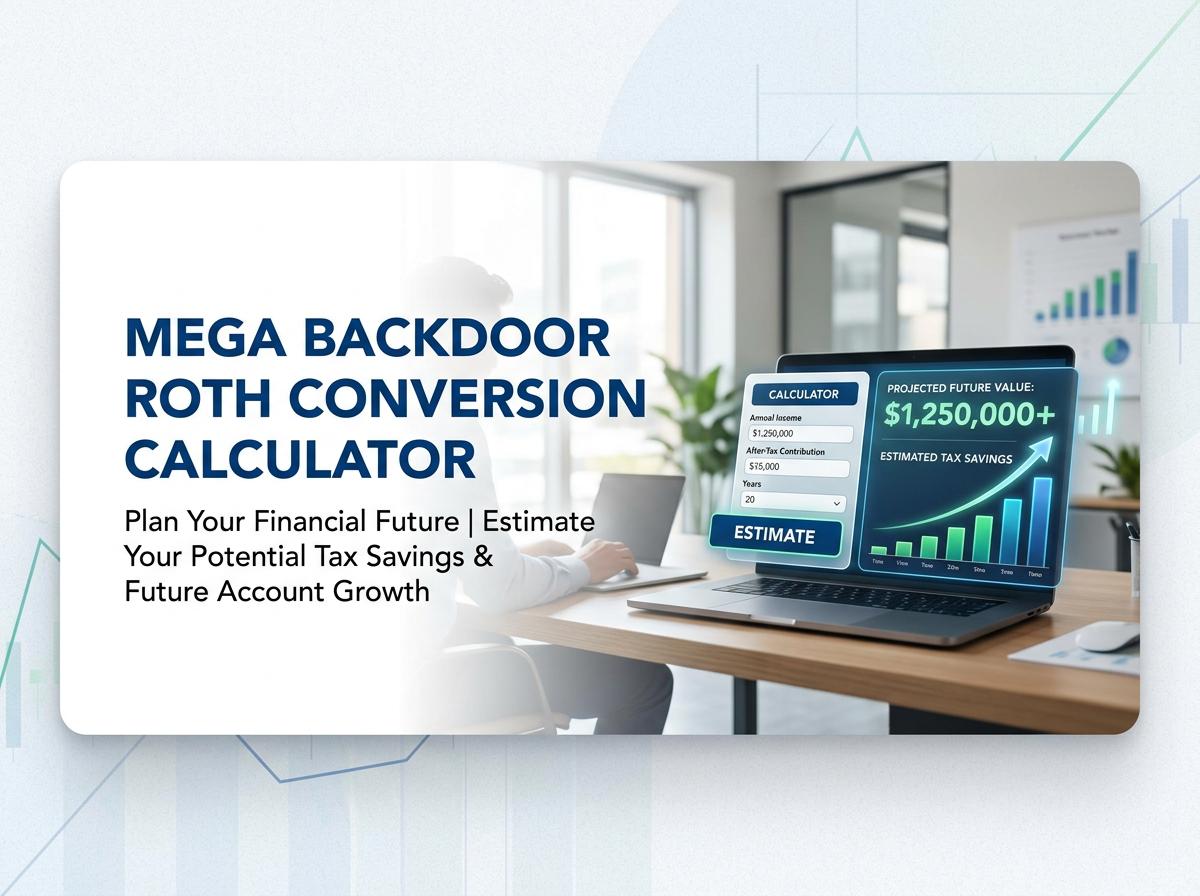

Maximize your retirement savings with our Mega Backdoor Roth Conversion Calculator. Easily estimate your maximum after-tax 401(k) contributions, project potential tax-free growth, and optimize your wealth-building strategy. Start planning your financial future today!
Mega Backdoor Roth Calculator
What is a Mega Backdoor Roth Conversion?
A Mega Backdoor Roth Conversion is a tax strategy allowing high-income earners who have already maxed out their traditional pre-tax or Roth 401(k) contributions to save significantly more in a tax-advantaged Roth account. It involves making after-tax (non-Roth) contributions to an employer-sponsored 401(k) plan, and then rolling those funds over into a Roth IRA or converting them to an in-plan Roth 401(k). This allows the money to grow and eventually be withdrawn completely tax-free.
Does my employer plan allow after-tax non-Roth contributions?
Not all employer plans permit this strategy. You must check your specific 401(k) plan document or ask your HR/benefits administrator. Look specifically for the ability to make "after-tax non-Roth contributions." This is a separate classification from standard Roth 401(k) contributions. If your plan only allows traditional pre-tax and standard Roth contributions, you cannot execute the Mega Backdoor strategy.
Does my plan permit in-service distributions or in-plan conversions?
To successfully complete the strategy, your plan must allow you to move the after-tax money while you are still employed. You need to check your plan documents for one of two specific features:
- In-service distributions: This feature allows you to roll your after-tax contributions out of your 401(k) and into an external Roth IRA.
- In-plan Roth conversions: This feature allows you to convert the after-tax money directly into the Roth 401(k) portion of your existing employer plan.
What is the IRS overall defined contribution limit for this year?
The IRS sets a strict annual limit on total contributions (combined from both employee and employer) to a defined contribution plan.
| Tax Year | Overall Limit (Under Age 50) | Limit with Catch-up (Age 50+) |
|---|---|---|
| 2023 | $66,000 | $73,500 |
| 2024 | $69,000 | $76,500 |
Your maximum after-tax contribution space is this overall limit minus your regular 401(k) contributions and your employer's match.
How do employer matching funds impact my maximum contribution amount?
Employer matching funds directly reduce the amount you can contribute as after-tax non-Roth money. The formula to calculate your maximum Mega Backdoor Roth contribution is:
Overall IRS Limit − Your Pre-tax/Roth Contributions − Employer Contributions/Match = Maximum After-Tax Contribution.
For example, in 2024 (under age 50), if the overall limit is $69,000, you contribute the standard $23,000 max, and your employer matches $5,000, your remaining space for after-tax contributions is $41,000.
Will I owe taxes on any earnings generated before the conversion?
Yes. While your initial after-tax contributions are not taxed upon conversion (since you already paid income taxes on them), any earnings those contributions generated before the conversion takes place are treated as pre-tax money. When you convert the funds to a Roth account, you will owe standard income taxes on those earnings. To minimize this tax hit, it is highly recommended to convert the after-tax funds immediately or set up automatic conversions if your plan allows it.
How does the IRS pro-rata rule affect this specific strategy?
Unlike the standard backdoor Roth IRA, the Mega Backdoor Roth largely avoids the restrictive Traditional IRA pro-rata rule. The IRS allows 401(k) participants to split their after-tax distributions. This means you can roll your after-tax contributions directly into a Roth IRA (tax-free) and roll any pre-tax earnings directly into a Traditional IRA (tax-deferred). As long as the distribution originates from a 401(k) and is separated correctly, the standard IRA pro-rata rule does not apply.
Should I move the funds to a Roth IRA or an in-plan Roth 401(k)?
This depends on your plan options and personal financial preferences:
- Roth IRA: This is generally better if you want access to a wider range of investment options, potentially lower fees, and more flexible withdrawal rules. It requires your plan to allow in-service distributions.
- In-plan Roth 401(k): This is easier to automate if your plan offers automatic daily conversions, which prevents taxable earnings from accumulating. However, your investments remain limited to your 401(k) menu.
How do I properly report the conversion on my tax return?
You must report the transaction to the IRS, even if the conversion triggers zero taxes.
- You will receive a Form 1099-R from your 401(k) provider detailing the distribution.
- Report the total distribution amount on your Form 1040 (Lines 5a and 5b).
- If there were any earnings, the taxable portion will be noted on the 1099-R and must be included in your taxable income.
Because the reporting can be complex, using tax software or consulting a CPA is highly recommended.
Are there any pending legislative changes that might ban this strategy?
Currently, the Mega Backdoor Roth strategy remains completely legal. However, it is frequently a target for legislative reform. In 2021, the Build Back Better Act proposed eliminating both the standard and Mega Backdoor Roth conversions for high earners, though that specific provision did not become law. While there are no imminent bills banning the strategy as of 2024, Congress could reintroduce similar tax legislation. It is wise to utilize the strategy while it remains legally available.
Sources:
 State Income Tax Relocation Savings Calculator