
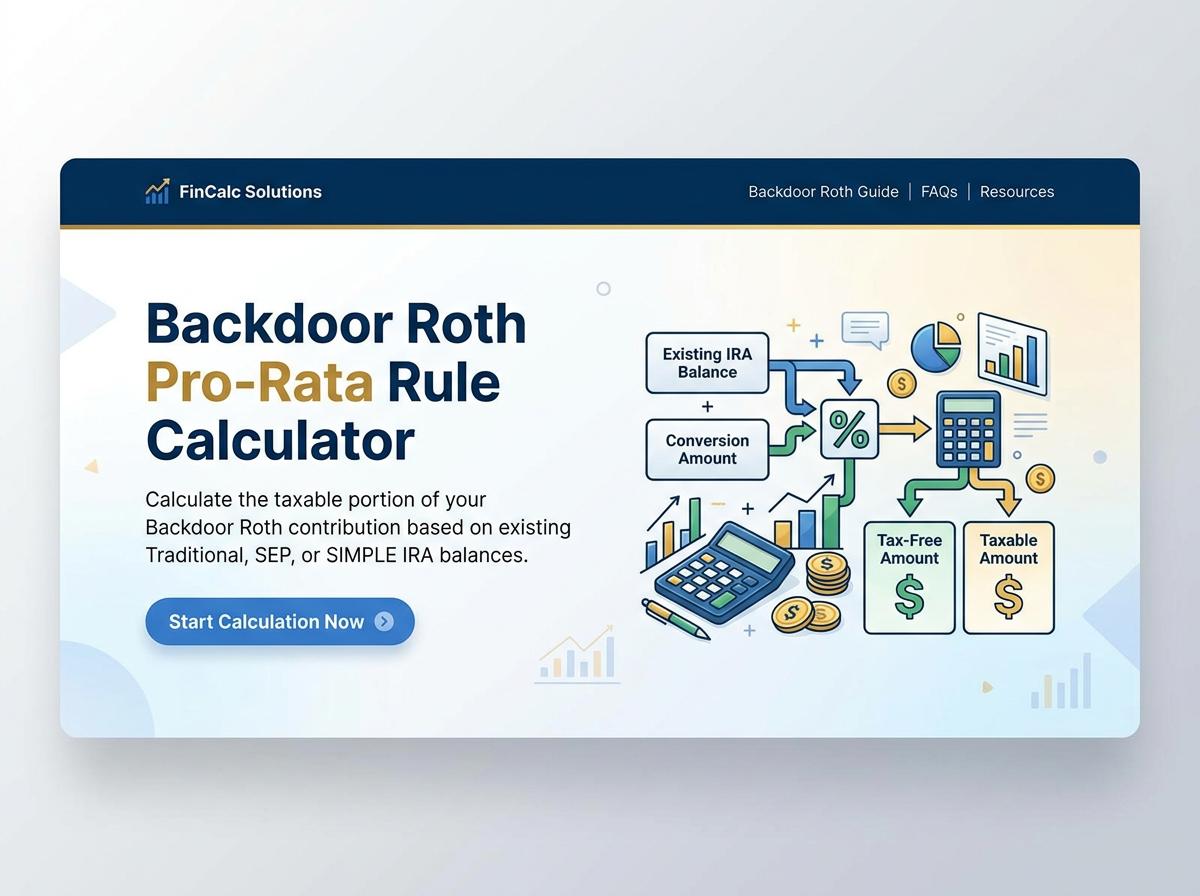

Avoid unexpected taxes on your IRA conversion. Use our Backdoor Roth Pro-Rata Rule Calculator to instantly determine the taxable and tax-free portions of your Roth conversion based on your existing pre-tax IRA balances. Plan ahead and optimize your retirement strategy today.
Backdoor Roth Pro-Rata Calculator
What is the Backdoor Roth pro-rata rule?
The Backdoor Roth pro-rata rule is an IRS tax regulation determining how much of your Roth IRA conversion is subject to income tax. When you perform a Backdoor Roth IRA conversion (moving non-deductible, after-tax IRA contributions into a Roth IRA), you cannot simply choose to convert only the after-tax money if you also hold pre-tax money in any of your non-Roth IRAs.
Instead, the IRS forces you to convert a proportional mix of your pre-tax and after-tax funds. The percentage of pre-tax money across all your Traditional IRAs dictates the percentage of your conversion that will be subject to ordinary income taxes. This rule prevents individuals from shielding pre-tax funds from taxation while shifting after-tax funds into a tax-free growth account.
How does the IRS calculate the pro-rata percentage?
The IRS calculates the pro-rata percentage using a mathematical formula to separate the tax-free portion of your conversion from the taxable portion. The formula is:
- Tax-Free Percentage: (Total After-Tax Money in all IRAs) ÷ (Total Balance of all IRAs on Dec 31)
Once you calculate that percentage, multiply it by your conversion amount:
- Tax-Free Amount: Tax-Free Percentage × Conversion Amount
- Taxable Amount: Total Conversion Amount - Tax-Free Amount
For example, if your total IRA balance is $100,000 and $10,000 of that is after-tax basis, your tax-free percentage is 10%. If you convert $10,000 to a Roth IRA, only $1,000 is tax-free. The remaining $9,000 will be taxed as ordinary income.
Which types of IRAs are included in the pro-rata calculation?
The IRS makes a strict distinction between accounts that must be included in the calculation denominator and those that are excluded. Here is a breakdown:
| Included in Pro-Rata Calculation | Excluded from Pro-Rata Calculation |
|---|---|
| Traditional IRAs | Roth IRAs |
| SEP IRAs | Inherited IRAs |
| Rollover IRAs | 401(k)s / 403(b)s / TSPs |
| SIMPLE IRAs | HSA / FSA Accounts |
Do employer plans like a 401(k) trigger the pro-rata rule?
No, active employer-sponsored retirement plans do not trigger the pro-rata rule. The IRS specifically excludes these types of accounts from the pro-rata calculation.
Accounts that are completely shielded from this rule include:
- 401(k) plans
- 403(b) plans
- 457 plans
- Thrift Savings Plans (TSP)
Because these employer plans are ignored by the pro-rata rule, keeping your pre-tax retirement savings inside a 401(k)—rather than rolling it out into a Traditional IRA—is a highly effective strategy. High-income earners use this loophole to continue making tax-free Backdoor Roth IRA conversions without facing unexpected tax penalties.
How does my IRA balance on December 31st affect the conversion?
The IRS does not look at your IRA balances on the specific day you execute the Roth conversion. Instead, they look at the total aggregate balance of all your non-Roth IRAs on December 31st of the year the conversion takes place.
This timeline is extremely beneficial because it gives you until the end of the calendar year to "zero out" your pre-tax IRA balances. If you convert after-tax money in March, but then roll all your existing pre-tax Traditional IRA funds into an employer 401(k) by December 31st, your end-of-year IRA balance will be zero. As a result, your pro-rata fraction will not include any pre-tax money, rendering the earlier conversion totally tax-free.
What is the IRA aggregation rule regarding multiple accounts?
The IRA aggregation rule states that for tax purposes, the IRS treats all of your non-Roth IRAs as if they were a single, giant IRA account. You cannot protect pre-tax money simply by storing it in a separate account or at a different brokerage firm.
For example, if you have one Traditional IRA with $50,000 of pre-tax money and you open a brand-new IRA to deposit $7,000 of after-tax money, the IRS views you as having one combined IRA worth $57,000. When you attempt to convert just the $7,000 account to a Roth IRA, the aggregation rule activates. The pro-rata taxation will apply based on the ratio of pre-tax to after-tax funds across the entire $57,000 aggregate balance.
Are SEP and SIMPLE IRAs counted in the pro-rata calculation?
Yes, both SEP IRAs and SIMPLE IRAs are absolutely counted in the pro-rata calculation. Even though they are employer-funded or small-business retirement plans, the IRS legally classifies them under the umbrella of Traditional IRAs for the purpose of Roth conversions.
If you are a freelancer, independent contractor, or employee participating in a SEP or SIMPLE IRA, any pre-tax funds sitting in those accounts on December 31st will be aggregated with your other Traditional IRAs. This rule frequently catches self-employed individuals off guard, as a large, pre-tax balance in a SEP IRA will make a Backdoor Roth conversion highly taxable.
How can a reverse rollover to a 401(k) help avoid this rule?
A "reverse rollover" is a maneuver where you move pre-tax funds out of your Traditional IRA and into your current employer's 401(k) plan. Since 401(k) balances are excluded from the pro-rata calculation, this strategy effectively hides your pre-tax money from the IRS formula.
Here are the steps to successfully execute a reverse rollover:
- Verify that your current employer’s 401(k) plan allows "roll-in" contributions from active IRAs.
- Initiate a direct trustee-to-trustee transfer of only your pre-tax IRA funds into the 401(k).
- Leave your non-deductible (after-tax) contributions resting in the Traditional IRA.
- Convert the remaining after-tax IRA funds into your Roth IRA completely tax-free.
Which IRS tax form is used to report the pro-rata calculation?
The pro-rata calculation is reported to the IRS using Form 8606 (Nondeductible IRAs). You must file this form alongside your standard Form 1040 tax return in any year you make a non-deductible Traditional IRA contribution, take a non-deductible distribution, or perform a Roth conversion.
Form 8606 is used to track your "basis"—the total amount of after-tax money you have contributed to your IRAs over your lifetime. The form walks you through the pro-rata math step-by-step, asking for your total IRA balances as of December 31st and your conversion amount. This mathematically dictates exactly how much of your conversion is taxable and updates your remaining after-tax basis for future years.
How do existing pre-tax IRA funds impact my tax bill during conversion?
Existing pre-tax IRA funds can significantly increase your tax bill during a Backdoor Roth conversion. Thanks to the pro-rata rule, you are not allowed to isolate and convert only your after-tax contributions. Every dollar you convert will be pulled proportionally from your pre-tax and after-tax pool.
The pre-tax portion of the conversion is added directly to your gross income for the year and taxed at your ordinary marginal income tax rate. If you have a massive amount of existing pre-tax IRA funds (such as from a previous 401k rollover) and attempt a Backdoor Roth conversion, the vast majority of the conversion will be taxable, potentially pushing you into a higher tax bracket.
 Nanny Tax / Household Employer Calculator