
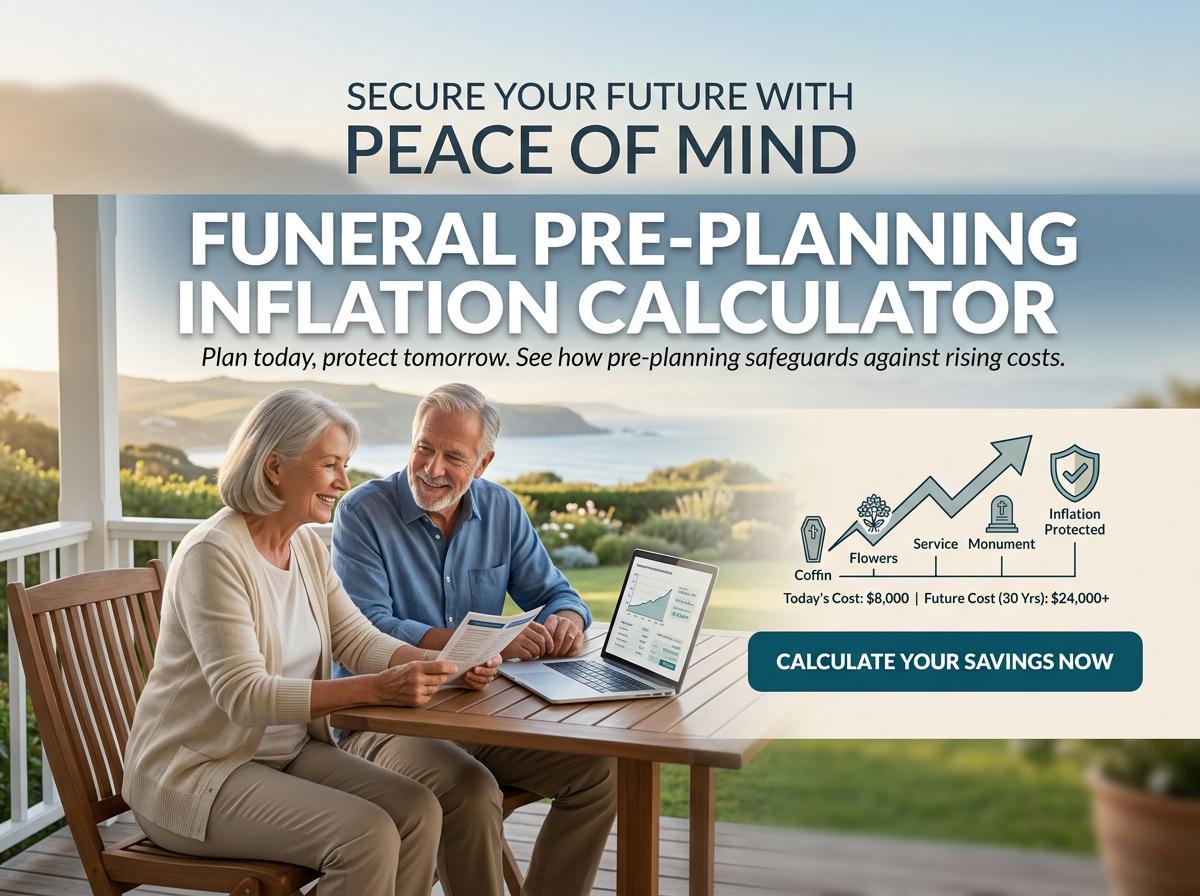

Estimate future funeral costs with our easy-to-use Funeral Pre-Planning Inflation Calculator. Discover how inflation impacts end-of-life expenses over time so you can budget effectively. Plan ahead today to protect your loved ones from unexpected financial burdens and secure lasting peace of mind. Try our free calculator now.
Funeral Pre-Planning Inflation Calculator
Original Cost:
Inflation Increase:
Future Estimated Cost:
How much do average funeral costs typically increase each year due to inflation?
Historically, funeral costs tend to rise steadily each year, often outpacing general consumer inflation rates. On average, funeral expenses increase by 4% to 7% annually.
According to historical data from the National Funeral Directors Association (NFDA), the cost of a traditional funeral can roughly double every 10 to 15 years. This steady increase makes long-term end-of-life planning crucial, as a funeral costing $8,000 today could easily cost over $15,000 in fifteen years.
Does pre-paying for a funeral permanently lock in current prices?
Pre-paying does not automatically lock in prices; it entirely depends on the type of legal contract you sign with the funeral director:
- Guaranteed Contracts: These permanently lock in the exact cost of specific goods and services (like the casket, embalming, or facility fees) you select. The funeral home absorbs any future inflation costs.
- Non-Guaranteed Contracts: These treat your payment merely as a deposit. If prices rise before your passing, your family will be required to pay the difference out of pocket.
Are third-party fees like obituaries and death certificates protected from inflation?
Generally, no. Third-party fees—often referred to as "cash advance items"—are rarely protected from inflation, even within a guaranteed funeral contract. Because the funeral home does not control these external costs, they cannot promise a locked-in rate.
Common cash advance items include:
- Death certificates
- Obituary newspaper publications
- Clergy or musician honorariums
- Flowers
- Cemetery plot opening and closing fees
When the time comes, your family will likely need to pay the difference if the actual cost of these third-party services exceeds the funds initially set aside.
Can my family be billed for the difference if prices rise significantly before I die?
Yes, your family can absolutely be billed for the difference under a few specific circumstances:
- Non-Guaranteed Contracts: Since the original payment only acts as an initial deposit, the family must cover the shortfall if the cost of services and merchandise increases significantly.
- Cash Advance Items: Even with a guaranteed contract, third-party fees (obituaries, flowers, permits) are not usually locked in, leaving families to pay increased costs.
- Contract Upgrades: If your family decides to upgrade the casket or add services not listed in the original pre-need agreement, they will be billed for those additions at current retail prices.
What is the exact difference between guaranteed and non-guaranteed funeral contracts?
The core distinction lies in who assumes the financial risk of inflation over time:
| Feature | Guaranteed Contract | Non-Guaranteed Contract |
|---|---|---|
| Price Lock | Yes, for specified funeral home goods/services. | No, the funds simply act as a down payment. |
| Inflation Risk | The funeral home absorbs the cost difference. | The family pays the cost difference. |
| Excess Funds | The funeral home usually keeps any financial overage. | Excess funds (if any) are returned to the estate. |
How are pre-paid funeral funds legally held or invested to keep up with inflation?
To protect consumers, strict state laws dictate that funeral homes cannot simply deposit pre-paid funds into their standard business checking accounts. The money must be legally held in one of two ways to generate growth:
- State-Regulated Trust Funds: The funeral home deposits your money into a regulated, interest-bearing master trust. The accrued interest is intended to offset future inflation.
- Pre-Need Life Insurance: The funds are used to purchase a specialized whole-life insurance policy. The funeral home is named as the assignee, and the policy's death benefit typically grows over time to cover rising costs.
Does a pre-need funeral insurance policy automatically adjust its payout for inflation?
Not always. Whether a pre-need insurance policy adjusts for inflation depends entirely on the specific policy terms:
- Increasing Benefit Policies: Many pre-need policies are designed with a built-in growth factor. The death benefit slowly escalates over time, specifically intended to keep pace with inflation.
- Fixed Benefit Policies: Some policies have a strict, flat payout that will never increase.
If the policy is tied to a guaranteed funeral contract, the funeral home absorbs any inflation costs regardless of the policy's growth. If the contract is non-guaranteed, a fixed insurance payout may leave your family paying a hefty difference.
What happens to my locked-in rates if the funeral home goes out of business?
Because pre-paid funds are legally required to be held in an independent trust or an insurance policy, your principal money is protected from the funeral home's bankruptcy. However, your locked-in rates may be at risk.
Typically, when a funeral home closes:
- Another local funeral home or corporate entity will acquire the closed business's active contracts.
- The new funeral home receives the trust funds or insurance assignment.
- The Guarantee Status: The acquiring funeral home is not always legally obligated to honor the original guaranteed prices. While many will honor them as a gesture of goodwill to retain your business, they could legally choose to treat the transferred funds as a non-guaranteed deposit.
Are my inflation-protected prices transferable if I move to a different state?
While your underlying monetary funds are usually transferable, the inflation-protected price guarantees generally are not.
- Transferring Funds: You can typically transfer your trust funds or reassign your pre-need insurance policy to a new funeral home in another state. Note that irrevocable trusts may have stricter, state-specific transfer rules.
- Losing the Guarantee: The new funeral home in your new state is not bound by the contract you signed with the original provider. They will treat your transferred funds as a non-guaranteed deposit applied against their current local retail prices.
If you move to a region with higher living costs, your original funds may fall significantly short.
Is it more financially beneficial to pre-pay a funeral home or invest the money myself?
From a strictly financial perspective, investing the money yourself is usually more beneficial. Funds placed in an S&P 500 index fund, a high-yield savings account, or a payable-on-death (POD) bank account will almost always earn a significantly higher rate of return than a funeral trust.
However, pre-paying a funeral home offers unique non-financial benefits:
- Medicaid Exemption: Placing money into an irrevocable funeral trust safely shields those assets from Medicaid spend-down requirements if you need to enter a nursing home.
- Emotional Relief: It relieves grieving family members from the stress of making expensive decisions and hunting for accessible funds during an emotional time.
 Prenuptial Agreement Asset Segregation Calculator