
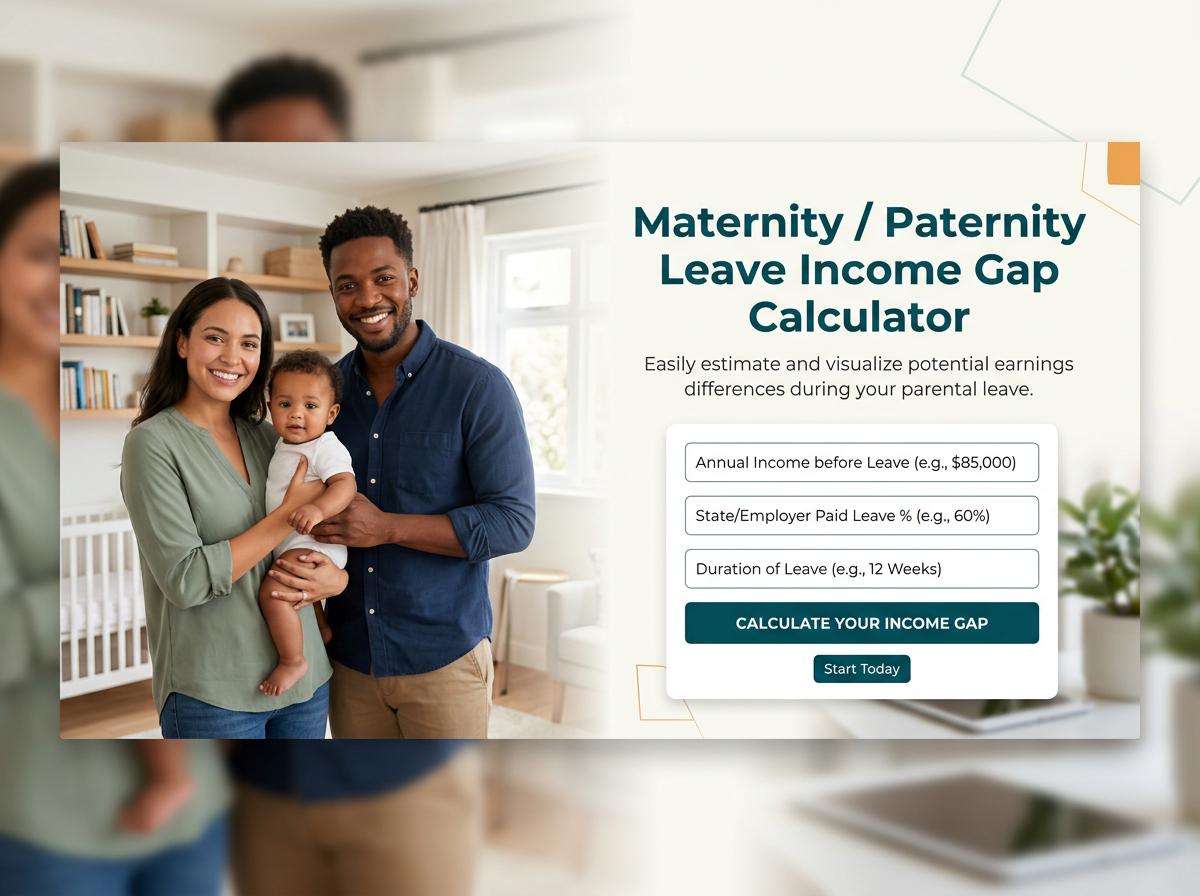

Plan your finances with our Maternity / Paternity Leave Income Gap Calculator. Easily estimate lost wages by comparing your regular salary against government and employer parental leave benefits. Discover your exact income shortfall to confidently prepare your family budget and reduce financial stress before your new baby arrives. Try our free tool today!
Leave Income Gap Calculator
What is the parental leave income gap and how is it measured?
The parental leave income gap refers to the financial disparity between individuals who take time off to care for a new child and those who do not. It highlights the immediate and long-term earnings lost due to caregiving responsibilities.
Economists and researchers typically measure this gap using several metrics:
- Earnings comparisons: Tracking pre-leave and post-leave salaries over time.
- Peer comparisons: Comparing the earnings of mothers and fathers against childless peers with similar experience.
- Lifetime wealth: Calculating cumulative lost wages, missed bonuses, and reduced retirement contributions.
How does unpaid or partially paid leave immediately impact household earnings?
Unpaid or partially paid leave causes an immediate and often severe shock to a household’s monthly cash flow. When regular salaries stop or decrease, families face several financial strains:
- Income Deficit: Households must cover regular expenses (rent, mortgage, utilities) plus new child-related costs (diapers, medical bills) with reduced revenue.
- Savings Depletion: Families often drain emergency funds to bridge the gap.
- Increased Debt: Many parents resort to credit cards or loans, accruing high-interest debt.
Even when partially paid, wage replacement caps (e.g., receiving only 50% of usual pay) can push middle- and lower-income families into financial precarity, fundamentally altering short-term stability.
What is the motherhood wage penalty compared to the fatherhood bonus?
The divergence in how parenthood affects earnings is starkly divided by gender, driven by deeply ingrained workplace biases.
| Concept | Definition | Financial Impact |
|---|---|---|
| Motherhood Penalty | The systemic drop in wages women experience after having children. | Mothers typically lose 4% to 5% of their hourly wage per child. |
| Fatherhood Bonus | The wage increase men experience after becoming fathers. | Fathers often see an earnings increase of over 6%. |
Employers subconsciously assume mothers will be distracted or less committed, leading to fewer raises. Conversely, fathers are often viewed as "providers" who are now more stable and dedicated, resulting in preferential treatment and higher compensation.
How does taking time off for a child affect long-term career promotions?
Taking parental leave can derail long-term career trajectories due to both missed opportunities and shifting employer perceptions. The effects include:
- Missed Milestones: Being away means missing high-profile projects, client networking, and annual performance review cycles.
- The "Mommy Track": Returning parents, especially mothers, are frequently steered away from demanding, fast-track roles into less visible positions with fewer advancement opportunities.
- Experience Gaps: Even a few months of leave reduces cumulative tenure and experience, delaying promotions compared to continuously working peers.
Consequently, the initial gap compounds over time, making it significantly harder for parents who took leave to reach executive positions.
Does taking paternity leave negatively impact a father's future wages?
Yes, fathers who take extended paternity leave can face financial repercussions, driven primarily by flexibility stigma.
Workplace cultures often penalize men who deviate from the traditional "ideal worker" norm. Fathers taking significant time off may be:
- Viewed as less committed to their careers.
- Passed over for key assignments or promotions.
- Subjected to lower performance evaluations upon return.
However, research shows that short leaves (1-2 weeks) rarely impact wages. It is typically longer leaves (several months) that trigger a wage penalty for men, highlighting the double standard in corporate expectations surrounding gender roles and caregiving.
How does the length of parental leave correlate with lifelong wealth?
The correlation between leave length and lifelong wealth is generally U-shaped, balancing workforce attachment against wage depreciation.
- Too Short (0-12 weeks): A lack of adequate leave often forces mothers to quit entirely to care for infants, causing a permanent halt in lifetime earnings and severe wealth loss.
- Optimal Length (14 weeks to 9 months): Moderate, paid leave keeps parents attached to the workforce, allowing them to return to their salaries and preserve wealth.
- Too Long (1+ years): Extended leaves lead to significant skill depreciation, loss of professional networks, and severe wage penalties upon return. This results in compounded lifelong wealth reduction.
What role does workplace stigma play in the parental wage gap?
Workplace stigma is a primary driver of the parental wage gap. It operates through conscious and unconscious biases regarding a parent’s dedication, competence, and availability.
Key impacts of this stigma include:
- Hiring Bias: Mothers are significantly less likely to be recommended for hire compared to equally qualified childless women.
- Performance Evaluation: Parents utilizing flexible schedules or returning from leave are often rated more harshly on performance reviews.
- Wage Suppression: Employers often offer lower starting salaries to mothers, assuming they prioritize flexibility over pay.
Ultimately, stigma transforms the logistical reality of taking a temporary leave into a permanent blemish on a worker's perceived value.
How does the income gap during leave affect future retirement savings?
The income gap during parental leave has a devastating compounding effect on retirement readiness. When earnings drop or stop, retirement savings are impacted in three distinct ways:
- Halted Contributions: Unpaid leave means zero contributions to 401(k)s, IRAs, or pensions during that period.
- Loss of Employer Match: Without active employee contributions, lucrative employer matching funds are forfeited.
- Loss of Compound Interest: Missing months of investments early in a career eliminates decades of compound growth, resulting in tens of thousands of dollars lost by retirement age.
Furthermore, because post-leave salaries often stagnate, lifetime Social Security benefits—which are based on highest-earning years—are also permanently reduced.
Which government and corporate policies effectively close this income gap?
Systemic changes at both the government and corporate levels are required to close the parental income gap. The most effective policies include:
| Policy Type | Effective Interventions |
|---|---|
| Government | Universal, mandated paid family leave; subsidized childcare; non-transferable paternity "Daddy quotas" to normalize men taking time off. |
| Corporate | Equal paid leave for both parents regardless of gender; phased return-to-work schedules; routine pay equity audits; sponsored backup childcare. |
When companies and governments mandate equal, paid time off for all parents, the stigma of caregiving is diluted, leveling the professional playing field and protecting earning power.
How can expectant parents negotiate to protect their earning potential?
Expectant parents can take proactive steps to safeguard their career trajectory and earning potential before taking leave:
- Negotiate Keep-in-Touch Days: Arrange paid days to attend key meetings or training during leave to stay visible.
- Pre-schedule Performance Reviews: Ensure your review and bonus discussions happen before your leave begins so you are compensated for completed work.
- Design a Phased Return: Negotiate a gradual return (e.g., starting at 3 days a week) at prorated pay to ease the transition while maintaining your role.
- Document Achievements: Leave behind a clear portfolio of your contributions and a coverage plan, reinforcing your value to management.