
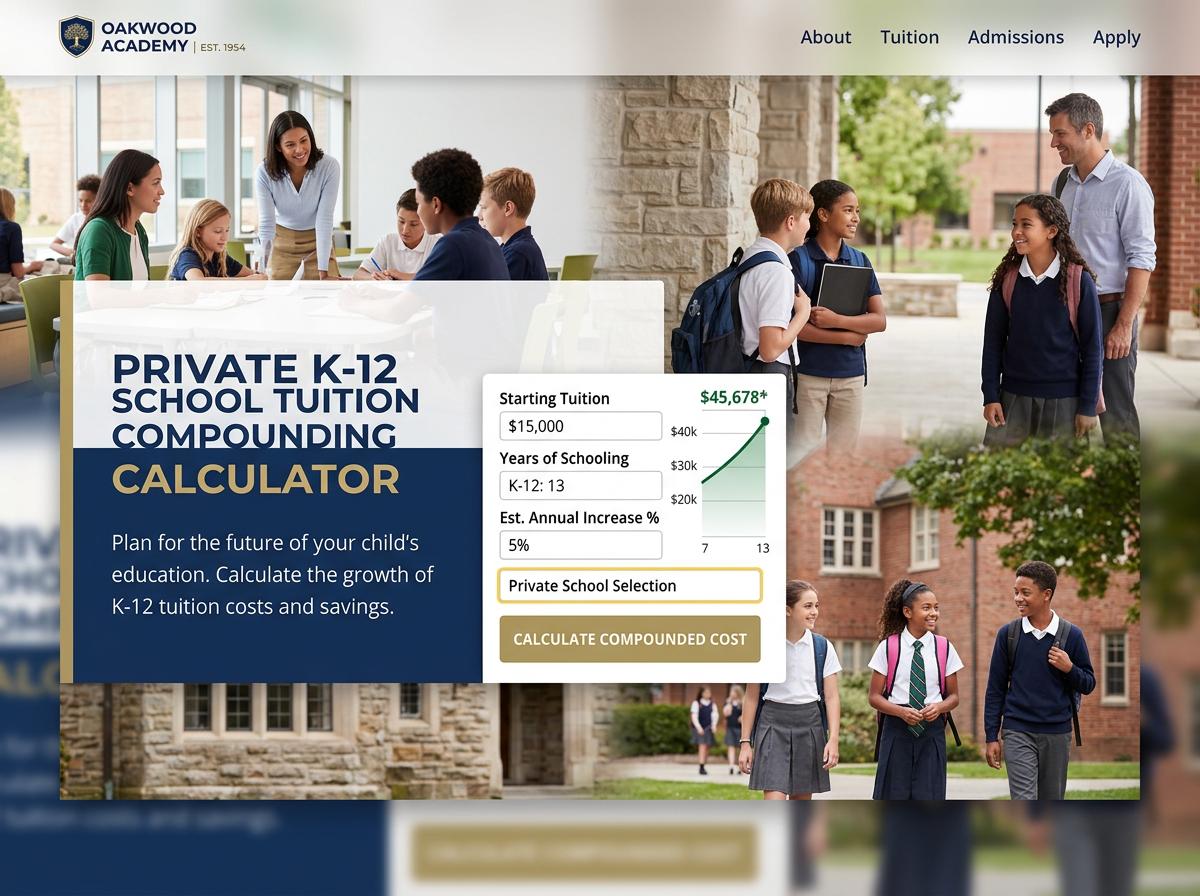

Accurately estimate future education costs with our Private K-12 School Tuition Compounding Calculator. Factor in annual tuition inflation from kindergarten through high school to project total expenses and confidently plan your family's financial future.
Tuition Compounding Calculator
| Grade Level | Estimated Tuition |
|---|
What is the average annual inflation rate for private K-12 tuition?
The average annual inflation rate for private K-12 tuition typically ranges between 3% and 5%, historically outpacing general inflation. However, this rate can vary significantly based on the school's location and prestige.
- National Average: ~4% per year
- Elite/Prep Schools: 5% to 7% per year
- Parochial Schools: 2% to 4% per year
Parents must account for these steady increases when budgeting. A seemingly small annual percentage can dramatically increase the baseline cost from Kindergarten all the way through 12th grade.
How does a yearly percentage increase compound the total cost over thirteen years?
A yearly percentage increase acts like compound interest working against you. Instead of calculating the increase on the original tuition, each year's hike is calculated on the previous year's already-inflated price.
For example, assuming a baseline Kindergarten tuition of $10,000 and a 4% annual increase, the compounding effect looks like this:
| Grade | Tuition Cost |
|---|---|
| Kindergarten (Year 1) | $10,000 |
| 5th Grade (Year 6) | $12,166 |
| 12th Grade (Year 13) | $16,010 |
Over thirteen years, the tuition increases by roughly 60% from the starting rate, making the cumulative total significantly higher than a flat $10,000 multiplied by 13 years.
What is the long-term opportunity cost of not investing K-12 tuition funds elsewhere?
The long-term opportunity cost of private K-12 tuition is substantial when factoring in lost investment returns. If parents invest tuition money into a compounding asset instead of paying for school, the wealth generated over time is massive.
Consider a family spending $15,000 annually on tuition for 13 years ($195,000 total out-of-pocket). If they instead invested that $15,000 annually at an average 7% stock market return:
- After 13 years: The investment would grow to approximately $302,000.
- After 20 more years (until retirement): That $302,000, left to compound without further contributions, would grow to over $1.1 million.
Therefore, the true financial cost is not just the sticker price, but the forfeited future wealth.
Can 529 savings plans effectively offset compounding private school costs?
Yes, 529 savings plans can be an effective tool to offset compounding private school costs, thanks to the Tax Cuts and Jobs Act of 2017. Parents can now withdraw up to $10,000 per year, per beneficiary from a federal tax-free 529 plan for K-12 tuition.
The primary benefit is tax-free compounding growth. If parents front-load a 529 plan early in a child's life, the investment returns can help absorb the school's annual tuition inflation. However, there are limitations:
- The $10,000 annual limit restricts its utility for highly expensive prep schools.
- Funds used for K-12 reduce the balance available for college, where expenses are typically much higher.
Strategic use of a 529 plan requires balancing immediate K-12 needs against future university costs.
Do private schools adjust financial aid packages annually to match tuition inflation?
Whether financial aid packages adjust to match tuition inflation depends heavily on the school's endowment and specific policies. Generally, aid does not automatically scale up with tuition hikes.
Most private schools require families to reapply for financial aid every single year. During this review process, the financial aid committee assesses:
- The family's current income, assets, and tax returns.
- The school's available financial aid budget for that academic year.
- Recent tuition increases.
If a family's financial situation remains identical, schools with robust endowments may increase the grant to cover the tuition hike. However, many schools expect the family to absorb a portion of the annual increase, meaning out-of-pocket costs will still compound.
Are there prepayment plans available to lock in rates and avoid compounding hikes?
Yes, some private schools offer Tuition Prepayment Plans (sometimes called Tuition Stabilization Plans) to help families avoid compounding annual hikes. By paying multiple years of tuition—or even the full K-12 balance—upfront, families can lock in the current year's rate.
Pros and Cons of Prepayment:
| Advantages | Disadvantages |
|---|---|
| Avoids 3-5% annual inflation | Requires massive upfront liquidity |
| Predictable educational budgeting | Loss of investment opportunity cost |
| Potential slight lump-sum discount | Complicates refunds if the child changes schools |
While locking in a rate shields you from inflation, parents must weigh this savings against what that large sum of cash could have earned in a high-yield investment.
How do sibling discounts alter the compounded trajectory for multiple children?
Sibling discounts can significantly alter the total financial trajectory for families, though they do not stop the compounding effect itself. Typically, private schools offer a 5% to 15% discount on tuition for the second child, and sometimes more for subsequent children.
Because tuition increases are calculated as a percentage, a lower baseline tuition means the raw dollar increase each year is slightly smaller for the younger siblings. For example:
- Child 1: $10,000 base + 5% inflation = $10,500 (Year 2)
- Child 2 (10% discount): $9,000 base + 5% inflation = $9,450 (Year 2)
While the sibling discount flattens the overall cost curve, the overlapping years where multiple children are enrolled simultaneously still create a massive, compounding cash-flow burden.
What are the compounding financial effects of funding K-12 tuition through loans?
Funding K-12 education through loans exposes families to a dangerous financial phenomenon: double compounding. Not only does the base tuition increase every year due to inflation, but the interest on the borrowed money also compounds.
Private K-12 education loans generally carry higher interest rates than federal college loans. If a parent borrows to cover the widening gap caused by tuition inflation, they face:
- Compounding debt: Paying interest on top of interest over a standard 5-to-15-year repayment term.
- Cash flow strain: Monthly loan payments reduce the family's ability to save for the child's upcoming college expenses.
Borrowing for K-12 is financially hazardous because it maximizes liabilities just as the family is about to enter the most expensive educational phase: college.
How do annual fee increases and hidden costs compound alongside the base tuition?
Base tuition is rarely the final cost of a private education. Annual fees and "hidden" costs are subject to their own inflationary pressures and often compound at rates higher than base tuition.
Common supplemental costs that inflate annually include:
- Technology fees: Laptops, software licenses, and 1:1 device programs.
- Extracurriculars: Sports gear, travel, and specialized coaching.
- Required trips: Grade-level retreats and international excursions.
- Facility fees: Mandatory contributions to building funds.
As a student ages from elementary to high school, these peripheral costs naturally increase in scope. When combined with annual inflation, the compounding effect on these hidden costs can add 10% to 20% to the total educational bill.
How early should parents model the future compounded cost of a private education?
Parents should begin modeling the future compounded costs of private K-12 education before the child is born, or at the latest, before committing to a private Kindergarten. Early modeling is crucial for preventing "tuition shock" in later years.
A proper financial model should include:
- A projected 4% to 5% annual tuition inflation rate.
- The escalating base costs of transitioning from elementary to middle and high school.
- The overlapping enrollment years if planning for multiple children.
By projecting the true 13-year cost early, parents can make informed decisions. They can set up 529 plans or determine if they should utilize public schools for elementary years and reserve private funding exclusively for high school.
Source Data: