
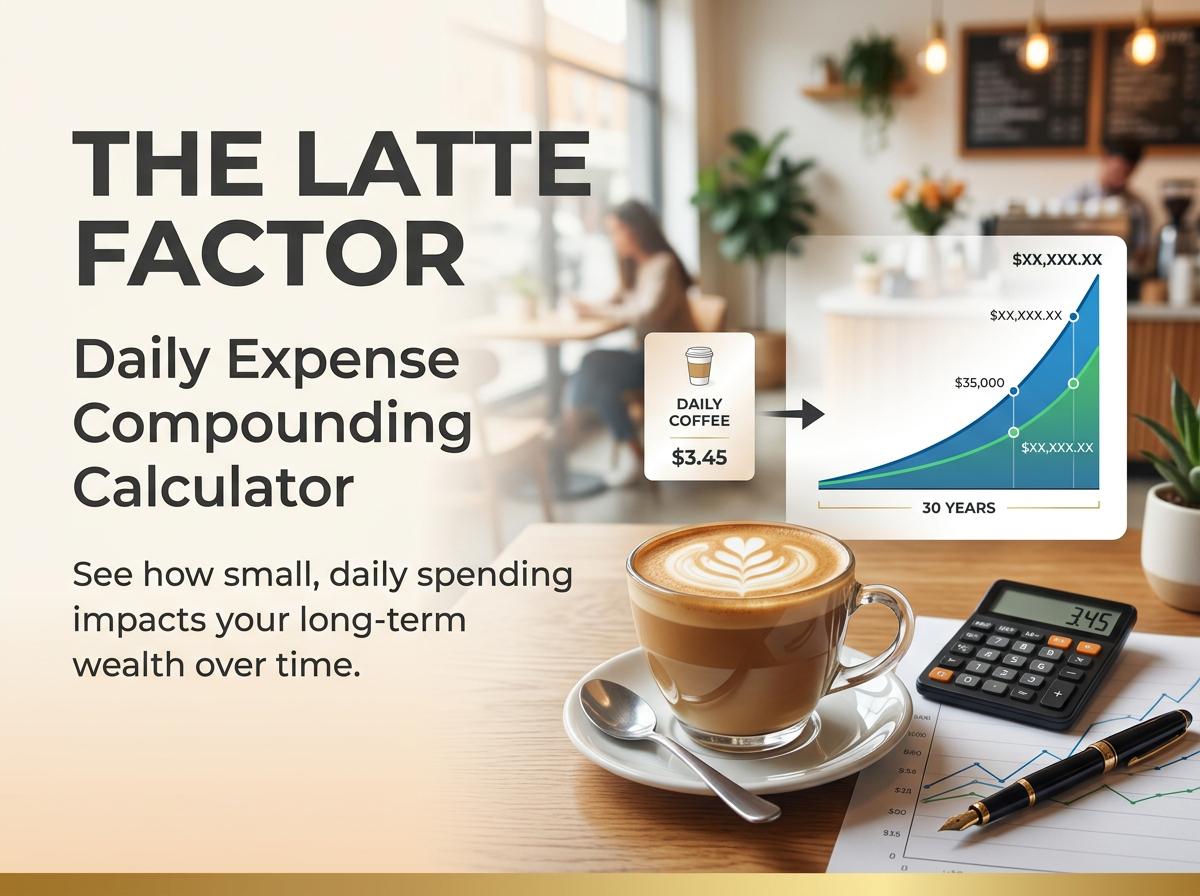

Discover the true cost of your daily habits with our free Latte Factor Calculator. See how compounding turns small daily expenses like coffee into massive long-term savings and take control of your financial future today.
Latte Factor Calculator
What exactly is the Latte Factor?
The "Latte Factor" is a personal finance concept popularized by author David Bach. It illustrates how small, routine discretionary expenses—such as buying a daily $5 latte—can accumulate into substantial sums over time. The core premise is not merely about saving pocket change, but rather about the powerful mathematical effect of redirecting that money toward long-term investments.
By cutting out trivial daily habits that you don't truly need or value, and investing those small amounts instead, you can build significant wealth. It highlights that you don't necessarily need a high income to achieve financial freedom; you just need to be mindful of your micro-expenses.
How does compound interest magnify small daily expenses?
Compound interest is the process of earning interest on both your original principal and the accumulated interest from previous periods. When you redirect small daily expenses into an investment account, those small sums start generating returns. Over time, those returns generate their own returns.
- Year 1: You invest a small amount, earning a base return.
- Year 5: Your balance grows, and returns are calculated on a much larger base.
- Year 30: The "interest on interest" drastically outpaces your original contributions.
Because of this compounding effect, spending $5 a day isn't just a loss of $5; it represents the loss of the thousands of dollars that $5 could have grown into over decades.
Does the Latte Factor only apply to buying coffee?
Absolutely not. While coffee is the famous namesake, the Latte Factor serves as a metaphor for any unconscious, habitual discretionary spending. It encompasses any small daily or weekly leaks in your budget. Common examples include:
- Dining out for lunch daily instead of packing a meal.
- Unused subscription services or gym memberships.
- Buying bottled water, energy drinks, or snacks at convenience stores.
- In-app purchases or impulse online shopping.
The concept encourages you to identify your own personal "latte"—the specific, repetitive purchases in your life that drain your wallet without bringing significant lasting joy or value.
What is the opportunity cost of daily discretionary spending?
Opportunity cost is the potential benefit you forfeit when choosing one alternative over another. In the context of daily discretionary spending, the opportunity cost is the future wealth you could have built if you had invested that money instead.
When you spend $10 on a fast-food lunch, the cost is not just $10. You must also account for:
- Lost Principal: The $10 immediately leaves your net worth.
- Lost Returns: The 7-10% annual historical stock market return that $10 could have generated.
- Lost Time: The decades of compounding growth forfeited.
Therefore, the true opportunity cost of a daily financial leak is the delayed retirement or lost financial security it causes.
How much wealth can five dollars a day become over decades?
Redirecting just $5 a day ($150 per month) into an investment account can yield astonishing results over time. Assuming an average annual return of 8% (in line with historical stock market averages), here is the potential growth:
| Time Period | Total Principal Invested | Estimated Future Value |
|---|---|---|
| 10 Years | $18,000 | ~$27,400 |
| 20 Years | $36,000 | ~$88,300 |
| 30 Years | $54,000 | ~$225,000 |
| 40 Years | $72,000 | ~$523,900 |
As the table demonstrates, over a 40-year working career, a mere $5 daily expense ends up costing you over half a million dollars in potential wealth.
How can I effectively track my own daily micro-expenses?
Tracking micro-expenses requires deliberate awareness to capture small transactions that usually slip through the cracks. You can effectively track them using several methods:
- Budgeting Apps: Link your bank accounts to apps like YNAB, Mint, or Monarch Money to automatically categorize and review every swipe.
- The "Pen and Paper" Audit: Carry a small notebook for one week and physically write down every single purchase, no matter how small.
- Bank Statement Reviews: Dedicate an hour monthly to highlight recurring low-cost subscriptions or frequent convenience store stops on your credit card statements.
By making the invisible visible, you can easily identify your personal Latte Factor.
Does eliminating the Latte Factor mean giving up all small luxuries?
No, eliminating the Latte Factor does not mean living a life of utter deprivation or completely abandoning all small luxuries. The goal is conscious spending, not absolute austerity.
If buying a high-quality coffee every morning brings you immense joy and kickstarts a highly productive day, keep buying it! However, you must then find other areas to cut back—perhaps by canceling unused streaming services or eating out less. The Latte Factor encourages you to eliminate the "mindless" spending that you don't even notice or care about, so you can redirect those funds toward securing your financial future without sacrificing the things you genuinely love.
Where should the money saved from daily expenses actually be invested?
To harness the power of compound interest, saved money must be put to work in wealth-building vehicles. Instead of leaving it in a checking account, consider investing in:
- Broad-Market Index Funds or ETFs: Funds tracking the S&P 500 offer low-cost, diversified exposure to global economic growth.
- Tax-Advantaged Accounts: Maximize contributions to a 401(k), Roth IRA, or HSA to benefit from tax-free or tax-deferred growth.
- Robo-Advisors: Platforms like Betterment automatically invest small, recurring deposits into diversified portfolios.
- High-Yield Savings Accounts (HYSA): For short-term goals or an emergency fund, an HYSA provides a risk-free return.
How does inflation impact the future value of these small savings?
Inflation represents the gradual increase in the cost of goods and services over time, which silently erodes the purchasing power of your money. If you simply save your Latte Factor money in a cash jar, inflation will severely diminish its real value over decades.
However, when calculating future wealth, investors usually account for inflation by using real return rates. Historically, the stock market returns about 10% annually. By subtracting an average historical inflation rate of 3%, we arrive at an inflation-adjusted "real" return of about 7%. This means the massive sums projected from a $5 daily investment represent the actual purchasing power in today's money.
What is the first step to curbing automated spending habits?
The most effective first step to curbing automated spending is to automate your savings. Because humans are prone to temptation, relying on willpower to save what is left at the end of the month usually fails.
Instead, set up systems that remove the money before you can spend it:
- Set up an automatic daily or weekly transfer from your checking account to your investment account.
- Increase your automatic 401(k) payroll deduction by 1% or 2%.
By artificially reducing your visible cash flow, you force yourself to adapt to a slightly tighter budget, naturally eliminating mindless spending without having to micromanage every transaction.
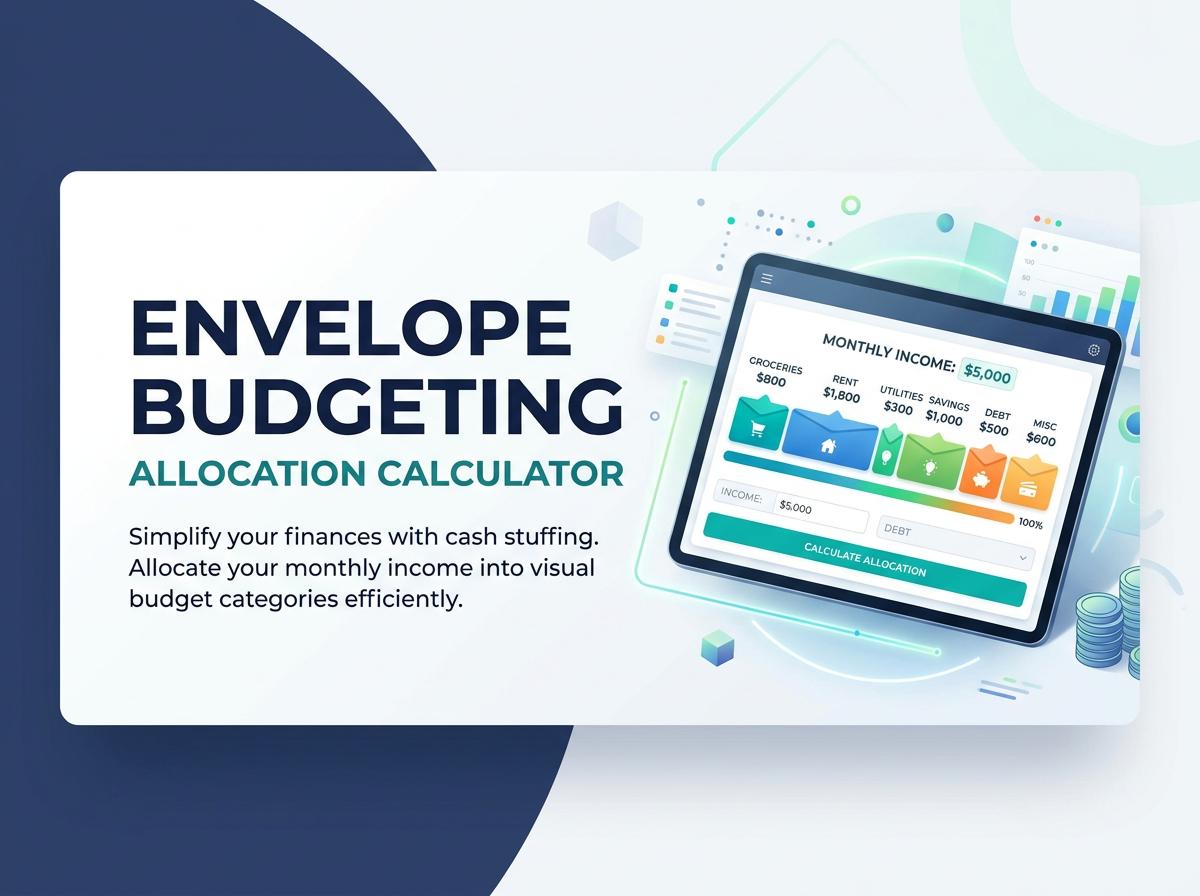 Envelope Budgeting Allocation Calculator