
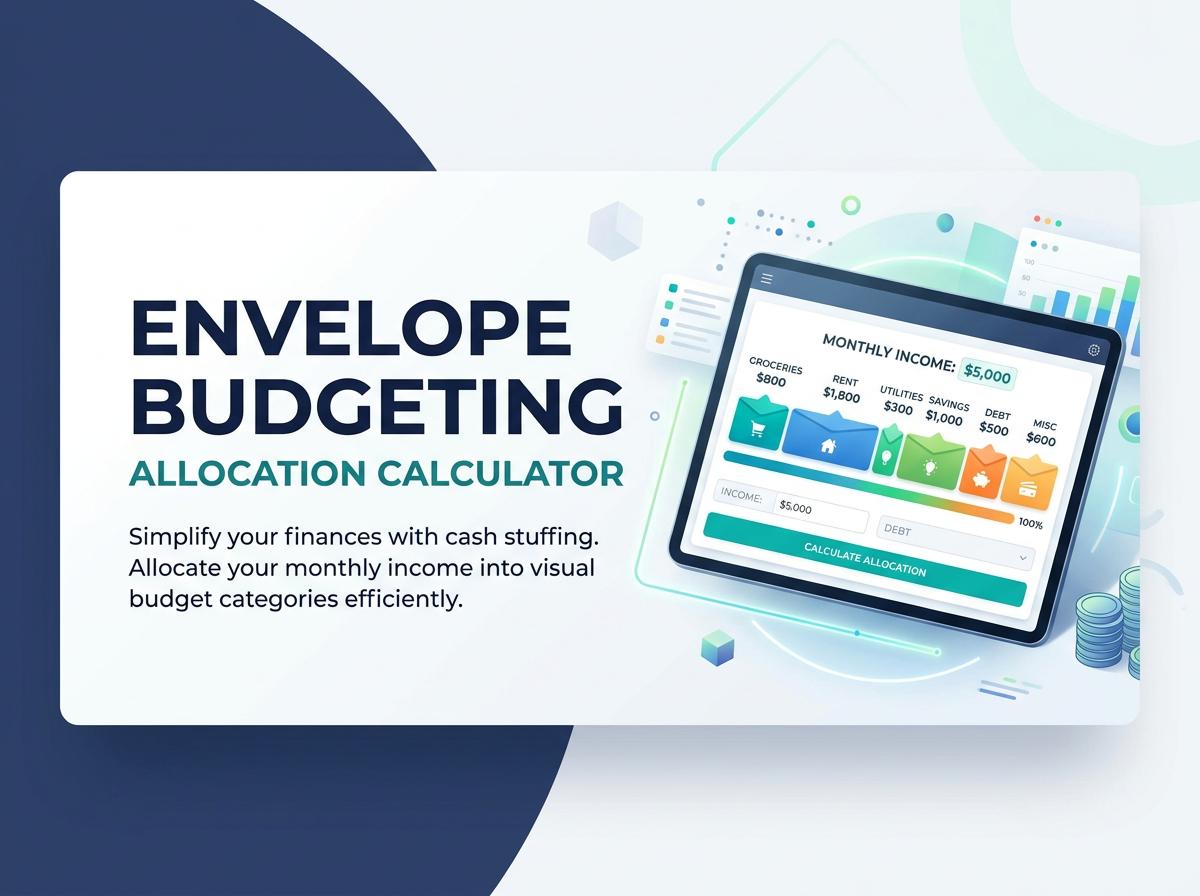

Take control of your finances with our free Envelope Budgeting Allocation Calculator. Easily divide your paycheck into custom spending categories, prevent overspending, and reach your savings goals using the proven cash envelope method. Start budgeting smarter today!
Envelope Budgeting
What exactly is envelope budgeting allocation?
Envelope budgeting is a proactive financial management method where you divide your expected income into specific spending categories. Each category is assigned an "envelope" (either physical or digital) funded with a predetermined amount of money based on your budget.
The core rule is simple: you can only spend the money available in that specific envelope. Once the funds are depleted, you must stop spending in that category until the next budgeting cycle. This system prevents overspending by forcing you to allocate every dollar before the month begins, giving you a tangible limit on discretionary expenses.
How do I choose the right categories for my envelopes?
To choose the right categories, start by reviewing your past month's bank statements to identify your frequent variable expenses. Envelopes are best used for categories where you tend to overspend, rather than fixed electronic bills like rent or auto loans.
- Groceries: Supermarket trips and basic household items.
- Dining Out: Restaurants, coffee shops, and takeout orders.
- Transportation: Gas, parking, and transit fares.
- Entertainment: Movies, hobbies, and social events.
- Personal Care: Haircuts, cosmetics, and clothing.
Keep your system simple. Starting with 5 to 7 envelopes is usually enough to gain control of your daily spending without feeling overwhelmed.
How much of my income should go into each envelope?
Your allocation should be based on a comprehensive budget structure, such as the 50/30/20 rule, tailored to your historical spending. After setting aside money for fixed needs and savings, divide the remainder into your envelope categories.
| Budget Category | Percentage Limit | Example (Based on $3,000 Net Income) |
|---|---|---|
| Needs (Fixed & Variable) | 50% | $1,500 (e.g., Grocery envelope: $300) |
| Wants (Discretionary) | 30% | $900 (e.g., Dining Out envelope: $150) |
| Savings & Debt | 20% | $600 (Kept in bank, not envelopes) |
Adjust the specific dollar amounts based on your real-life requirements, ensuring the total allocated never exceeds your monthly net income.
Should I use physical cash or digital envelope apps?
Both methods are effective, but the right choice depends entirely on your spending habits and lifestyle preferences.
- Physical Cash: Best for chronic overspenders. Handing over physical bills triggers a psychological "pain of paying," naturally curbing impulse buys. However, cash is less secure and highly inconvenient for online shopping.
- Digital Envelopes: Ideal for people who prefer cards or shop online. Budgeting apps simulate envelopes digitally. You pay with a debit card, and the app deducts the amount from a virtual envelope.
Many people successfully use a hybrid approach: carrying physical cash for impulsive categories like groceries and dining out, while using digital tracking for online shopping and bills.
What happens if an envelope runs empty before payday?
When an envelope runs empty, the foundational rule of the envelope system kicks in: you must stop spending in that specific category immediately. For example, if your "Entertainment" envelope is empty, you cannot go to the movies until your next payday.
This forced spending freeze is the exact mechanism that prevents debt and fundamentally changes your financial behavior. If the empty envelope is for an absolute necessity—like groceries to feed your family or gas to commute to work—you will need to creatively solve the problem (like eating pantry staples) or carefully pull funds from a less critical envelope.
Is it okay to borrow money from another envelope?
Yes, but it should be done sparingly and strategically. Borrowing from another envelope is often referred to as "reallocating." If you genuinely need more money for essential groceries, you are permitted to take it from a discretionary envelope, like entertainment or clothing.
However, you must strictly follow these rules:
- Never borrow from envelopes designated for fixed bills like rent or utilities.
- Never borrow from your savings or debt payoff funds.
- Acknowledge the trade-off: if you spend more on essentials, you must accept having less for fun.
If you find yourself frequently borrowing, your initial budget allocations likely need adjustment.
How do I handle unexpected emergency expenses?
Unexpected emergencies should not disrupt your standard, day-to-day envelope allocations. Instead, you should prepare for them by creating a dedicated "Miscellaneous" or "Sinking Fund" envelope. Fund this slightly each paycheck to cover minor, unpredictable expenses, like a flat tire or a small medical copay.
For major, catastrophic emergencies—such as a large hospital bill, sudden job loss, or a significant home repair—you should bypass your daily envelopes entirely. Draw from a separate, fully funded Emergency Fund, which should be stored in a high-yield savings account rather than a physical spending envelope. This keeps your monthly cash flow perfectly intact.
What should I do with leftover money at the end of the month?
Having leftover money is a wonderful sign of successful budgeting! You have three primary, financially healthy options for managing these surplus funds:
- Roll it over: Leave the money in the envelope to give yourself a larger budget for that category next month. This is excellent for categories like clothing or car maintenance.
- Boost your savings: Empty the remaining cash and deposit it directly into your emergency fund, a sinking fund, or an investment account.
- Accelerate debt payoff: Apply the extra funds as an additional principal payment on credit cards or loans to save heavily on interest.
How do I manage highly variable expenses like groceries or gas?
Managing highly variable expenses requires establishing a buffer and tracking prices carefully. Since costs fluctuate, look at your highest spending month over the past quarter and use that figure as your baseline envelope allocation. It is much better to slightly overfund a variable envelope than to run out of money for basic necessities.
To stretch the funds within these fluctuating envelopes, use active cost-saving strategies:
- Plan meals around grocery sales and utilize coupons.
- Combine errands to reduce fuel consumption.
- Track the remaining envelope balance weekly to adjust your consumption before the money runs completely out.
Can I still use credit cards while using the envelope system?
Yes, but it requires strict discipline and a digital envelope approach. Because credit cards separate the act of buying from the act of paying, they can easily undermine the cash envelope philosophy.
To do this safely, you must use a specialized budget app. When you spend $50 on groceries using a credit card, you must immediately deduct $50 from your virtual "Grocery" envelope and move it to a virtual "Credit Card Payment" envelope. This ensures the cash to pay the bill is locked away and ready. If you cannot pay the balance in full, stick to debit cards.
 Zero-Based Budgeting Reconciliation Calculator